Alfacash is a long running instant exchange and brokerage style crypto service, not a traditional order book exchange. It lets customers buy, sell, and swap digital assets through a straightforward conversion interface, with payment methods varying by country and currency. In market terms, it occupies the middle ground between a fully regulated retail broker such as Bitstamp and a minimal no account swap widget. It has been around long enough to be recognizable, but its model still requires customers to scrutinize the quote rather than simply read a posted trading fee.
The service began operating in the late 2010s and has built a broader asset and payment menu than many small instant exchangers. That matters. A provider that can handle bank transfer purchases, card options where available, and crypto to crypto swaps is more useful than a site built around one narrow route. It also makes Alfacash more complicated, because the price and verification rules can change substantially between a SEPA payment, a card purchase, and a blockchain exchange.
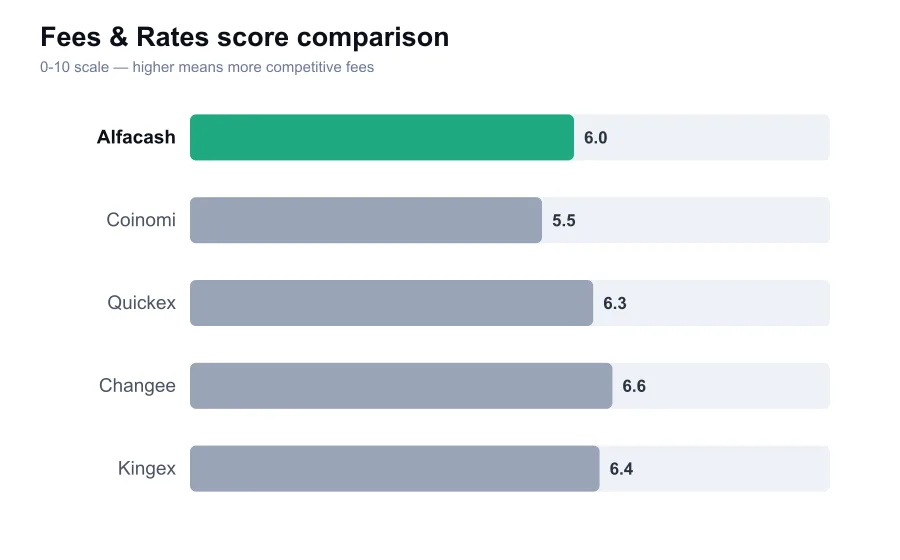
Alfacash's pricing is best understood as all in quotation pricing. The customer selects the amount and sees the expected result before payment, while the service's compensation is generally incorporated into the exchange rate and may be accompanied by payment processing or network costs. This is normal in the instant exchange sector, but it is not the same as cheap. A smooth interface can hide a sizable spread, especially on card funded purchases or less liquid coins.
For a bank funded purchase, the effective cost can be reasonable if the quoted price is close to the market reference and the transfer method is inexpensive. For card payments, I would expect the convenience premium to be much more noticeable. Cards involve fraud risk, chargeback exposure, and payment processor fees, all of which tend to find their way into the final rate. Customers comparing Alfacash with a spot exchange should compare the total coin received, not just an advertised percentage fee.
That distinction is particularly important for repeat buyers. Someone making one modest purchase may decide that the streamlined checkout justifies paying more. Someone buying crypto every month can lose a meaningful amount to spread over a year. For regular accumulation, a transparent fee venue with low cost bank deposits is usually the more rational option. Alfacash makes most sense when access, payment convenience, or a particular conversion route matters more than getting institutional style execution.
The delivery experience is usually governed by the slowest part of the transaction. A crypto to crypto exchange can be processed once Alfacash sees enough blockchain confirmations and obtains the outgoing asset. A fiat purchase by bank transfer cannot be completed until the funds are received and reconciled. SEPA Instant can reduce that wait sharply when both banks support it, while ordinary bank transfers can take longer. Card transactions may look immediate but can still face payment review.
I would not describe Alfacash as the place to buy crypto for a deadline measured in minutes. It can be quick under normal conditions, but payment verification, bank rails, blockchain confirmations, and manual checks are all outside the simplistic promise of instant exchange. The company does at least work in a model where customers generally receive coins to their own wallet instead of leaving them parked on the platform. That reduces custodial exposure after settlement.
Identity verification is not optional in the broad sense. Alfacash applies KYC and anti money laundering controls, with the level of documentation depending on payment method, transaction size, jurisdiction, and risk indicators. A customer may be asked for identity documents, a selfie, proof of address, or source of funds information. This can frustrate users who arrived expecting anonymity, but it is a more honest reflection of how fiat linked crypto services operate than pretending compliance will never apply.
The key annoyance is that verification can feel reactive to users who are used to a fixed signup checklist. A transaction can trigger a review after the customer has started the process, and crypto transfers are irreversible. Read the terms before sending anything. If you are unwilling or unable to supply documents, don't assume a low friction first screen guarantees a no KYC experience. That assumption causes many of the complaints seen across the instant exchange industry.
From a security perspective, Alfacash benefits from not being built around a large customer trading balance. Receiving purchased coins in a private wallet is preferable to keeping them indefinitely with a broker. Yet that puts more responsibility on the buyer. Use a wallet you control, verify the network, and never accept a pasted address without checking it character by character. The company cannot undo a completed transfer to a wrong address or unsupported chain.
Its reputation is respectable but not spotless. Alfacash has a materially longer visible operating history than anonymous new swap sites, and it is known in exchange comparison circles. At the same time, it doesn't command the same institutional trust as Kraken, Coinbase, Bitstamp, or a nationally regulated specialist. Public customer feedback for services of this kind often splits between successful fast orders and stressful verification cases. That pattern should make prospective users careful, not dismissive.
Customer support is central to whether Alfacash feels dependable. The support team needs to clarify payment status, confirmation requirements, and document requests without sending customers vague stock replies. Email and ticket based support can be adequate for a normal conversion, but it is weaker than immediate phone or high quality live chat if money is pending. Keep transaction hashes, payment references, screenshots, and order numbers ready. Clear evidence speeds up any investigation.
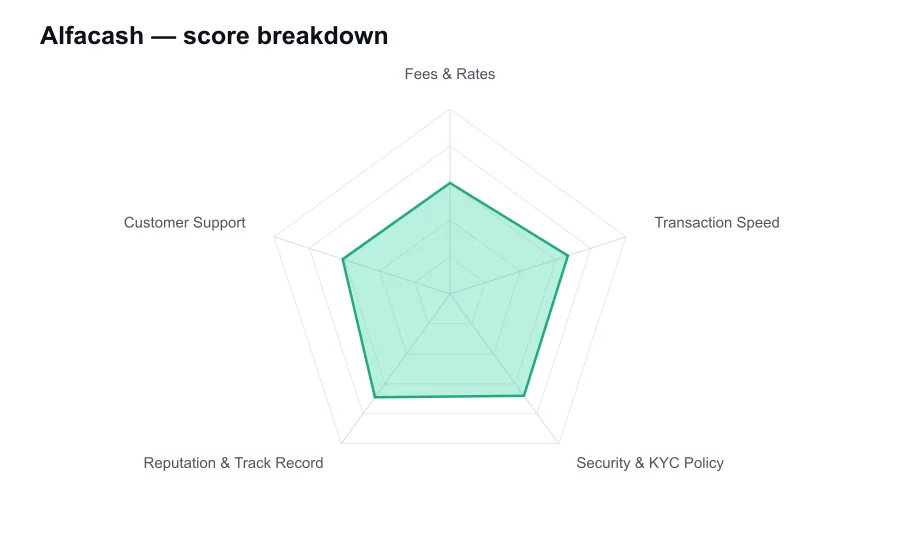
I like Alfacash more for a specific purchase or conversion problem than as a default home for every crypto activity. It has enough history to be taken seriously, and the self custody delivery model is sensible. Still, the pricing is quote driven and its verification process can be inconvenient at precisely the point a customer wants certainty. That is the tradeoff buyers should understand before they are committed to an order.
My recommendation is practical. Use Alfacash if its final quote is competitive for your chosen payment method, you are comfortable with possible KYC, and you want coins sent to your own wallet. Use a major spot exchange if you care most about low recurring trading costs, advanced order types, or deeply documented safeguards. Alfacash is a legitimate convenience tool, not a bargain hunting tool by default.