Kingex is a straightforward instant crypto exchange service rather than a full trading venue. It targets people who want to swap one asset for another without opening an order book, funding a custodial account, or learning a professional trading interface. That makes it closer to ChangeNOW, SimpleSwap, and StealthEX than to Binance or Kraken. Its appeal is simplicity, though simplicity also means fewer controls for serious traders.
The site offers floating and fixed-rate exchanges across a broad list of mainstream coins and tokens. Bitcoin, Ethereum, stablecoins, Litecoin, XRP, TRON, and common ERC-20 assets are the obvious use cases. The process is familiar: select a pair, enter a receiving address, send the deposit, and wait for the payout. There is no exchange wallet balance to manage, which reduces one category of platform risk.
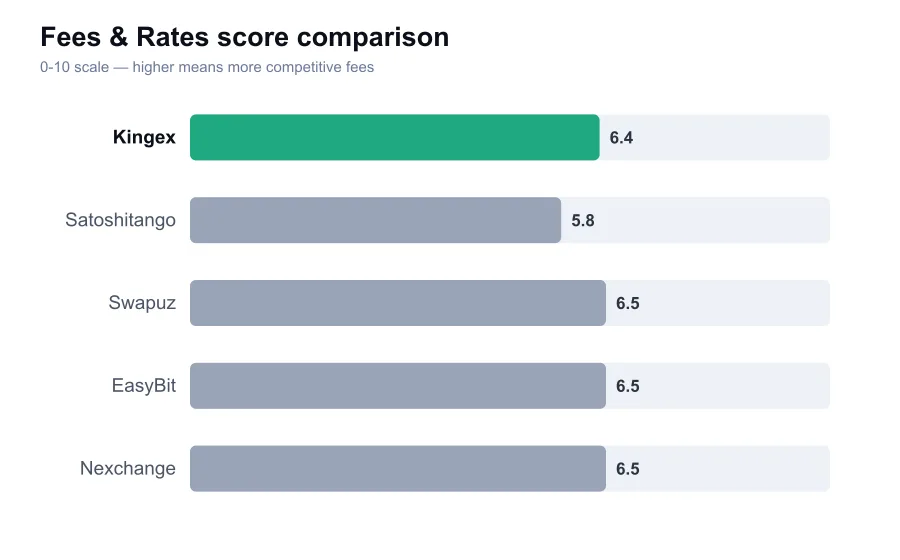
Kingex does not present itself as the cheapest route for every swap. Its pricing is embedded in the quote rather than displayed as a clean maker and taker schedule. That is normal for instant-swap services, but it makes comparisons important. The quoted amount can include liquidity-provider spread, the provider's service margin, and network fees. A user swapping a large amount should always compare the final receive figure with LetsExchange, ChangeNOW, and a liquid centralized exchange.
For smaller purchases and swaps, the convenience premium can be reasonable. A user converting a few hundred dollars of USDT to BTC may value a fast, one-screen transaction more than squeezing out a fraction of a percent. That argument weakens for larger orders. On a five-figure trade, a seemingly modest difference in the quoted rate can cost more than the visible trading fee on Kraken or Binance. Kingex is best treated as a convenience product, not a price-discovery engine.
Fixed-rate swaps are the feature that gives Kingex a real practical edge. In volatile markets, a floating quote can shift between the moment a customer sends funds and the moment the provider sources liquidity. A fixed quote gives a clearer expectation, provided the deposit arrives within the stated time window and meets the required amount. It is particularly useful for users paying invoices, moving into stablecoins, or making a time-sensitive on-chain payment.
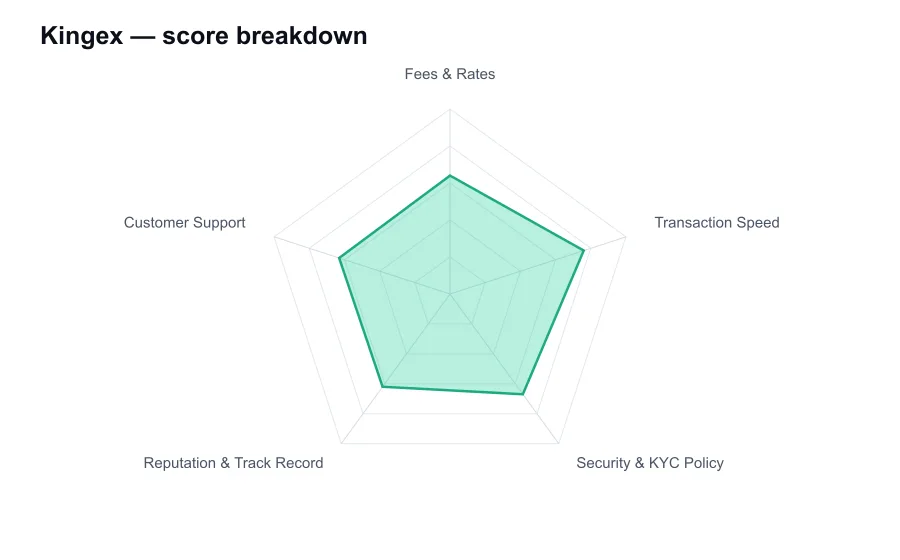
Speed is usually good for standard, liquid pairs. Once the incoming transaction has enough blockchain confirmations, many exchanges complete within minutes. Bitcoin transactions can naturally take longer during congestion, while Ethereum and token swaps depend on gas conditions. Kingex cannot make a slow source chain fast, and customers should not confuse blockchain confirmation time with service delay. A 10 to 30 minute experience is realistic for many ordinary swaps, but it is not a guarantee.
The awkward cases are where instant exchanges earn their reputations. An unusual token, a thinly traded pair, an incorrect memo, or an underpaid transaction can turn a quick swap into a support case. Kingex does provide transaction tracking, which helps, but the customer still has limited control once funds are sent. Unlike a proper exchange order book, there is no visible market depth, cancellation button, or manual intervention interface for the user.
Kingex operates as a noncustodial exchange in the usual instant-swap sense: it does not ask users to maintain a long-term account balance on the platform. That is better than leaving coins on a lightly regulated exchange for months. Still, funds pass through the service during execution, so noncustodial should not be mistaken for trustless. The company and its liquidity partners remain part of the transaction path.
KYC is not normally required for routine use, which is one reason privacy-minded users consider services like Kingex. Yet the absence of compulsory account verification does not mean every transaction is immune from compliance checks. Suspicious activity, sanctions screening, large transfers, or blockchain-risk flags can trigger a request for information. This is common industry practice, but it can be frustrating if a user assumed that no-KYC meant no possibility of review.
That policy creates a sensible rule: do not send money you urgently need until you have tested the service with a small amount. It is also wise to use only wallets and funds with a clear transaction history. Users who need guaranteed regulatory clarity, institutional reporting, or dependable fiat support should use a regulated exchange instead. Kingex is for crypto-to-crypto conversion, not a substitute for a banking relationship.
Its public reputation is decent but not as established as the largest names in the segment. Kingex has been visible for several years and has built a recognizable brand around quick exchanges, but it does not have the long corporate history, deep regulatory footprint, or independently audited disclosures associated with major centralized venues. That does not make it unreliable. It does mean users should judge it as a mid-tier service and manage exposure accordingly.
Support is available through online channels and transaction-specific assistance, which is what matters most for an instant exchanger. Responses tend to matter more than polished documentation here, because a delayed payout is usually the moment customers need help. The site provides the basics, but it does not offer the extensive help center, phone support, or institutional service structure found at larger exchanges. A clear transaction ID and screenshots will make any support request easier to resolve.
Kingex is strongest for someone who already understands wallet addresses, network selection, and confirmation times. It removes much of the friction of trading without asking the user to master order types. Beginners can use it, but beginners are also the people most likely to choose the wrong network or send an asset with an omitted destination tag. The interface cannot fully protect against irreversible blockchain mistakes.
My view is that Kingex is a useful secondary exchange tool, especially for fixed-rate swaps and ordinary crypto-to-crypto conversions. It is not where I would park assets, make repeated high-volume trades, or expect exchange-grade transparency around costs. Compare quotes before committing, test the workflow with a small transaction, and keep records. Used with that discipline, it does the job well enough. Used blindly, its convenience can become expensive.