Quickex is an instant crypto exchange, not a full trading venue in the Kraken or Binance sense. Its purpose is straightforward: choose a coin, enter a receiving address, send the source asset and receive the converted asset without opening a traditional custodial account. That model is useful for occasional swaps and cross-chain conversions. It is much less useful for anyone who wants charts, limit orders, tax reporting depth or a long-term account relationship.
The service positions itself as a non-custodial exchanger. In practical terms, that means Quickex does not aim to hold a standing customer balance after the swap is completed. Funds still pass through the service's transaction flow, so non-custodial should not be read as trustless. You are relying on Quickex and its liquidity partners to quote, receive, exchange and forward the assets properly. It reduces storage risk, but it does not eliminate execution risk.
The user experience is one of its better qualities. You do not need to learn an order book or manage a complicated trading dashboard. The conversion flow is easy to follow, and the required information is usually limited to the asset, amount and destination wallet address. For someone moving from one major asset to another, that simplicity has real value. The danger is that simplicity can make users skip the checks they would naturally perform on a more formal exchange.
Quickex offers floating-rate and fixed-rate exchanges for supported pairs. Floating rates follow the market during the transaction and can produce a different final amount if prices move. Fixed-rate swaps aim to lock the quoted outcome for a defined time, generally at a premium. That is a sensible choice during volatile conditions, but users need to read the minimum and maximum amounts carefully. A fixed quote is only useful if the deposit arrives correctly and within the stated window.
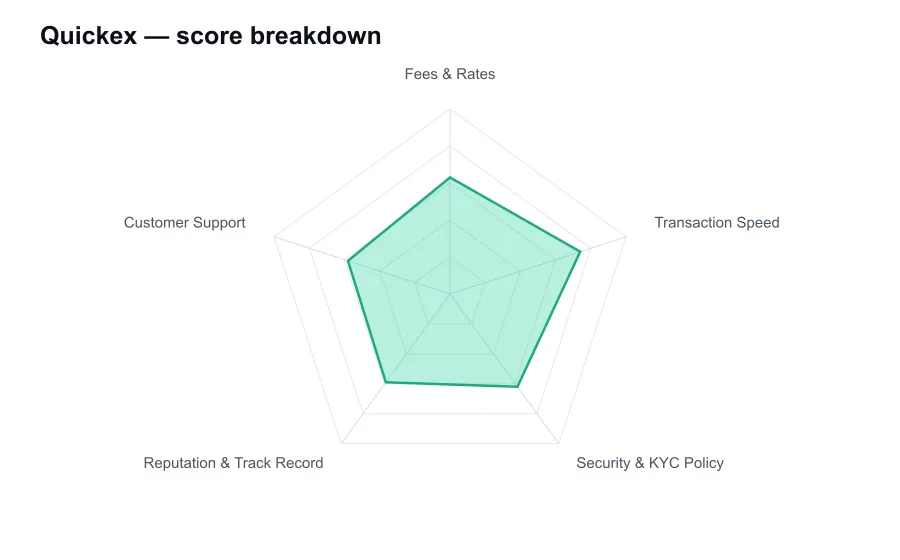
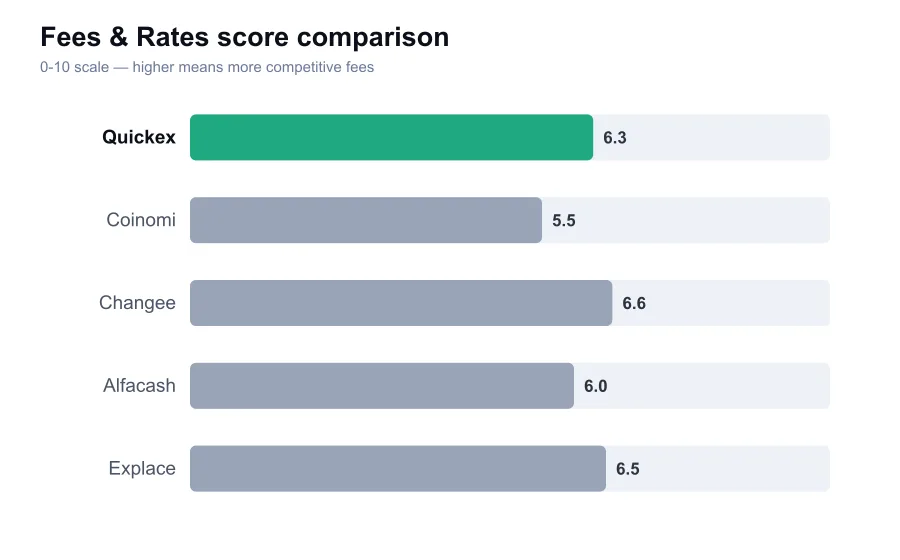
The company does not present a single easy universal trading-fee schedule comparable to a major exchange's maker-taker table. The cost is embedded in the quote and can vary by coin, liquidity conditions and rate type. That makes Quickex convenient but not automatically cheap. Before confirming, compare the amount you will receive with at least one competitor such as ChangeNOW, FixedFloat, SimpleSwap or a liquid centralized exchange. On popular pairs, the difference can be meaningful.
Network fees also matter. A swap can be cheap in percentage terms and still be poor value if the withdrawal or blockchain fee is large relative to the amount sent. This is particularly true for small Bitcoin or Ethereum transactions during congestion. Quickex displays transaction details before the user proceeds, but it is still the customer's job to judge whether a $25 network cost makes sense for a $150 exchange. Many instant exchangers look inexpensive until this calculation is made.
Speed is usually solid for ordinary pairs. Once the incoming transaction receives the necessary confirmations, Quickex can route the conversion and send the output without the manual withdrawal delay common at some centralized exchanges. The full time depends on the source blockchain, liquidity availability and the required confirmation count. A fast-chain transfer may complete in minutes. Bitcoin, congested Ethereum transfers or compliance checks can make the same experience much slower.
A fixed-rate order should not be treated as a guarantee of immediate settlement. If a user sends the wrong asset, uses an unsupported network, deposits too little, or sends after the rate window closes, the process can become manual. That is where instant-exchange convenience stops feeling instant. Always copy the deposit address carefully, use the exact selected network and preserve the transaction ID. Those steps are boring, but they are the difference between a clean swap and a support ticket.
Quickex can operate without routine account registration, which is appealing for users who value privacy and dislike handing identity documents to every service. It does, however, reserve the right to request KYC or AML information where a transaction triggers risk controls. This is common among instant exchangers. Anyone claiming that such services are permanently and unconditionally no-KYC is selling a fantasy. Compliance screening can happen after funds are already in motion, which users should understand before sending.
That policy creates the service's biggest practical security drawback. If a transaction is flagged, the user may be asked for identity documents and source-of-funds evidence before a resolution or refund. A legitimate compliance program is not inherently bad, especially in a sector full of stolen funds. Yet the lack of an account relationship and the urgency of a pending crypto swap can make the process stressful. Do not use any instant exchanger for funds you need to access at a precise deadline.
Quickex has a more established web presence than an unknown DEX, but it does not have the regulatory footprint, audited financial disclosure or long public history of a major licensed exchange. Its reputation is therefore functional rather than institutional. Plenty of users report routine swaps completing as expected. The complaints that matter tend to involve delayed transactions, rate disputes and verification requests, which are familiar risks throughout the instant-exchange category.
Security is mostly about reducing user mistakes. Quickex cannot protect a customer who enters an attacker's wallet address, buys a fake token or sends assets on the wrong chain. It also cannot offer the same controls as a full exchange account with withdrawal whitelists, hardware security keys and detailed session management. Use a private, updated wallet, verify destination addresses character by character, and avoid clicking exchange links from ads or unsolicited messages.
Support is available through the site's help channels and transaction-specific communication, and it is usually adequate for basic order tracking. I would not call it a standout strength. A simple completed swap needs no support, while an exceptional case demands fast, precise human intervention. Public experience with instant exchangers suggests that those exception cases are where quality varies most. Keep screenshots, timestamps and transaction hashes ready if you need to contact the team.
Quickex is best viewed as a practical conversion tool, not a financial home. It can be convenient for swapping assets between wallets without leaving coins on an exchange account. It is a poor choice for high-frequency trading, large institutional conversions or users who need certainty about KYC treatment before funds move. I like the narrow utility, particularly for modest, well-understood swaps. I do not like the idea of relying on it for a time-sensitive or life-changing transaction.