BitcoinVN occupies a far more recognizable position than a generic instant exchanger. It is a Vietnam-focused Bitcoin business that has operated through multiple market cycles and has built products around local access to Bitcoin, including exchange services and its VBTC brand. That local identity is its real advantage. It understands a market where banking habits, cash use, language, and regulatory uncertainty matter just as much as a global exchange's headline trading fee.
The company is not trying to outspend Binance on token listings or turn every visitor into a derivatives trader. Its appeal is practical access, particularly for Vietnamese users who want BTC or VND conversion through a provider with local roots. That focus gives BitcoinVN more substance than many anonymous swap sites. It also means international users should not assume every product, payment rail, or support process will be equally convenient outside Vietnam.
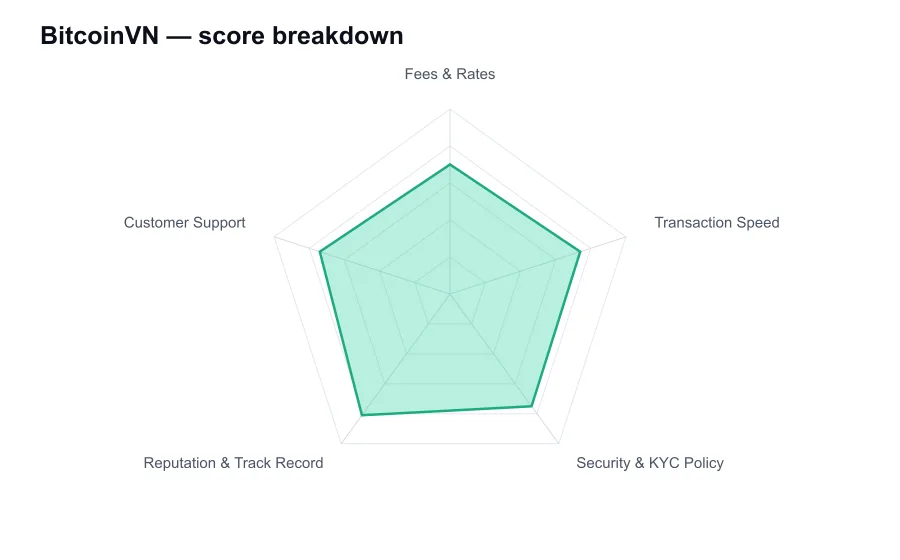
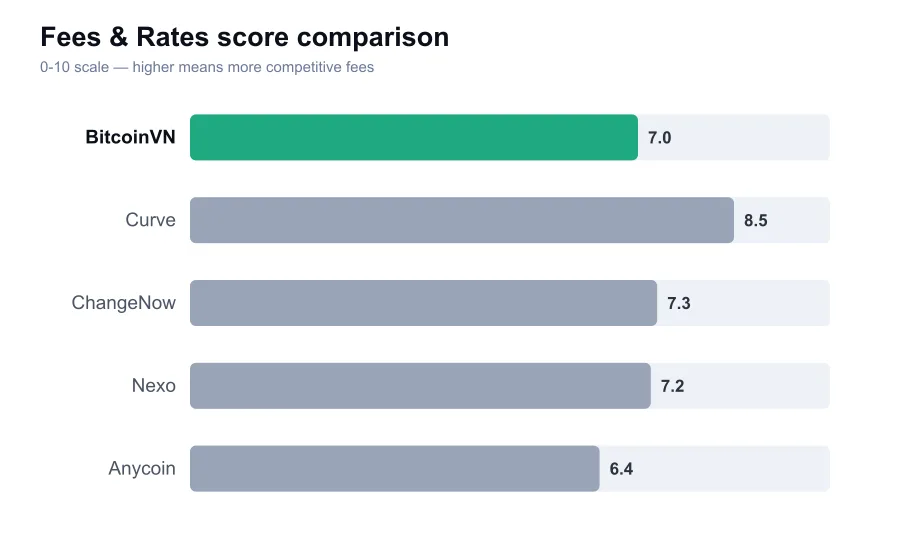
On fees, BitcoinVN deserves a nuanced reading. The relevant cost varies by product. A broker-style purchase, an exchange trade, a cash transaction, and a withdrawal are not interchangeable services and should not be compared through one headline percentage. The trading interface has historically offered a clearer fee framework than many instant converters, while broker and cash-oriented channels naturally include a convenience premium in the rate. Users should inspect the current fee page at the time of trading because schedules and local payment costs can change.
That transparency is a meaningful strength. A venue that distinguishes trading fees from blockchain withdrawal fees allows customers to calculate their own all-in cost. It is still possible to pay more at BitcoinVN than at a global exchange with enormous liquidity, especially on larger trades. Binance can often quote tighter spreads on major pairs, and Kraken may offer stronger international banking infrastructure. But neither comparison fully captures the value of a local VND-oriented route for a customer who would otherwise face awkward deposits or informal peer-to-peer trading.
The VND market can have wider spreads than dollar-based global markets, particularly during sharp local demand changes. That is not automatically a BitcoinVN failure. It is a feature of liquidity, banking access, and market risk. The important question is whether the price is shown honestly before confirmation and whether the customer knows which service they are using. BitcoinVN's product separation is useful here, because it discourages the fiction that a quick retail purchase has the same economics as placing a limit order.
Execution speed is usually good for the kind of customer BitcoinVN serves, but it is not magic. Internal exchange activity and supported local payment flows can be swift once requirements are met. Blockchain withdrawals are governed by network conditions and the provider's security procedures. Bitcoin transactions can sit while confirmations accumulate, and withdrawals may be subject to automated or manual risk checks. That is normal, particularly at a service that takes custody and compliance seriously.
The company has an advantage over pure online exchangers in that it has built a local operating identity rather than a disposable brand. In crypto, longevity matters. Surviving bear markets, bank-access complications, and changing rules is evidence of operational discipline. BitcoinVN has been visible in Vietnam's Bitcoin scene since the mid-2010s, which is a substantial record in an industry full of firms that vanish after one cycle.
Security policy is not just a collection of website features. A responsible local provider has to balance customer privacy with the real risk of fraud, hacked bank accounts, and sanctioned or illicit fund flows. BitcoinVN's processes can feel less frictionless than an anonymous swap site, particularly if a transaction needs review. I see that as preferable to pretending risk screening does not exist. The frustration comes when customers are surprised by a request they could have anticipated from the terms.
KYC requirements are likely to vary according to the service, payment method, transaction size, and risk profile. Users should expect identity checks for services involving fiat rails and should not treat a crypto company operating in a real local market as a reliable anonymity tool. Anyone whose priority is minimizing disclosure should look to lawful self-custody practices and understand the legal consequences in their own jurisdiction, rather than trying to force a compliant local business into an unsuitable role.
BitcoinVN's security reputation benefits from its longevity and visible engagement with the Bitcoin community, but no centralized provider is risk-free. Customers should still enable available account protections, use a unique password, verify withdrawal addresses, and move long-term holdings to self-custody. A local exchange can provide a useful on-ramp. It should not become the vault for an entire savings balance simply because it feels familiar.
The breadth of BitcoinVN's public reputation is strongest in Vietnam and among people who follow the regional Bitcoin scene. It does not command the same global name recognition as Coinbase or Bitstamp, but that is not the right standard for every customer. Its more relevant comparison is with informal dealers, Telegram sellers, and thinly documented local services. Against those alternatives, a long-running branded operation with public-facing products is much easier to take seriously.
Customer support is another area where local orientation can be valuable. A user dealing with VND transfer questions or Vietnamese-language onboarding often needs context, not a generic help-center article written for a global audience. BitcoinVN has historically presented itself as accessible to local users, and that matters. Still, users should keep records of transfer receipts, order IDs, and wallet addresses. Good support works faster when the customer can provide the facts immediately.
I would like to see every regional exchange make more operational information easy to find in one place, especially current transaction limits, exact verification tiers, and withdrawal timing rules. BitcoinVN is stronger than opaque swap services, but a user should still read the current terms rather than rely on an old forum post or social media comment. Crypto companies evolve, and policy changes can be significant.
For someone in Vietnam who wants a credible domestic path between VND and Bitcoin, BitcoinVN is a serious candidate. It has a clearer reason to exist than a generic offshore exchange. It also makes sense for users who value local context, a known regional brand, and product options beyond a bare conversion widget. It is less compelling for an international altcoin trader seeking hundreds of markets, ultra-deep derivatives liquidity, or the lowest possible maker fee.
BitcoinVN's limitations are the natural limits of specialization. Local liquidity is not always global liquidity. Some users will find the selection narrower and the effective pricing less aggressive than at international giants. Those tradeoffs can be sensible if local banking support and established regional operations reduce the practical hassle of buying or selling crypto. They are not sensible if the user's only criterion is a fraction of a percent on a high-volume trading screen.
My final view is positive, with the kind of caution any custodial exchange deserves. BitcoinVN has a materially stronger track record and a more credible local-market role than many small conversion sites. Its fee picture needs to be checked product by product, and serious holders should withdraw to self-custody after purchase. For Vietnamese users who want a legitimate-looking local bridge into Bitcoin, that is a trade I can understand. For global power traders, it is a specialist rather than a destination.