DefiLlama occupies an unusual place in crypto. It is primarily a data and research platform, not a conventional exchange. Its reputation was built on tracking total value locked, protocol revenue, stablecoin supply, bridges, chains, yields and fundraising across DeFi. The site also offers a swap interface, but treating the whole brand as though it were a Coinbase-style trading venue misses the point. DefiLlama is first a map of onchain finance.
That matters because the quality of its best product is different from the quality of an exchange. The main dashboard is useful precisely because it makes it easier to compare protocols without relying entirely on marketing copy. A researcher can inspect chain-level TVL, historical changes, fee and revenue data, and project links in one place. The data still requires interpretation, but DefiLlama has become a standard starting point for many analysts and DeFi users.
The swap tool is better understood as an aggregator interface. It seeks routes through liquidity sources and trading aggregators rather than operating a large proprietary order book or taking custody like a centralized exchange. You connect a wallet, receive a route quote, approve assets if needed, and submit a blockchain transaction. The speed of the result depends on the selected network, liquidity source, gas conditions, token approvals and the wallet itself.
That architecture is attractive for users who want self-custody. DefiLlama does not need to receive your deposit and credit an internal account balance before a trade can happen. The transaction happens through the connected wallet and underlying contracts. That removes a meaningful category of exchange insolvency and withdrawal risk. It does not remove the risk of signing a bad approval, using a spoofed website, choosing an illiquid token, or interacting with a vulnerable third-party route.
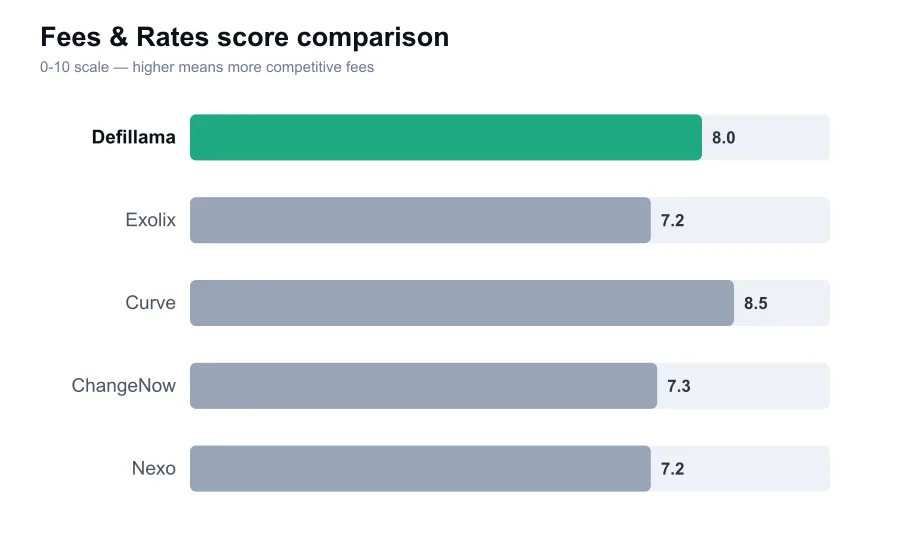
Fees need careful wording here. DefiLlama's swap interface has promoted itself as a zero-fee or no-additional-fee service, but that should never be read as free trading. Every onchain swap has network fees, and the liquidity venue or route can include its own pool fees and price impact. A route can also be economically worse than another route even if an interface advertises no platform fee. The received amount is the figure that matters, not the marketing label.
For small swaps on Ethereum mainnet, gas is often the real enemy. A few dollars of tokens can incur a fee that makes no economic sense to pay. On lower-cost networks, the aggregator model is much more appealing because routing competition can reduce slippage without a punishing base-layer transaction cost. It is sensible to compare the final output with another aggregator, a direct DEX quote, or an established wallet's swap quote before signing.
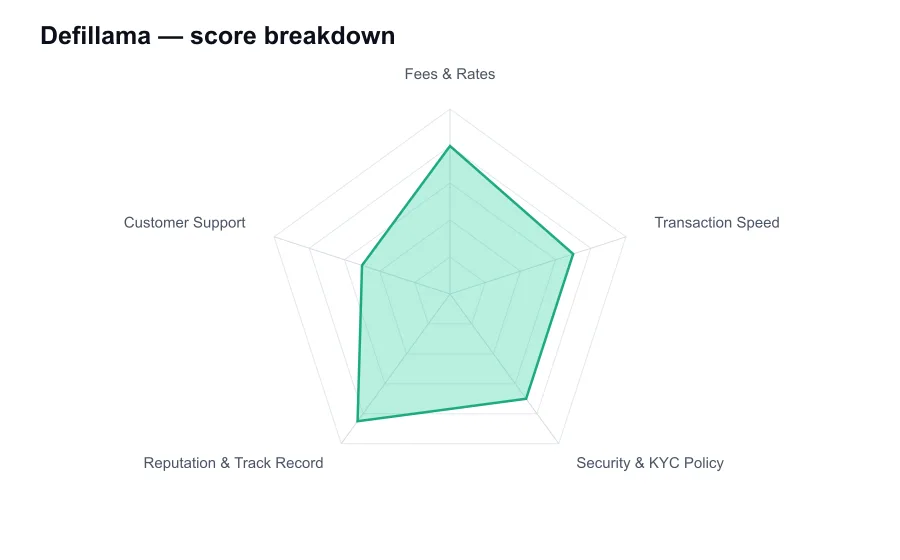
DefiLlama's data pages are fast, clean and unusually restrained by crypto-industry standards. There is less visual noise than on many token tracking websites, and fewer obvious attempts to turn every visitor into a yield farmer. That editorial restraint is part of why the brand is respected. Still, TVL is not a quality stamp. It can be inflated by incentives, borrowed collateral, duplicated bridges or a short-lived campaign.
The platform's open and data-driven posture is a strength, but it can also create a false sense of certainty. Metrics are compiled from public chains and project sources, then categorized using methodology that inevitably involves judgment calls. A protocol's revenue number, a chain's TVL figure, or a project's classification can change as contracts are discovered or definitions are refined. Serious users should read methodology notes and cross-check important conclusions.
There is generally no account-based KYC for browsing DefiLlama or connecting a wallet to a decentralized swap flow. That is appropriate to its role as a public analytics site and noncustodial interface. It also means there is no familiar account-recovery process. If a browser extension wallet is compromised, DefiLlama cannot restore assets. If a user executes a trade from a sanctioned jurisdiction or encounters compliance restrictions at an underlying service, the situation is more complicated than a simple website login.
Security is stronger at the custody layer than at the user-experience layer. DefiLlama is not asking customers to leave coins in a house wallet, which is a major positive. But the interface directs users into a broad DeFi ecosystem, where risks sit in smart contracts, token contracts, bridge designs, RPC providers and wallet permissions. A secure analytics site cannot make a speculative token safe, and it cannot guarantee that every route provider will behave perfectly in stressed conditions.
The brand's public reputation is good, partly because it has remained useful through multiple market cycles while many data dashboards disappeared. It is frequently cited by researchers, journalists, builders and funds. The 2023 internal dispute involving team members and a proposed token launch was messy, though it also showed how quickly governance and control questions can affect a supposedly neutral data brand. The project continued under the widely recognized DefiLlama name, but the episode was a reminder that people and incentives sit behind every dashboard.
Customer support is not the reason to choose DefiLlama. Documentation, social channels and community spaces can help with a site issue or an explanation of a metric, but there is no consumer-style service desk capable of reversing an onchain trade. If a swap has failed, the relevant answer may be in the transaction explorer, the wallet's activity record, or the underlying route provider. That can be frustrating, but it is the honest reality of noncustodial tooling.
For research, I would rate DefiLlama much higher than I would rate it as a standalone exchange. Its strongest contribution is helping users see the market before they act. The yields section, chain dashboards, stablecoin pages and protocol metrics can expose questions that a promotional landing page would rather avoid. A high advertised APY looks different after checking whether the protocol is tiny, recently launched, dependent on emissions, or losing capital rapidly.
The swap feature is convenient, especially for someone already using DefiLlama for research, but convenience should not be confused with execution certainty. Review the spender address, token contract, route, minimum received amount and gas estimate. Avoid unlimited approvals where practical. If a trade is large enough to matter, simulate it mentally and compare at least one competing quote. That is not paranoia, it is the minimum standard for onchain trading.
DefiLlama deserves credit for being one of the more useful and less promotional brands in DeFi. As an analytics platform, it is excellent. As a trading gateway, it is competent but secondary, and it inherits the limitations of the chains and liquidity sources it touches. I would happily recommend it as part of a DeFi research workflow. I would not recommend relying on any aggregator interface, DefiLlama included, as a substitute for understanding the transaction you are about to sign.