Curve is one of DeFi's foundational trading venues, built around a fairly narrow but extremely important job: swapping assets that should trade at nearly the same price. Stablecoins, wrapped Bitcoin assets, liquid staking tokens and ETH derivatives are its natural territory. It is not trying to look like Binance, Coinbase, or even Uniswap. Curve is infrastructure for users who understand pools, token approvals, liquidity positions and the uncomfortable fact that a wallet transaction has no undo button.
That specialization still gives Curve a real edge. A USDC to USDT trade in a deep Curve pool can be much more capital efficient than the same order on a general automated market maker. Its StableSwap design concentrates liquidity around parity, so a sensible-sized stablecoin swap often suffers less slippage than it would on a conventional x*y=k pool. For treasury managers, arbitrageurs and experienced DeFi users, that is the reason Curve remains relevant.
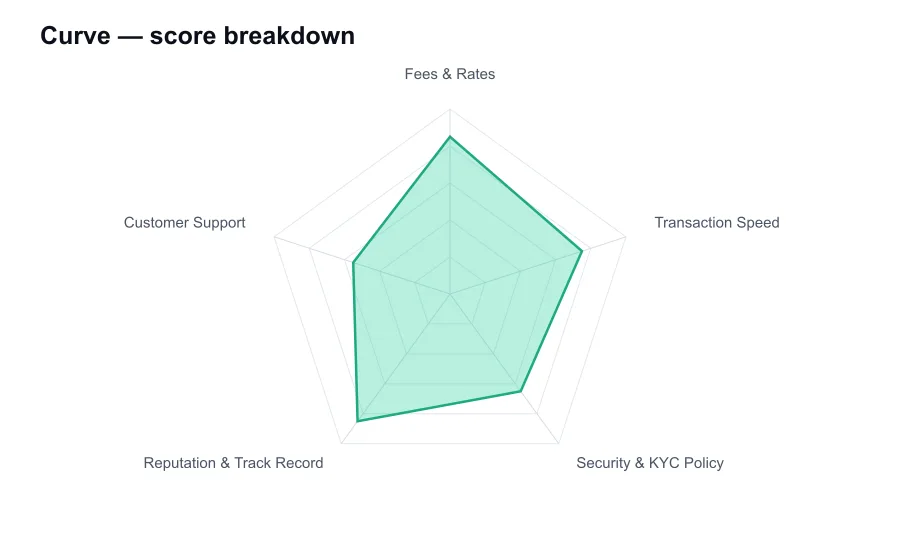
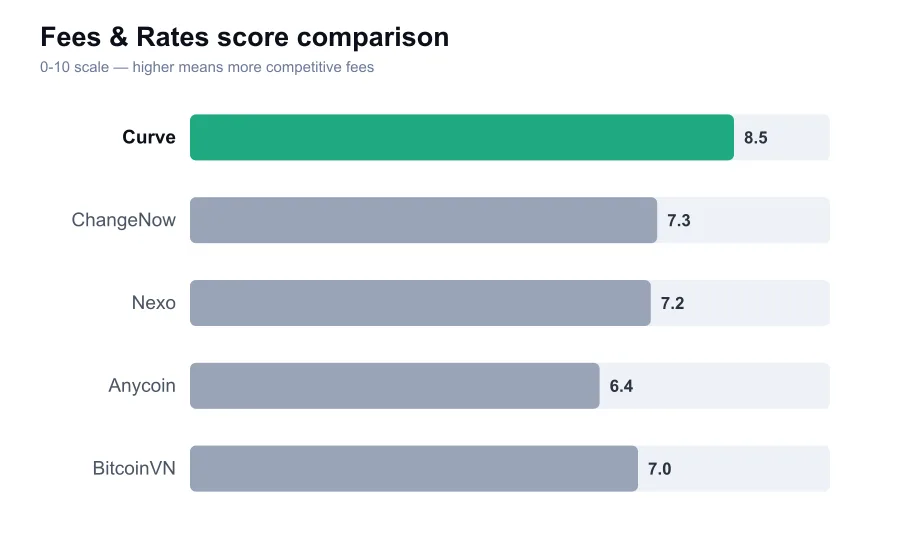
The headline fee is usually low. Many classic Curve pools charge a 0.04% swap fee, although individual pools can use different parameters and newer pool designs give deployers more discretion. That is materially cheaper than the common 0.30% fee tier people associate with older Uniswap pools. But calling Curve cheap without qualification would be misleading. Ethereum gas can dwarf the protocol fee, particularly on a small trade during a busy period.
The price shown before a swap also isn't the complete cost of trading. Users pay the pool fee, network gas, and potentially price impact if a pool is imbalanced or shallow. Some pools involve lending-market integrations, external reward tokens, or assets with redemption risk. The nominal fee can look excellent while the practical trade is bad. Curve rewards users who check the route, compare the received amount with an aggregator, and understand exactly which token version they are buying.
On Ethereum mainnet, execution speed is simply Ethereum speed. A transaction may be visible quickly but still needs blocks and confirmations, and the experience becomes unpleasant when gas spikes or a wallet sets an inadequate fee. Curve deployments on networks such as Arbitrum, Optimism, Polygon, Base and other supported chains can feel dramatically faster and cheaper. The protocol itself does not hold up a swap. The chain, the wallet, and the state of the pool do.
That distinction matters because Curve isn't an instant-exchange service. There is no operations desk manually processing an order and no promise that a transfer will settle in three minutes. A swap is a smart-contract call. If the transaction is confirmed, it settles according to contract rules. If it fails, the assets generally stay in the wallet, though gas is still spent. That is a cleaner model than sending coins to an opaque exchanger, but it puts more responsibility on the user.
Curve's security record is sophisticated, battle-tested and far from spotless. The protocol has been repeatedly audited, runs bug bounty programs, and has a long history as a major DeFi liquidity layer. Yet its history also demonstrates that audits are not insurance. In July 2023, a vulnerability affecting certain Vyper compiler versions enabled reentrancy exploits against several Curve pools, with losses estimated around $70 million before recoveries and white-hat actions reduced the final damage.
That incident deserves more weight than a generic claim that DeFi is risky. Curve's core idea was not disproven, but smart-contract risk was made painfully concrete. The event also showed how interconnected DeFi can be: Curve pool disruption affected lending positions, CRV liquidity, market confidence and protocols that depended on Curve pricing or collateral. The team and community worked aggressively to contain the fallout, but no user should treat a mature protocol as equivalent to a regulated custodian with deposit insurance.
There is no standard KYC wall for using Curve. Connect a self-custody wallet and, subject to local law and the wallet provider's own controls, interact directly with the contracts. That is a substantial privacy advantage for people who do not want to open yet another exchange account. It also means Curve cannot realistically rescue someone who sends funds to the wrong chain, signs a malicious approval, or chooses a fraudulent token contract from a search result.
The interface has improved over time, but it remains designed for crypto-native users. Pool pages can show gauges, boosted rewards, LP token mechanics, parameter details and a selection of assets that make little sense to a first-time buyer. A beginner looking to buy Bitcoin with a bank card should not start here. A user who already keeps assets in Rabby, MetaMask, Coinbase Wallet or a hardware wallet will find the directness refreshing once they learn the terminology.
Curve's reputation is unusually layered. It has been central to stablecoin liquidity since 2020 and helped define the so-called Curve Wars, in which protocols and DAOs competed for CRV voting influence and emissions. That is real credibility. At the same time, the CRV ecosystem has been criticized for complexity, incentive dependence and governance dynamics that ordinary swappers neither need nor should be expected to understand.
The June 2024 liquidation pressure around founder Michael Egorov's large CRV-backed borrowing was another reminder that protocol reputation and token-market risk are related but not identical. Curve kept operating, yet the episode was not flattering. A platform can have useful code and deep liquidity while its associated governance token has concentrated ownership and leverage concerns. I would not use CRV's price alone as a health gauge, but I also would not ignore it.
Support is where Curve feels least like a consumer product. Documentation, Discord, governance forums, analytics pages and community contributors can be genuinely useful, especially for a technically literate user. There is no traditional account manager or chargeback department, though. Impersonators in Telegram and Discord are a persistent danger. Anyone offering private support and asking for a seed phrase is a scammer, full stop.
For liquidity providers, the analysis must go beyond advertised APY. Fees, CRV emissions, external incentives, impermanent loss, asset depegging, smart-contract exposure and the tax treatment of rewards all matter. A stablecoin pool can appear sedate right up until one asset loses its peg. The same applies to liquid staking pools, where the derivative may trade below its redemption value in stressed conditions. Yield is payment for risk, not a coupon.
Curve is excellent at its particular job, and it is still among the better places to exchange closely related onchain assets at scale. It is not a comfortable all-purpose exchange, and the 2023 exploit means its security score cannot be treated as elite just because it is famous. Use it with a self-custody wallet, verify every contract and token, compare quotes, and keep position sizes appropriate for smart-contract risk. For stable-asset DeFi trading, Curve remains a serious tool. For a newcomer seeking simplicity and human help, it is the wrong first stop.