BTC2Pay sits in the crowded market of small instant crypto exchangers, aimed at people who want to swap coins without opening a full trading account. It is not trying to be Binance, Kraken, or Coinbase. The appeal is simpler than that: pick a pair, send funds, receive the other asset. For users who already understand wallets and network fees, that can be a useful proposition. The problem is that convenience only counts if the service is transparent enough to trust with a meaningful transfer.
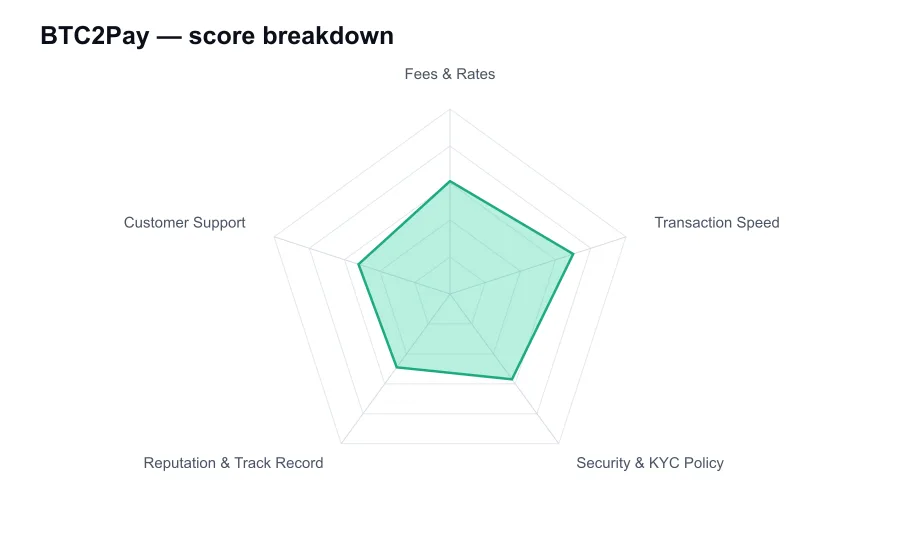
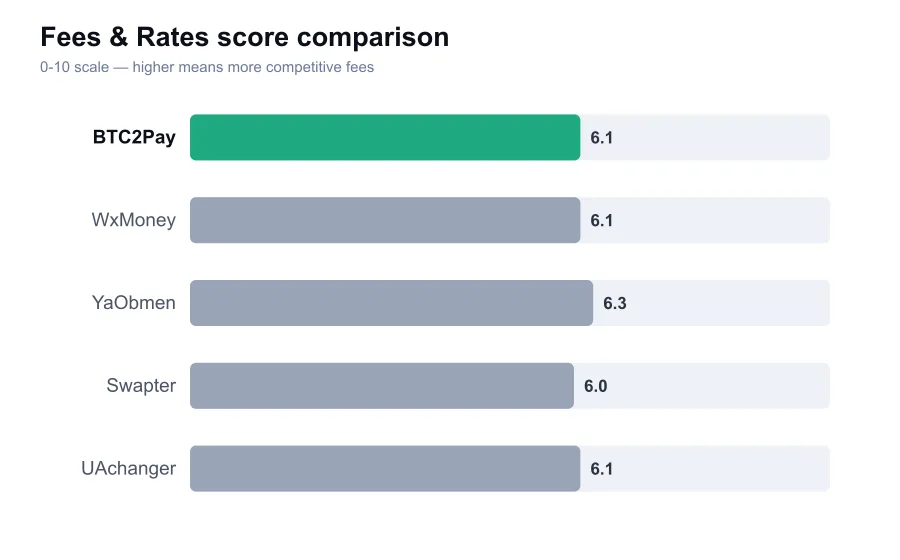
The first thing I look for with a service in this category is whether it clearly distinguishes its exchange rate from its fee. BTC2Pay's pricing presentation has historically been closer to the common instant-exchange model, where the quoted output amount carries the provider's spread and the network cost. That is not automatically bad. Many non-custodial swap services work this way. But it makes comparison shopping harder than it should be, particularly for newcomers who see a good headline rate and do not notice how much of it has disappeared in the final quote.
For small exchanges, BTC2Pay can be reasonably competitive if you check the final amount against several alternatives immediately before sending. That caveat matters. A quote that looks appealing for BTC to USDT may be less compelling for Litecoin, TRON, or a token operating on a busy network. The effective cost is not just BTC2Pay's margin. It also includes the blockchain fee, any liquidity premium on the chosen pair, and the cost of moving funds again after the swap.
I would not use it as a place to make repeated speculative trades. The lack of a conventional order book means there is no transparent maker and taker fee schedule, no limit-order control, and no easy way to see the depth behind a rate. A centralized spot exchange is usually cheaper for a trader converting frequently between major coins. BTC2Pay makes more sense for a one-off wallet-to-wallet conversion, where avoiding account setup has real value.
Speed is one of BTC2Pay's stronger selling points, but the word "instant" needs translating. The platform can process its side of an order quickly once it detects an adequate deposit, yet blockchains still set the pace. A Litecoin or TRON transaction may move through in minutes. Bitcoin and Ethereum can take longer, especially if the sender used a low fee or the network is congested. No exchange interface can fix an unconfirmed deposit.
In a clean transaction, the practical experience should be straightforward: create the order, send exactly the requested amount, wait for confirmation, then receive the payout. The weak point is exceptions. A delayed deposit, an underpayment, a token sent on the wrong chain, or an address-tag mistake can turn a quick swap into a support case. Smaller exchange services are judged by those cases, not by the easy ones. BTC2Pay has less public evidence of consistently excellent exception handling than larger rivals with established operations teams.
The service's non-custodial positioning is useful but should not be romanticized. Funds are not held in a trading balance in the same way they are at a large exchange, which reduces the risk of leaving coins parked on a platform. During an active order, however, you are still sending money to an address controlled by the service or its liquidity process. You should treat that as counterparty exposure until the receiving transaction is confirmed in your wallet.
KYC is another area where users need to read the conditions rather than rely on marketing shorthand. A service may permit many ordinary swaps without demanding identity documents, while retaining the right to request verification for risk controls, sanctions screening, suspicious transaction patterns, or compliance reviews. That is common across instant exchangers. It means "no registration" does not guarantee that every transfer is anonymous or immune from review.
That conditional approach may be acceptable to privacy-conscious users making lawful, ordinary wallet swaps. It is less suitable for anyone who cannot tolerate a paused transaction or a request for source-of-funds evidence. If your funds are time-sensitive, such as a stablecoin payment needed for a business settlement, the safer choice is a provider with clearer escalation procedures and a stronger public compliance record. BTC2Pay does not inspire enough confidence here for high-stakes transfers.
Reputation is where BTC2Pay needs the most patience from prospective users. It does not carry the long, independently documented operating history of established exchanges such as Kraken or Bitstamp, and it is not a brand whose name alone settles the safety question. That does not make it fraudulent. It does mean the burden shifts to the user to test cautiously, examine current independent feedback, and avoid sending an amount that would be painful to have delayed.
I also dislike the way small exchange brands can be difficult to evaluate once you move beyond their own website. A polished interface, a live chat badge, and a list of supported currencies are not proof of deep liquidity or reliable operations. Search for recent complaint patterns, not only favorable ratings. Pay particular attention to reports about delayed payouts, rate changes after deposit, and how the company responds publicly when an order goes wrong.
Support appears designed around the usual channels for this type of service, primarily web contact tools and email-style ticket handling rather than the extensive phone and account-management infrastructure found at major regulated exchanges. That can be enough for a basic exchange question. It is not ideal when an order has been pending for hours and you need a clear explanation, transaction hash, and realistic timeline rather than a generic status update.
If you decide to try BTC2Pay, start with a modest transaction on a familiar network. Save the order ID, screenshots of the quoted amount, your sending transaction hash, and the recipient address before you send anything. Check the network carefully, especially with USDT, where the same ticker can refer to multiple chains. These habits are boring, but they eliminate the user errors that instant exchangers are least equipped to resolve gracefully.
BTC2Pay is not a terrible fit for an experienced self-custody user who values a quick conversion more than a full trading terminal. The rate can be workable, and the streamlined flow is attractive for uncomplicated swaps. Still, it has not earned the kind of reputation that would make me comfortable using it as a default venue or trusting it with a large transfer. Use it as a convenience tool, not as financial infrastructure.