Vobmenka is a compact online exchanger serving the familiar post Soviet market for crypto, electronic payment systems, bank cards, and selected local transfer routes. It is not trying to compete with a full order book exchange. The point is speed of conversion and access to payment directions that can be awkward or unavailable at global platforms. That makes it useful to a particular customer, but it also creates a narrower margin for error.
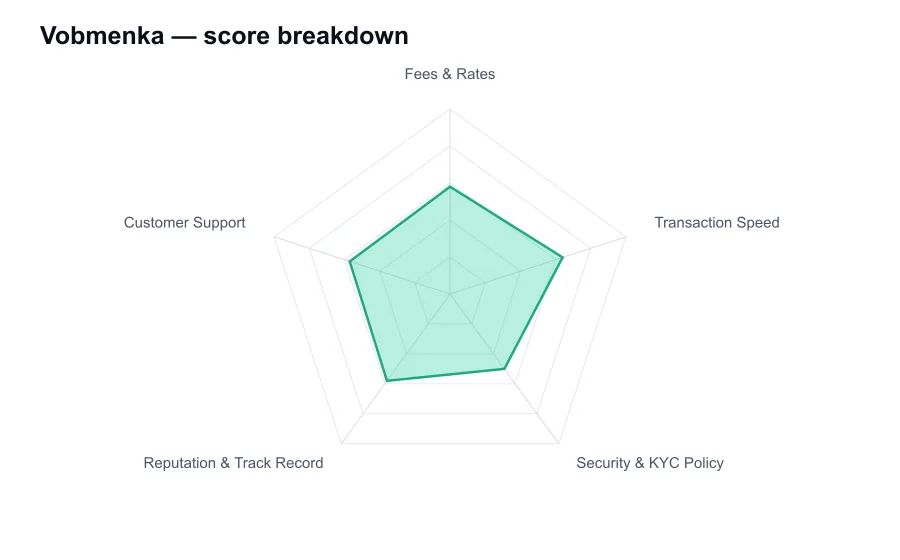
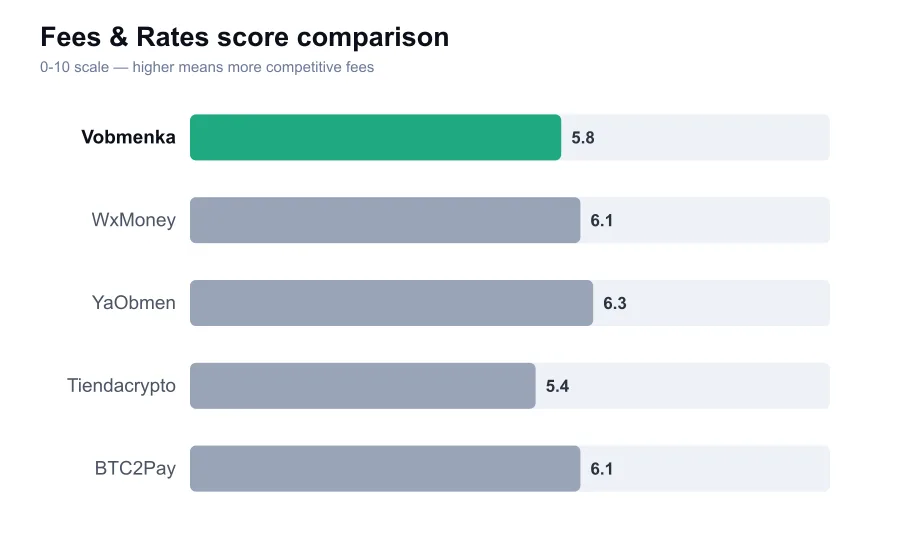
The first thing to understand is that Vobmenka sells a quoted conversion, not an exchange trading fee. A visitor may see an attractive rate and assume the commission is negligible, yet the actual cost lives in the difference between its quote and the underlying market price. This is normal industry practice. It is also why an exchanger should never be judged from a percentage claim alone.
For common, competitive directions, the spread may be acceptable payment for convenience. For niche payment systems and illiquid currencies, it can be substantial. The reserve shown for a direction also matters. A great quote is useless if the operator cannot pay the desired amount quickly, or if the order must be split into several smaller transactions. Check both the available reserve and the final receive amount before creating an invoice.
Vobmenka is best approached as a comparison shop transaction. Check its offer against exchange monitors, then look at what a liquid platform would cost after deposit, trading, withdrawal, and banking fees. This takes five minutes and protects against the common mistake of treating the first visible rate as the fair market rate. Users who exchange regularly should keep a record of actual received amounts, not just advertised percentages.
The order process is designed to be simpler than a centralized exchange account. You select a pair, enter payment details, receive instructions, and send funds within the specified window. For people who only need to turn one asset into another, that is a legitimate advantage. There are no trading screens to learn and no need to understand maker and taker fees. The downside is that the counterparty controls the execution process.
Fast completion is possible on well supported routes. A crypto to crypto conversion can move shortly after the incoming transfer gets the necessary confirmations. Card, bank, and electronic wallet transfers add their own queues. Some are automated, while others rely on operator review or a payment provider. A claim of instant exchange should always be read as a best case scenario rather than a binding promise.
The operational risks become visible at the edges. Sending less than the required amount, using an expired order, entering the wrong card number, or paying from a third party account can create a delay that feels disproportionate to the original transaction. This is not necessarily misconduct. It is the cost of a system where payment reconciliation and fraud controls matter. Still, Vobmenka could inspire more confidence by making exception handling timelines very explicit.
Security at an exchanger is partly technical and partly procedural. Secure website access helps, but the important question is how the business handles suspicious orders, identity documents, and a customer whose funds are held during review. Vobmenka should be treated as a temporary bridge. Send in, receive out, then store crypto in a wallet you control. Do not regard an order page, account balance, or chat history as a substitute for custody.
Users should also expect anti money laundering screening to exist even where a service advertises low friction. Crypto received from sanctioned, stolen, mixer associated, or otherwise high risk sources can trigger investigation. Bank linked operations can bring additional compliance checks. Anybody who needs predictability for a business payment should ask support about limits and required documents before sending, rather than discovering the policy after funds are already in transit.
Vobmenka has a recognizable name within the exchanger and monitoring ecosystem, which is a meaningful positive. Small exchange services live or die by completed orders and public feedback. However, the available public profile is not as deep as that of a large exchange with audited financial statements, extensive licensing disclosures, and years of mainstream scrutiny. Reputation reduces risk. It does not remove counterparty risk.
I would be especially careful with testimonials. Positive comments can show that routine transactions are being completed, but they rarely explain disputed transactions, frozen source wallets, or payout failures. Read the recent negative feedback as carefully as the positive feedback and look for how the operator responds. Silence, copy pasted answers, or vague promises are warning signs. A clear explanation of a specific delay is much more credible.
Support is likely to matter most on a first transaction. The service can be perfectly adequate if the order matches the instructions exactly. If it does not, customers need a real person who can locate the payment, explain the missing information, and give a practical next step. Vobmenka's support model is appropriate for ordinary retail orders, but it is not a replacement for the formal case management one expects from a large financial institution.
I would not use Vobmenka for a life changing amount, an urgent property payment, or funds with complicated provenance. Those situations call for a licensed exchange, bank, or specialist OTC desk where compliance is discussed before settlement. For a modest personal conversion, the service's directness can be attractive. Just make the rate comparison, document the order, and verify addresses twice.
Vobmenka has a sensible role in its regional niche. It can be quicker and easier than routing through a global exchange for the right payment pair, and it does not pretend to be a feature heavy trading destination. Its weak spots are the ones shared by many independent exchangers, pricing opacity, dependence on operational support, and limited public depth around governance. Use it deliberately, not casually.