Swapter is a small instant cryptocurrency exchange focused on direct coin-to-coin conversions. It follows the familiar model: choose a pair, send funds to a provided address, and receive the output asset in a wallet you control. That model is appealing because it avoids trading accounts and order books. It is also a business model where the quality of liquidity, support, and exception handling matters far more than the simplicity of the homepage.
The service is aimed at users who already understand wallets and blockchain transfers. It is not a broad retail exchange with bank deposits, recurring buys, advanced market orders, or a deep educational environment. If you want to turn one crypto asset into another without parking funds at a centralized venue, Swapter is trying to solve that narrow problem. Its appeal is convenience, not a fully featured trading ecosystem.
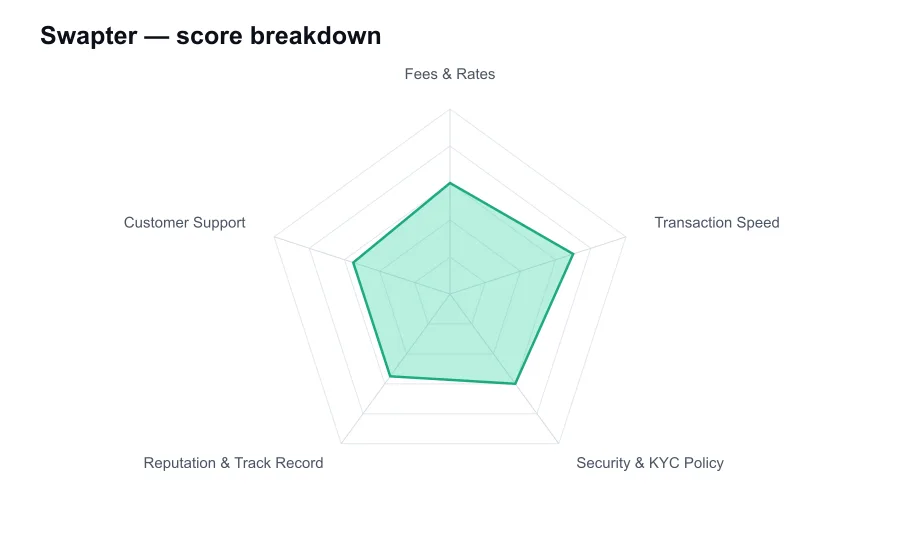
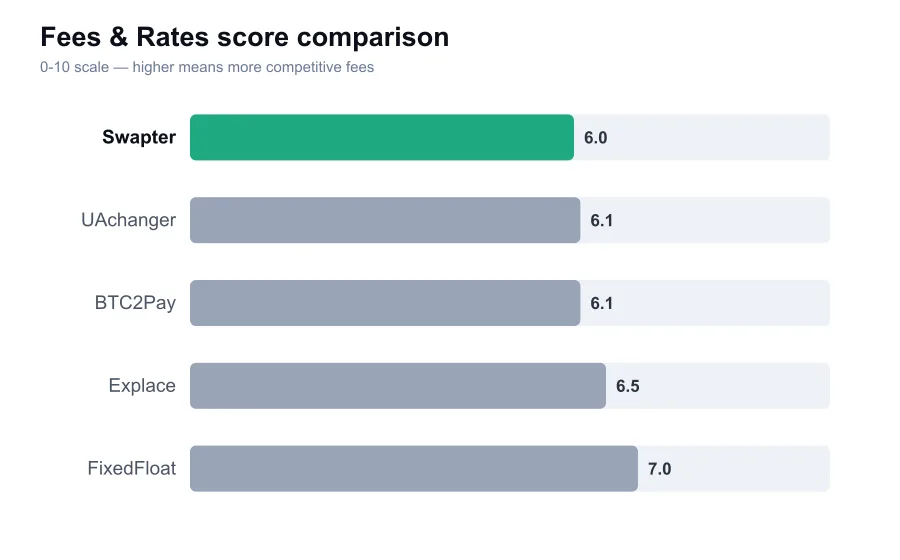
Swapter's pricing needs to be assessed through live quotes rather than broad claims about cheap exchanges. Instant-swap providers usually earn through a mixture of service markup, partner spreads, and network costs. The customer sees a rate, but that rate can move quickly between opening the page and creating the order. I would never assume a smaller provider is cheaper simply because it advertises a frictionless swap.
The practical fee test is simple. Build the same order at Swapter, StealthEX, ChangeNOW, and one other competitor, then compare the exact amount that will reach your wallet. Do this immediately before sending, using the same rate type and network. If Swapter is clearly ahead, use it. If the difference is tiny, I would lean toward the provider with stronger public documentation and a longer record of support activity.
Any fixed-rate option should be examined carefully. A fixed quote can protect the receiving amount during a volatile market, but only if the deposit arrives within the provider's stated time and amount tolerance. Sending too little, too much, or too late can turn what looked like a fixed exchange into a support issue. Floating rates are often more efficient for liquid pairs, but they are a poor choice if the receiving amount must cover a payment or a specific purchase.
Swapter can be fast on normal routes. Once the inbound transfer has enough confirmations, a standard swap involving well-supported assets may complete in minutes. That sounds obvious, but many frustrated users confuse a blockchain confirmation delay with the exchange refusing to act. Bitcoin's confirmation cycle, Ethereum gas conditions, and the chain used for stablecoins have more effect on delivery time than the checkout animation.
The weak point with a smaller service is not usually the happy path. It is the abnormal order. A deposit might arrive below the minimum, a wallet might omit a required memo, a coin wallet might be under maintenance, or a transaction might be screened by a liquidity provider. In those circumstances, the user needs accurate status information and an identifiable route to a refund. That is where a limited public footprint becomes a real consideration.
Swapter's direct, no-account style reduces the temptation to leave a balance on the platform. That is a positive security characteristic. You control the receiving address and the service is meant to process a single transaction rather than act as your custodian. But the word noncustodial is often used too casually in this industry. Funds still leave your wallet and enter an operational process that you do not control until the swap is completed.
Users should also understand that no account requirement does not guarantee no verification. Transaction monitoring and partner compliance checks can lead to a request for KYC documents, especially where funds are linked to risk signals or sanctions screening. The likelihood is impossible for an outsider to predict, and users should not send funds if a potential verification hold would be unacceptable. This is true across most centralized instant-swap services, not just Swapter.
Swapter does not have the same volume of long-term independent discussion as the biggest names in the sector. That leaves less evidence to judge how it responds to difficult cases. A clean interface, a wide asset list, or a favorable quote are not enough on their own. Reputation should be based on repeat execution, transparent policies, and how a provider behaves when a customer makes a genuine mistake.
I would be particularly careful with unsupported networks and token versions. USDT and USDC are common sources of avoidable losses because they exist on several chains. The network selected on the send side must precisely match the order instructions. Do not assume that a token bearing the same ticker can be recovered if it is sent over the wrong chain. Before sending, check the minimum deposit, expected confirmation count, refund procedure, and receiving address.
Support is likely adequate for routine questions, but prospective users should set realistic expectations. Most instant exchanges do not provide the kind of phone support or named account manager offered by a large regulated broker. Live chat and email are useful, provided the service can give a specific answer tied to an order ID. Save the transaction hash from the beginning. Without it, even good support cannot do much.
Swapter makes the most sense as a secondary route to compare against better-known services. That may sound unglamorous, but it is a sensible role. If its quote is materially better for a small or medium-sized conversion, and you have tested the flow successfully, it can be a practical option. It is not the provider I would choose by default for a large first-time transaction.
There is a difference between being cautious and being unfair. Smaller instant exchanges can execute perfectly well and can sometimes offer attractive pricing. Still, customers are entitled to demand evidence before assigning trust. Swapter needs a deeper, more easily audited track record and clearer visibility around operational policies to earn the confidence that established competitors have accumulated.
My final view is that Swapter is usable, but it needs to win the trade on price or asset availability to justify choosing it over a more proven rival. Start with a modest amount, use a liquid pair, and preserve every record of the order. If support proves responsive and the execution matches the quote, it can become a useful tool in a comparison shortlist. Until then, it is a service to approach thoughtfully, not casually.