YaObmen is a regional-style online exchange service built around direct conversion rather than conventional crypto trading. Its name and presentation place it squarely in the familiar exchanger ecosystem used for moving between coins, electronic money and card or bank payment routes. It is designed for speed and convenience at the order level, not for investors seeking audited custody, advanced markets or a broad regulated financial relationship.
That distinction matters because customers often expect too much from an exchange office. YaObmen can be useful if the task is simple: send one asset, receive another, and move on. It is not the right place to hold a balance between transactions or build a recurring treasury process. A direct exchanger is a counterparty for a limited exchange, and the customer should minimise exposure accordingly.
The order journey is likely familiar to anyone who has used a rate-monitor service. Pick the direction, enter the amount and payout details, then follow the payment instructions. This is a less intimidating flow than an exchange order book, and for a routine cash-out it may be all a user needs. The price of that simplicity is less granular control over execution and less transparency than a spot-market trade.
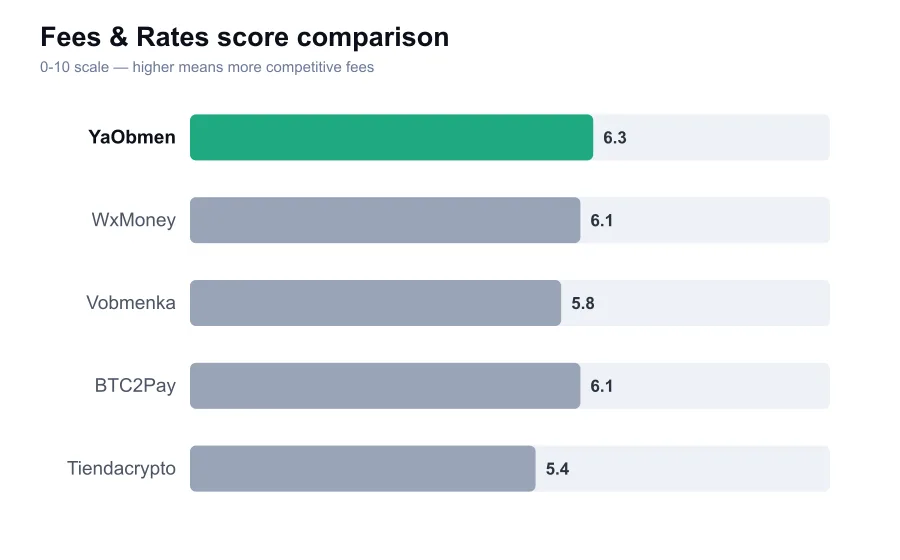
YaObmen's fee picture is therefore quote-led. The customer generally sees a receive amount rather than a clearly separated commission schedule. The spread can cover operational costs, liquidity risk, payout processing and profit. There is nothing inherently wrong with that model, but it makes it easy to pay more than expected if you compare only the advertised rate. The final amount is the number to judge.
A careful user should open at least two comparable live quotes before creating an order. Make sure the network, payment method, amount range and settlement currency are identical. An apparently superior quote may use a different stablecoin network, a slower payment route or a more restrictive limit. If YaObmen is best after those details are aligned, its convenience can justify use. If it is not, there is little reason to be loyal.
The service can be fast on a clean crypto route, especially where incoming transactions confirm quickly and the payout destination is uncomplicated. That is the upside of a specialised exchange office. There is no lengthy trading sequence, and the customer does not have to fund and withdraw from a separate exchange account. But the claimed speed is conditional. Reserve availability, bank processing and manual checks can interrupt it.
Bitcoin transfers, payment cards and higher-risk blockchain histories are the routes most likely to test a promised fast turnaround. A customer should never send funds on the assumption that every order is instant. Read whether the rate is fixed or floating, how many confirmations are required and how the service treats late payment. If the terms are unclear, ask before paying, not after the market has moved.
YaObmen's security posture deserves practical scrutiny rather than blanket praise or panic. A website can process many successful exchanges and still offer less protection than a regulated exchange. There is no good reason to assume deposits are segregated, insured or protected by the same governance controls found at major licensed companies. The proper defence is not trust in a logo, it is keeping each order limited and self-contained.
The low-friction nature of an exchanger does not erase KYC or anti-money-laundering obligations. A transaction may be accepted without an upfront account verification step, yet still be checked if payment data or on-chain activity raises a risk flag. YaObmen users should be ready to demonstrate ownership of a sending wallet or payment method if asked. Anyone unwilling to provide that should choose not to initiate the transaction.
This is also an area where clear policy text matters. A provider that states what can trigger a review, what documents may be requested and how disputed orders are handled is easier to assess than one relying on vague assurances. YaObmen does not offer the level of independently verifiable operational disclosure I would want for a major transfer. That is not a claim that it will fail an order, but it is a reason to control risk.
Its public reputation should be viewed through the lens of longevity and consistency. Exchange-monitor listings and user comments can be useful discovery tools, particularly for identifying recurring complaints. They are not a substitute for external audits, published financials or regulatory supervision. A long run of specific feedback is better than a short run of enthusiastic one-liners, but neither turns a small exchanger into a bank.
What I would look for before using YaObmen is evidence of competent exception handling. Does the service explain a delayed order in concrete terms? Does it acknowledge a payout reference after sending funds? Can it distinguish a blockchain confirmation delay from a bank-side delay? Those details reveal whether the operator has control of its process. Customers should be wary of support replies that merely promise to resolve everything soon.
The support experience is likely more important at YaObmen than the everyday interface. Most standard orders need little assistance. The difficult cases involve a missing memo, incorrect payment amount, compliance question or delayed card credit. In those situations, a customer needs a human who can read the actual transaction record. Test the available contact channel before a large exchange by asking a precise question about the pair you intend to use.
A first transaction should be treated as due diligence, not merely a purchase. Use a manageable amount, a familiar wallet and a standard payout route. Record the time sent, confirmation count and time received. If YaObmen meets its stated terms and support is responsive, it may become a reasonable option for comparable exchanges. If communication is slow on a small test, move on rather than arguing with a service holding more money.
YaObmen is more compelling for a repeat user who understands the mechanics than for a newcomer who simply wants the safest place to buy crypto. The experienced user can spot an unusual quote, recognise the correct network and preserve evidence if something goes wrong. A newcomer is better served by a larger provider with a clearer onboarding process, stronger documentation and formal account-level security tools.
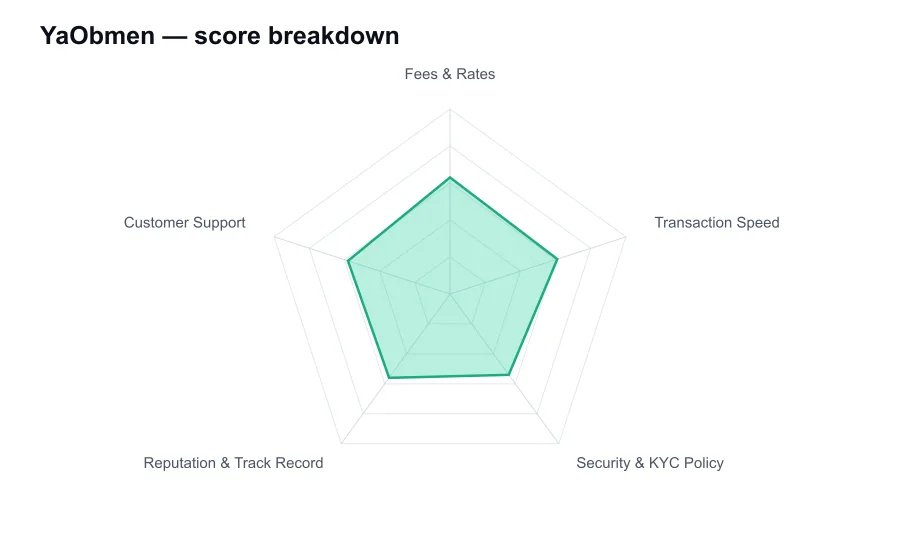
My take is measured. YaObmen may be a practical exchange route where its live net rate and available reserve are favourable, but it does not clear the transparency bar for casual large-scale use. The service should compete on each order, not receive automatic trust because a previous transaction went smoothly. Use it for what it is, a short-lived conversion counterparty, and it can be useful. Ask it to be more than that, and the risks become harder to justify.