LetsExchange is one of the better-known instant exchange aggregators, built for users who want to swap crypto across a large catalog without trading directly on an order book. It sits in the same broad market as ChangeNOW, SimpleSwap, SwapSpace, and StealthEX, but it has pushed hard on asset coverage and partner integrations. The service is designed for a wallet-first crypto user, not for someone who needs margin, charts, or a fiat banking suite.
The core experience is deliberately uncomplicated. Pick the asset you are sending, choose the asset you want back, paste a destination address, and fund the transaction. LetsExchange sources liquidity through partners rather than acting like a conventional spot market with one visible internal book. That approach is useful for obscure token routes, though it also means the quality of an exchange can depend on the particular route selected behind the scenes.
Its most persuasive selling point is coverage. LetsExchange supports a very large range of coins and tokens, including assets that smaller instant exchangers ignore. That does not mean every pair has deep liquidity or equally favorable execution. A long token list is useful, but users should distinguish between an asset being technically listed and a route having enough depth to handle a meaningful order at a competitive rate.
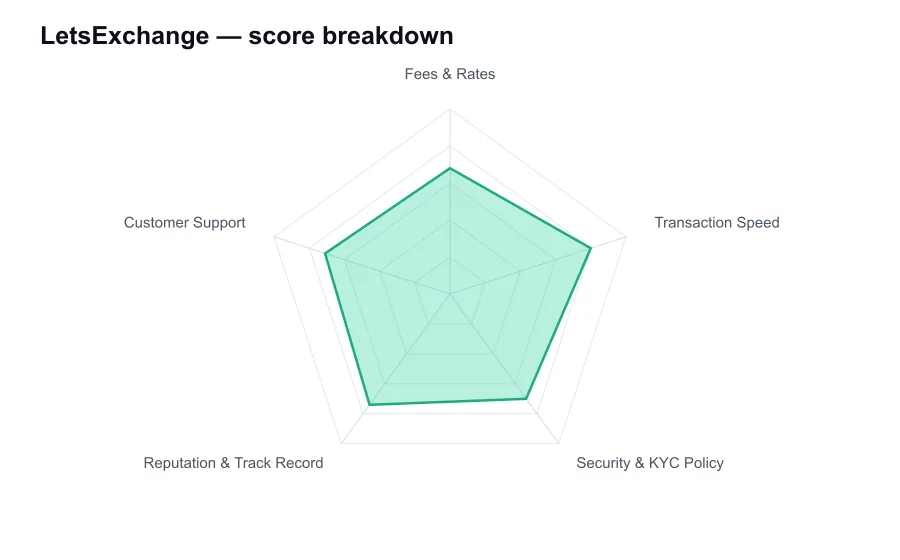
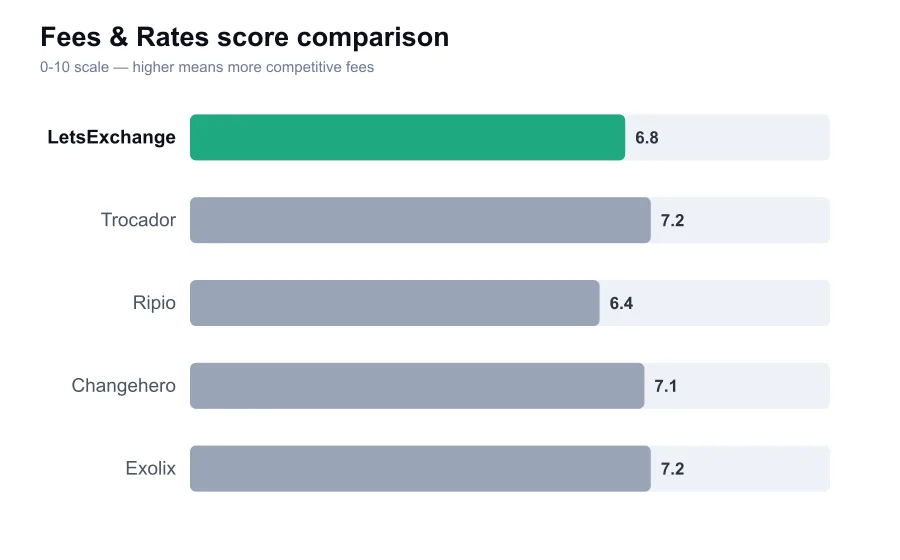
Fees are the area where an informed user needs to slow down. LetsExchange does not work from a simple public maker and taker table because each exchange is quoted individually. The final amount reflects market liquidity, a service margin, and network costs. This model is not inherently deceptive, but it makes a direct comparison essential. The receive amount, not a headline claim about low fees, is the number that matters.
For common pairs such as BTC to USDT, ETH to USDC, or SOL to USDT, LetsExchange is often competitive enough to be convenient. For bigger trades, however, a liquid centralized exchange can be materially cheaper. A trader who already has verified access to Kraken, Coinbase Advanced, Binance, or OKX will usually find better price discovery there. LetsExchange earns its keep when access and speed matter more than squeezing every basis point from execution.
The platform offers both floating-rate and fixed-rate modes for supported pairs. Floating rates can produce a better outcome if the market moves in the user's favor, but they can also leave a customer with less than the initial estimate. Fixed-rate swaps are safer for users who need certainty. There is still a deposit deadline and a required send amount, so fixed does not mean careless. Sending late or underpaying can change the result.
In normal conditions, speed is one of LetsExchange's stronger qualities. A fast chain and a liquid pair may complete shortly after the inbound transaction reaches the required confirmation threshold. Ethereum, Bitcoin, and congested networks are different stories. A service can process an order immediately while the blockchain itself remains slow. Users should also understand that cross-chain swaps involving several liquidity steps are inherently less predictable than a simple same-chain token conversion.
LetsExchange's status page and transaction tracking tools are useful touches. They give customers something concrete to follow instead of forcing them to ask support whether an order exists. That said, tracking does not solve the hardest disputes, such as a delayed partner payout or a transfer that was sent with the wrong memo. Anyone using XRP, XLM, ATOM, or other assets that may require destination information needs to be especially careful.
The service generally allows ordinary crypto swaps without mandatory registration or up-front KYC. That is a legitimate advantage for users who do not want to hand over identity documents simply to exchange assets. Still, LetsExchange has an AML and risk-control framework, and flagged transactions may be paused for review. This is the central caveat of the no-KYC instant exchange category. Privacy is better than at a regulated custodian, but it is not an unconditional guarantee.
On security, LetsExchange benefits from not requiring customers to leave funds sitting in a platform account. Your destination wallet remains under your control. Yet it is not a decentralized protocol. Customers trust LetsExchange and its liquidity network to receive, convert, and forward assets correctly. That is a manageable risk for short-lived swaps, but it should not be treated like a trustless on-chain transaction between smart contracts you have independently verified.
The company has developed a stronger public profile than many smaller swap widgets. Its API and white-label tools have helped it appear across wallets and crypto services, which is meaningful evidence that it is more than a throwaway storefront. It has also been active through several market cycles. Still, its track record should be judged against the standards of an instant exchanger, not those of a publicly accountable, regulated multinational exchange.
Support is available around the clock through chat and ticket-based channels, and the service has a reasonably broad knowledge base. In routine situations, that is enough. The real test is a compliance hold or an exchange that has remained pending beyond expectations. Public feedback suggests that experiences can vary sharply in those cases, which is common in this sector but not something to dismiss. Keep transaction IDs, wallet screenshots, and proof of source ready.
LetsExchange is best for users who value reach. If you need an uncommon asset, a cross-chain route, or an account-free swap from your own wallet, it is one of the more credible places to check. It is less compelling for disciplined active traders, who need detailed fills, limit orders, tax exports, and direct control over execution. Those users should not mistake a broad token catalog for a professional trading environment.
I rate LetsExchange above many anonymous instant-swap sites because it has real product depth, a recognizable market presence, and useful tools around the exchange itself. Its weakness is not functionality. It is the same weakness that shadows the category: opaque all-in pricing and limited control after funds are sent. Compare the quote, use fixed rate for important transfers, and avoid making your first transaction a large one. Within those limits, it is a capable service.