Trocador is an instant crypto exchange aggregator built for users who want to swap assets without opening a conventional trading account. It compares partner exchange offers, lets the user select a route, and sends the destination asset to a wallet address they control. The model resembles services such as SimpleSwap, ChangeNOW, SwapSpace, and BestChange-linked exchangers, but Trocador has carved out a reputation among privacy-conscious users by emphasizing no-account swaps and rate comparison.
The appeal is obvious for a certain kind of crypto user. You can exchange Bitcoin for Monero, Litecoin for USDT, or one altcoin for another without depositing into a custodial trading account and navigating an order book. That is much less intimidating than a centralized exchange for an occasional conversion. It also avoids the habit many people develop of leaving funds sitting on a platform simply because they were already there.
Trocador is not itself a magic pool of liquidity. It routes orders to partner services, which means the quality of a swap depends partly on the selected provider, the asset pair, network conditions, and whether the rate is fixed or floating. The aggregator can make shopping easier, but it cannot remove the underlying execution risk of the market. Users should read the provider name and route details instead of treating every displayed offer as identical.
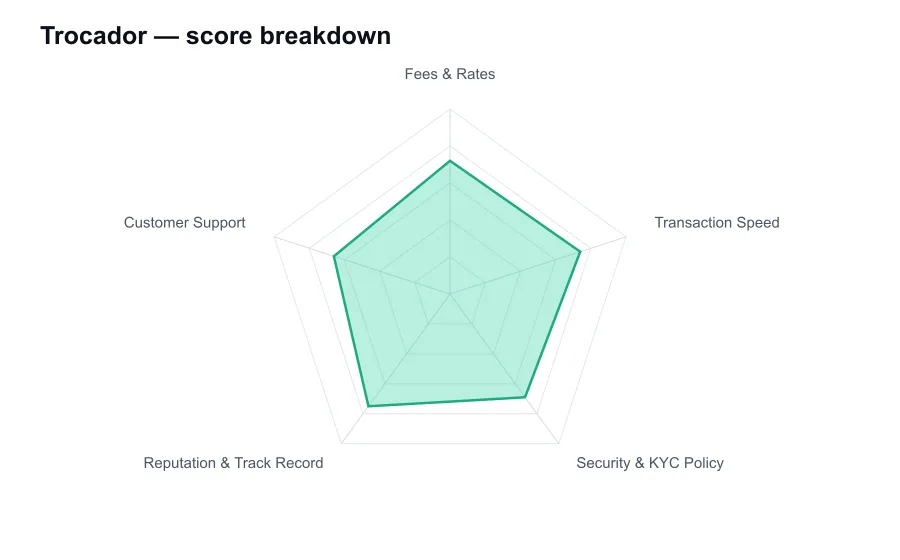
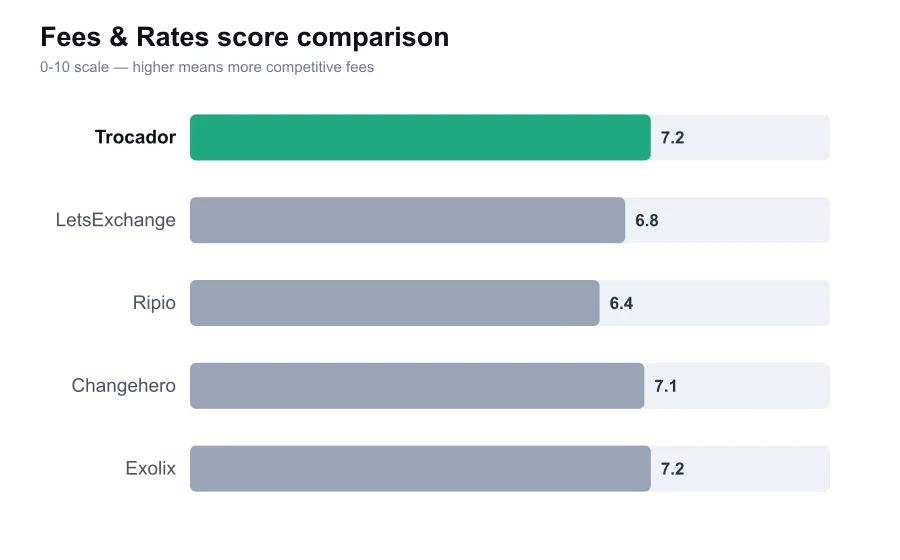
Fees are reasonably understandable if you know where to look. Trocador commonly earns a service fee through the quoted exchange route, and the effective cost can also include the partner’s spread and blockchain network fees. The platform has historically advertised a 0.5% fee model, though the practical number that matters is still the final received amount shown in the quote. A lower advertised fee does not guarantee a lower-cost trade if another provider has a better underlying rate.
This is why Trocador’s comparison interface is useful. For a medium-sized swap, checking several providers in one place can save more than the aggregator fee costs. The value is strongest for users who would otherwise visit multiple instant exchangers manually. It is weaker for liquid pairs that can be traded cheaply on Kraken, Binance, Coinbase Advanced, or a decentralized exchange. If you already have access to a deep order book, an instant exchanger is usually paying for convenience.
Fixed-rate offers deserve a premium when the market is moving quickly. They reduce the unpleasant surprise of sending funds and receiving less because the price changed during confirmation. Floating-rate offers can be cheaper on paper but expose the sender to market movement and occasionally to partner-specific execution variability. For Bitcoin deposits, where confirmations can take time, I generally prefer a fixed quote if the difference is modest and the provider has a solid record.
Speed is one of Trocador’s strengths, with a necessary caveat. The platform itself can create and route an order quickly. The actual completion time depends on the deposit chain, the partner exchanger, required confirmations, liquidity, and the destination network. A swap involving fast networks can finish in minutes. A Bitcoin or privacy-coin transaction can take longer, and a partner’s risk system can add an unpredictable delay.
Trocador does a good job of making the process legible compared with many barebones swap sites. You receive an order page, deposit address, expected amount, and status information. Keep that page and transaction ID until the destination funds arrive. If something goes wrong, those details are what support needs. Sending from an exchange can create extra trouble because exchanges may batch withdrawals or omit payment IDs and memos where those are required.
The privacy stance is a real differentiator. Trocador does not normally require users to create an account or complete standard KYC for an ordinary swap. That is attractive to people who do not want every conversion tied to a centralized customer profile. It should not be mistaken for a promise that no partner will ever request information. Because Trocador routes through third parties, a selected provider can flag an order under its own compliance policies.
That partner dependence is the central security limitation. Trocador reduces the time your money spends in a service’s control, and it lets you send the output directly to your own wallet. Those are meaningful benefits. But during the swap, a third-party provider is still handling the execution. If a partner pauses an order, requests compliance information, or has an operational failure, Trocador can assist but cannot always force instant resolution.
The platform has a stronger reputation than many anonymous instant exchange clones. It has been known in the exchange-comparison community for years, has a recognizable operating model, and offers features such as rate comparison and partner selection rather than simply presenting one opaque quote. Its reputation is still not equivalent to a regulated exchange with audited financial statements and a large compliance organization. Users need to understand that distinction before choosing privacy and convenience over formal recourse.
I like Trocador most as a tool for purposeful swaps, not a place to park money. It is especially useful for someone who holds assets in a self-custody wallet and wants to convert them without creating another exchange account. It is less suitable for recurring dollar-cost averaging, fiat purchases, leveraged trading, or professional-sized transactions. A specialist tool is often safest when used only for the job it was built to do.
Support is better judged by the quality of order assistance than by marketing claims about availability. Trocador provides support channels and order-level information, but resolution can still require communication with the underlying exchange partner. That means a straightforward missing transaction may be handled quickly, while a compliance hold can become slower and more frustrating. Users should choose established partners where possible and avoid complicated routes for urgent payments.
My final take is positive, with boundaries. Trocador is one of the more useful no-account exchange aggregators because it makes partner comparison visible and respects the self-custody workflow. It is not the cheapest way to trade liquid assets, and it cannot eliminate the counterparty risk introduced by its providers. For modest to medium wallet-to-wallet swaps, particularly where privacy and convenience matter, it is a credible option. For large sums, compare routes carefully and consider splitting the trade.