Changelly is one of the older and better-known names in instant crypto exchange. Founded in 2015, it helped popularize the idea that users could exchange coins from their own wallets without studying a trading terminal. The product has grown beyond that original proposition. Alongside its familiar swap widget, Changelly offers fiat purchases through payment partners and a Changelly PRO exchange for users who want order books. That breadth gives it reach, but also makes its pricing and identity policies more complicated than the simple homepage suggests.
The core instant-exchange workflow is still easy. Pick the assets, choose floating or fixed rate, enter a payout address, and send the deposit. Changelly then executes the conversion through liquidity sources and delivers the destination asset. It supports a large catalog of coins, tokens and networks, which is one reason wallets and third-party sites have integrated its services over the years. For obscure conversions that a conventional exchange does not list directly, its routing can be genuinely convenient.
The company is not a decentralized exchange. It is an intermediary, even if it does not provide a permanent hosted balance for the basic swap product. Funds are exposed to Changelly's execution process from the moment they are deposited until the payout is made. That distinction is important because customers sometimes read "non-custodial" as "trustless." It is not trustless. You retain control before sending and after receiving, but not during the transaction.
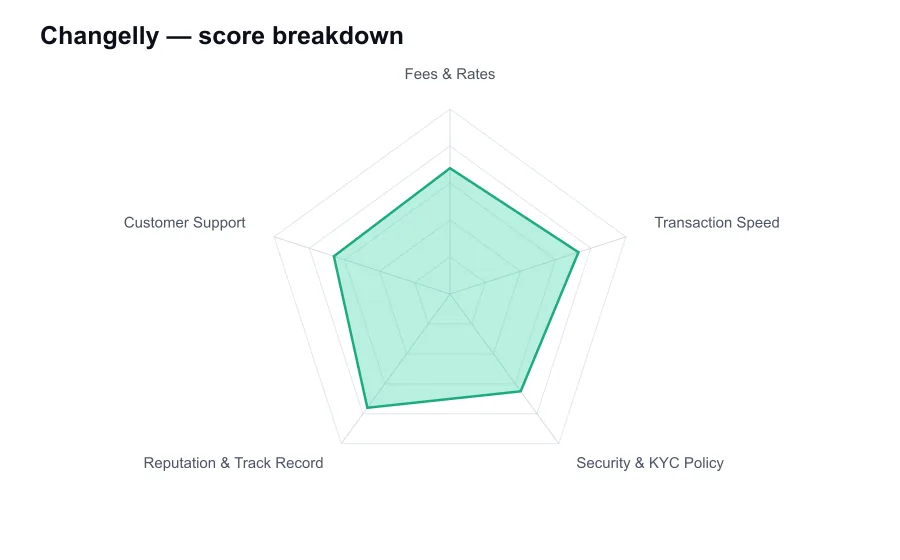
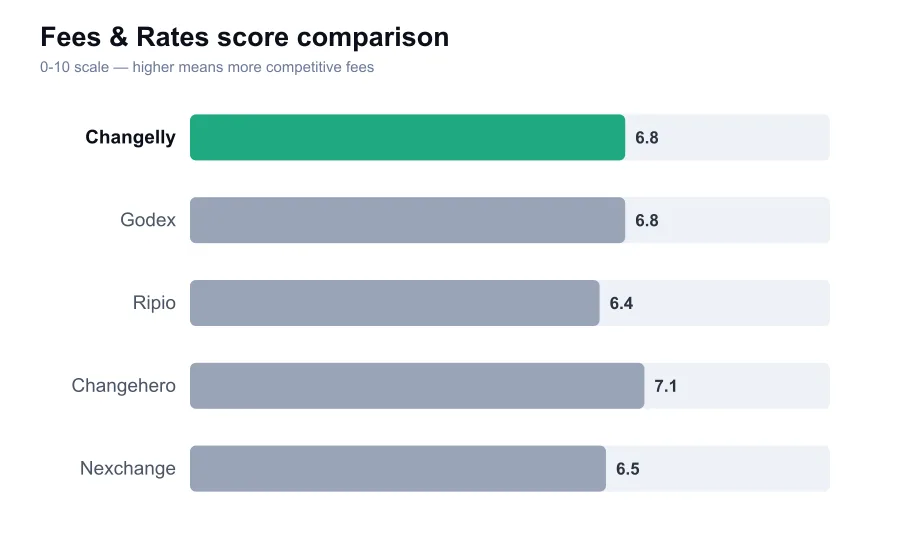
Changelly's published floating-exchange fee has long been associated with a 0.25% service fee. Compared with services quoting 0.5%, that sounds attractive. It is also incomplete. The final rate can include market spread, liquidity costs and network charges, while the route required for a given pair may involve multiple conversions. On a major pair, the effective cost may be quite reasonable. On a less liquid asset, the output can still be meaningfully worse than the headline percentage implies.
This is not a criticism unique to Changelly. Instant exchange providers sell convenience, and convenience is priced through the quote. But Changelly's brand recognition sometimes leads users to assume it will automatically be the best rate. It often is not. ChangeNOW, ChangeHero, StealthEX and SimpleSwap can all produce different results for the exact same transaction. A thirty-second comparison can save more than the advertised fee difference, especially if the trade is worth several thousand dollars.
Fixed-rate transactions are available for selected routes and can be useful during fast markets. The fixed quote normally carries a visible premium because Changelly is taking price risk while your deposit moves through the blockchain. That is a fair trade for someone who needs an exact output amount to repay a loan, meet a wallet minimum, or buy a specified asset. It is less compelling for tiny swaps. Floating rate is cheaper in calm conditions, but the final payout can move noticeably while a Bitcoin deposit waits for confirmations.
Fiat purchases are where users need to slow down and read. Changelly's card and bank purchase options are typically supplied by external payment partners, not by Changelly acting as a simple native card processor. Fees, exchange rates, country availability and KYC requirements can differ sharply by provider. Card purchases can be expensive compared with a bank transfer to a regulated exchange. They are best treated as an emergency convenience feature, not the default route for building a position.
Speed on the core crypto swap product is often decent. A fast-chain transaction may finish in a few minutes once the deposit is recognized. Bitcoin and Ethereum routes are less predictable, as they depend on confirmation policy and current network conditions. Changelly's estimate is helpful as a rough expectation, not a promise. A customer who has selected a low miner fee at the sending wallet can delay the entire sequence before Changelly has any ability to act.
The more serious delays come from liquidity and compliance. Changelly may need to obtain the destination asset through partners, and a highly volatile market can complicate that process. Its security and AML systems may also put a transaction under review. From the customer's perspective, this is where the cheerful instant-swap model becomes less attractive. A trade that needs documents after funds are sent is no longer quick or private, and support resolution can become the defining part of the experience.
Changelly does not impose routine account verification for every basic crypto swap, but it operates an AML and KYC framework and can request documents. Depending on the case, users may be asked for identity information, source-of-funds evidence, or details about the transaction. Those controls reflect legal and risk-management obligations, and established providers would be reckless to have none. Still, the policy deserves more prominence than marketing slogans about simple anonymous swaps usually receive.
The brand has faced its share of public criticism around compliance holds and blocked transactions. Some complaints will naturally come from users whose funds or counterparties raised legitimate red flags. Others show a customer experience problem: people did not understand that screening could interrupt a supposedly registration-free service. Changelly has also attracted attention from security researchers and journalists for disputes connected to stolen funds and tracing requests. That does not make it uniquely unsafe, but it means the reputation is more contested than the polished interface implies.
There is a positive side to being an older company. Changelly has a long operating record, partnerships, wallet integrations and a large user base. It is far less anonymous than a newly launched swap page with no history. The Changelly PRO product adds a conventional exchange option, though it should be evaluated separately because it has different account, trading and custody characteristics. The main instant exchange product remains the better-known offering and should stand on its own merits.
Security for the user starts with avoiding the wrong site. Changelly is a recognizable brand, which also makes it a target for phishing adverts and fake support accounts. Go directly to the official domain, verify the destination address on a hardware wallet if possible, and preserve screenshots of the quote and transaction ID. A blockchain transfer is final. Neither Changelly nor any other service can make a wrong-chain stablecoin deposit painless just because the user meant well.
Support is offered around the clock through chat and email, and the help center covers basic order states, limits and common deposit errors. For a standard question, Changelly has the resources of a larger brand and often responds quickly. The more difficult question is whether support has the authority and clarity to resolve an exceptional case. Public complaints suggest that compliance-related situations can feel slow and procedural. That is a weakness, even if the underlying review is legitimate.
Compared with ChangeHero, Changelly offers more brand recognition and a larger ecosystem, but that does not automatically translate into superior quotes. Compared with ChangeNOW, it has a longer history and a more developed exchange-adjacent product family, while ChangeNOW can feel more focused on the pure swap experience. Compared with Kraken or Coinbase, Changelly is faster to start and less demanding for a small crypto conversion, but less transparent for deep pricing and dispute handling. Different tools, different compromises.
Changelly works best for a user who values asset coverage and familiar branding, has a self-custody wallet ready, and is willing to compare rates before sending. I would not use it blindly for a large conversion simply because the name is well known. A small test transaction is wise on an unfamiliar route, particularly with token networks. For fiat buying, I would almost always examine the total card cost against a bank-funded regulated exchange first.
My final take is that Changelly remains a legitimate and useful instant exchange, but it is no longer enough to call it convenient and stop there. The service has earned its place through longevity and integration, yet its rate model is quote-driven and its conditional KYC process can be jarring. It is a good tool for specific wallet-to-wallet conversions, particularly where asset availability matters. It is not a substitute for a low-fee trading venue, and it is not the right choice for users who need certainty about compliance treatment before depositing.