Allswap presents itself in the crowded instant crypto exchange segment, a market full of services that promise a quick conversion without the complexity of a trading terminal. The basic proposition is familiar: choose a pair, submit a destination address, send the deposit, and receive the converted asset. That can be a useful product for someone moving between chains or consolidating a small portfolio. It is not, however, a category where a polished swap form should be confused with a proven financial institution.
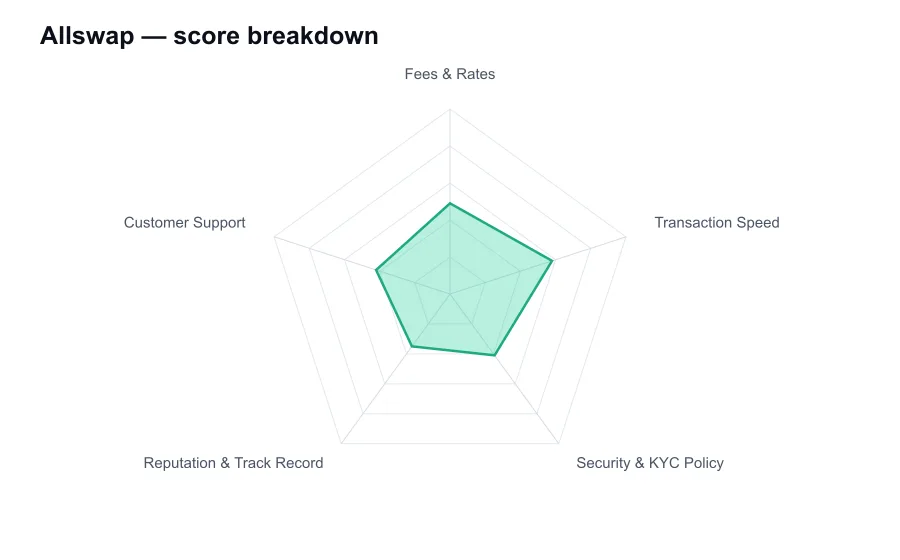
The biggest issue with Allswap is public depth. It does not have the broad, independently documented operating history of names such as Changelly, ChangeNOW, Kraken, or Coinbase. That does not settle the question of whether an individual order will work. It does mean that a user has less evidence to rely on if something unusual happens, such as a delayed payout, a compliance review, an incorrect network selection, or a disagreement about the rate.
A responsible review cannot fill those gaps with certainty. I would want to see readily available operator information, detailed terms, a clear privacy notice, a support escalation route, and external evidence that the service has handled a substantial volume of orders over time. If those materials are incomplete or difficult to find, that is a real product weakness. Crypto is already unforgiving because transfers are irreversible. Customers should not have to investigate the basics of the counterparty after they have sent funds.
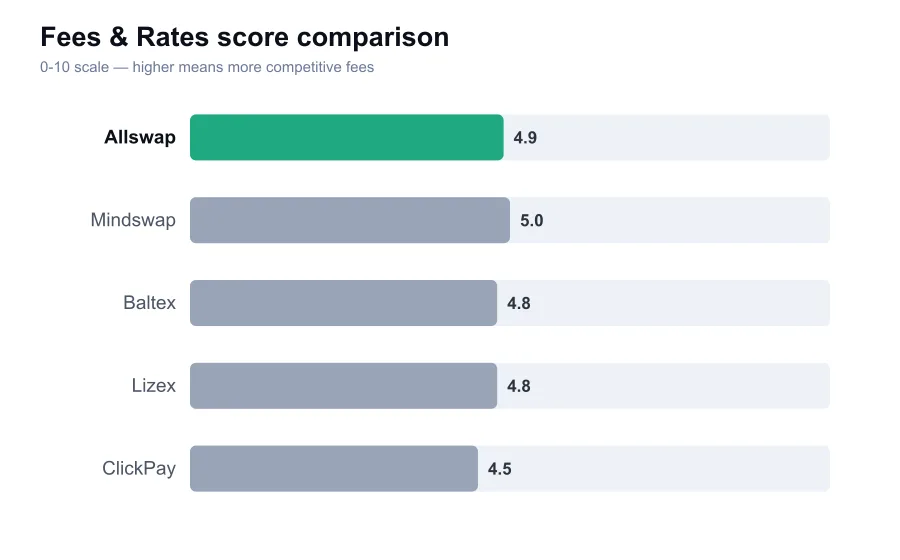
Allswap uses the quote driven model common to instant exchanges. Rather than charging a plainly posted 0.10 percent or 0.25 percent trading fee against an order book, it shows the customer an expected output amount. The rate can include a liquidity spread, provider margin, and relevant network costs. This arrangement is convenient, but it creates an information imbalance. The customer knows what they will receive, or approximately receive, but not necessarily how much of the difference is fee versus market price movement.
That makes quote shopping nonnegotiable. Open two or three established alternatives and compare the final receive amount for exactly the same input, network, and time. Don't compare token prices shown in a search result. Compare the actual amount delivered to your address after every cost. If Allswap is consistently competitive, it has made a practical case for itself. If it is materially worse, there is no special feature in the basic swap model that justifies paying a large premium.
Floating rates need extra care. With a floating transaction, the final amount may depend on the market rate available after your deposit confirms. During a quiet market that difference can be negligible. During a sharp Bitcoin move or a volatile altcoin rally, it can be significant. A fixed rate order can reduce the uncertainty, but only if the service clearly states the time window, the exact required deposit amount, and the consequences of a late or underpaid transfer.
Speed claims should be read through the lens of blockchain mechanics. Allswap can only act after it detects the deposit and receives the number of confirmations its risk rules require. Ethereum and EVM network congestion, Bitcoin confirmation delays, maintenance at a liquidity partner, or an unsupported token contract can all slow the process. A service can be responsive without being instant, and users should be wary of marketing that treats these external delays as invisible.
For ordinary, liquid pairs, an instant exchange may deliver in a matter of minutes once the deposit is confirmed. That is useful for a small portfolio adjustment. It is still not dependable enough for a payment deadline, liquidation event, or a transfer needed to meet a margin requirement elsewhere. If the timing matters, use a venue where you already hold funds, understand the withdrawal limits, and can execute the trade directly. An intermediary swap is an unnecessary point of failure.
The relative safety benefit of a noncustodial flow is real but narrow. Allswap does not need to hold a standing customer balance if it sends the output directly to the provided wallet. That lowers the risk of leaving assets on an exchange for months. It does not eliminate counterparty exposure during the swap. For that interval, the customer has transferred crypto to an address controlled by the service or one of its partners. The operator's security, liquidity, and procedures suddenly matter a great deal.
Users should also expect transaction monitoring even if the service does not require a traditional account opening ceremony. No KYC at signup is not a promise of no verification ever. Blockchain analytics alerts, sanctions concerns, unusually large size, or payment source issues can lead to a hold and a request for documents. There is nothing unusual about that in the current regulatory environment. The concern is whether Allswap explains its policy plainly before a user sends an irreversible deposit.
For a small provider, transparency is an important security control in itself. I want to know which entity processes data, what happens to a transaction under review, how long records are retained, and whether there is a defined refund route if a swap cannot be completed. Vague statements about security are not a substitute for those answers. Two factor authentication is useful on account based exchanges, but it is largely irrelevant if the real decision is whether to send crypto into an opaque one time order flow.
Allswap's support experience has to carry more weight because there is little institutional padding around it. A competent team should be able to tell a customer whether a deposit was received, how many confirmations remain, whether a payout has been broadcast, and why an order is under review. Support should never ask a customer to send an extra payment to unlock a completed transaction. That is a serious warning sign with any crypto service, not just this one.
I would use Allswap only with disciplined limits. Send a small test amount. Copy the order ID and deposit address from the active order page, not from an old browser tab. Save the transaction hash. Wait until the first transfer is complete before scaling up. Those habits are sensible everywhere, but they are especially important where the public reputation is not deep enough to compensate for mistakes or ambiguity.
My opinion is that Allswap may be functional for a low value, uncomplicated swap, but it has not earned the status of a default provider. There are too many established alternatives with clearer reputations, broader documentation, and more public user history. Until Allswap offers stronger transparency and demonstrates durable service through time, I would treat it as a niche option for experienced users rather than a recommendation for the general public.