Lizex is a far less established name than Kingex, LetsExchange, or Liquity, and that fact should shape how a prospective customer approaches it. It appears in the crowded instant-exchange market, where many services offer a familiar promise: quick crypto conversion, a wide token menu, and little or no account friction. The problem is not that smaller providers are automatically unsafe. The problem is that trust is harder to earn when public history and independent scrutiny are thin.
A new or lightly documented exchange can look polished. That tells you very little about execution quality, reserves, legal identity, or dispute handling. Lizex should therefore be assessed from the customer's point of view as a higher-risk counterparty until it has demonstrated otherwise. A clean interface and attractive quote are not substitutes for years of operational history, transparent ownership, reliable community feedback, and a visible compliance framework.
The basic instant-exchange model can be useful. Users choose an asset pair, enter a receiving address, send funds, and rely on the provider to complete the conversion. It removes the need to open an account at a traditional exchange. That convenience is real, especially for a user making an occasional wallet-to-wallet conversion. But with Lizex, the lack of a deep public track record makes the model less attractive than it is with a recognized competitor.
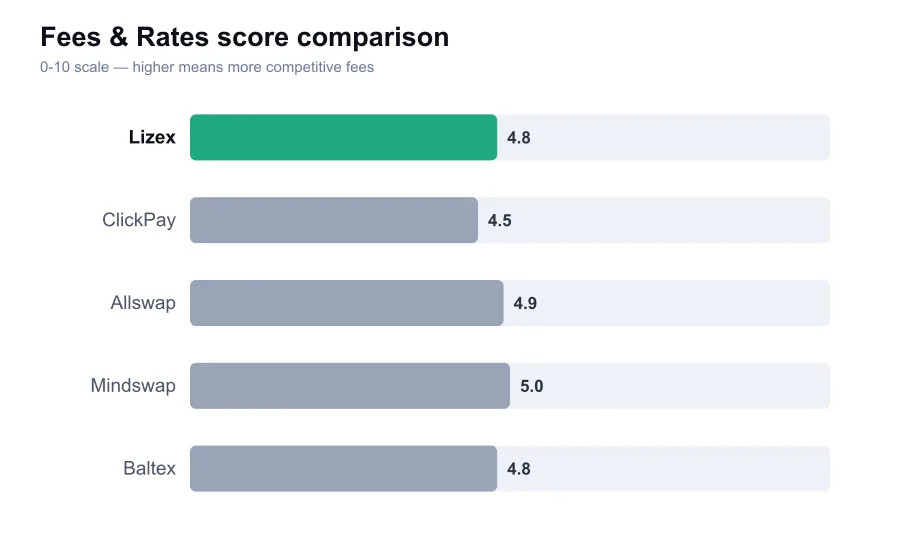
Fees should be approached with particular caution. If Lizex presents a quoted output rather than a detailed public fee schedule, the user cannot assume a competitive rate from a low-fee marketing claim. The quote can include spread, liquidity costs, and network charges. That is common practice, but a small provider has less reason to receive blind trust. Compare its final payout against at least two established alternatives before sending funds.
For a small test transaction, even a slightly weak rate may be acceptable if the service offers a route that is otherwise unavailable. For a large transaction, it is not. Major exchanges and mature swap providers have more visible liquidity sources, stronger reputational incentives, and clearer escalation paths. A user moving several thousand dollars or more should not let a marginally better advertised quote outweigh the value of proven operations.
Speed claims in this market also need translating. The service can only pay out after it sees and processes the incoming blockchain transaction. Bitcoin, Ethereum, and smaller networks each have their own confirmation behavior, and congestion can change the timeline quickly. A provider may call itself instant while a customer waits 20 minutes or longer for chain settlement. That is not always service failure, but transparent status information makes a major difference.
With Lizex, I would not rely on promotional turnaround estimates until I had completed a small transaction successfully. Check whether a transaction page shows deposit detection, confirmations, processing, and payout hash. A proper payout transaction ID is the minimum evidence that funds have left the provider. If the site does not provide clear tracking or if status language is vague, that is a reason to stop and use a better documented service.
Security is where the gap between a known provider and an obscure one becomes most important. An instant exchange may call itself noncustodial because it does not maintain customer balances. That does not eliminate counterparty exposure. During the exchange, customers send assets to an address controlled by the service or its partners. If anything goes wrong, the user needs responsive support and a credible operator. Those are precisely the areas that are hardest to verify with Lizex.
No-KYC access is often presented as a benefit, and for users concerned with unnecessary data collection, it can be. Yet any provider operating in the crypto market may apply sanctions screening, transaction monitoring, or a risk-based compliance review. If Lizex permits ordinary exchanges without registration, users should still read its terms and AML policy carefully. A service that can request documents after receiving funds needs a clearly explained process and realistic response standards.
The practical security rules are simple. Never use an unfamiliar exchange from a sponsored search result without verifying the domain independently. Do not connect a wallet that holds your long-term assets if a simple send transaction will do. Confirm every address and network. Keep screenshots of the quote and transaction page. Most importantly, do not make Lizex your first choice for a large or time-critical transfer until its reliability has been personally tested.
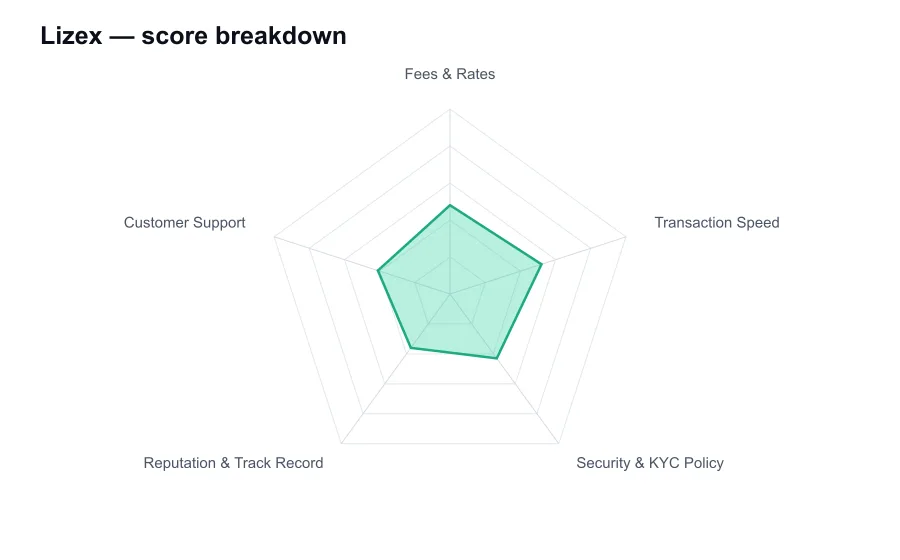
Public reputation is Lizex's weakest area, not because every small provider is disreputable, but because limited independent evidence offers limited grounds for confidence. It does not have the market visibility of LetsExchange, the established instant-swap profile of Kingex, or the extensively examined codebase of Liquity. That makes a high reputation score impossible to justify. A reviewer should not fill missing evidence with optimism.
Customer support is similarly difficult to rate highly without a robust record of resolved cases, multiple public channels, and transparent operating information. A contact form or chat widget is not enough by itself. The meaningful question is whether a customer can reach a competent person during a delayed payout, an incorrect deposit, or a compliance hold. Until that is independently demonstrated at scale, the prudent assumption is that support may be limited.
There are legitimate reasons a user might still try Lizex. Perhaps it supports a specific asset route, offers a useful rate on a small transaction, or fits a user who wants an account-light exchange flow. Those are narrow reasons, not grounds for making it a core crypto service. The right approach is to treat it as experimental infrastructure and limit exposure accordingly.
My recommendation is conservative. Lizex may work as advertised for a small, nonurgent swap, but it does not currently offer enough publicly verifiable weight to compete confidently with more established names. The potential savings from a favorable quote do not compensate for weak transparency on a large transfer. Use a tiny test amount, document the process, and move on if anything looks unclear. Trust should follow evidence, not marketing.