ClickPay is a difficult service to place beside ordinary crypto exchanges because the name has been used by more than one payments business, while the better known products attached to it are payment acceptance tools rather than open spot trading venues. That distinction matters. A reader looking to buy Bitcoin, trade perpetuals, or move coins between a wallet and an exchange should not treat ClickPay as a Binance, Kraken, Coinbase, or Bitstamp alternative. Its relevance to crypto is normally at checkout, where a merchant may offer digital asset payment options through a broader payment stack.
That positioning can be useful. A merchant doesn't always need a trading terminal, an order book, or a catalogue of obscure tokens. They need a customer to pay, a receipt to be generated, and funds to arrive in a settlement account without an accounting headache. ClickPay's appeal is that it aims at that mundane but important part of commerce. The problem is that public information under the ClickPay name is fragmented enough that prospective users must verify the exact legal entity, country, supported currencies, and acquiring partner before sending any money.
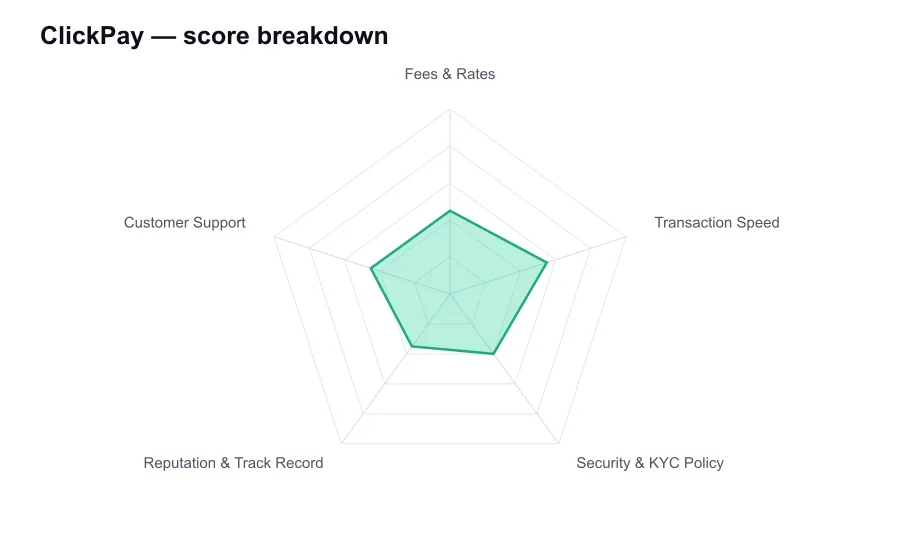
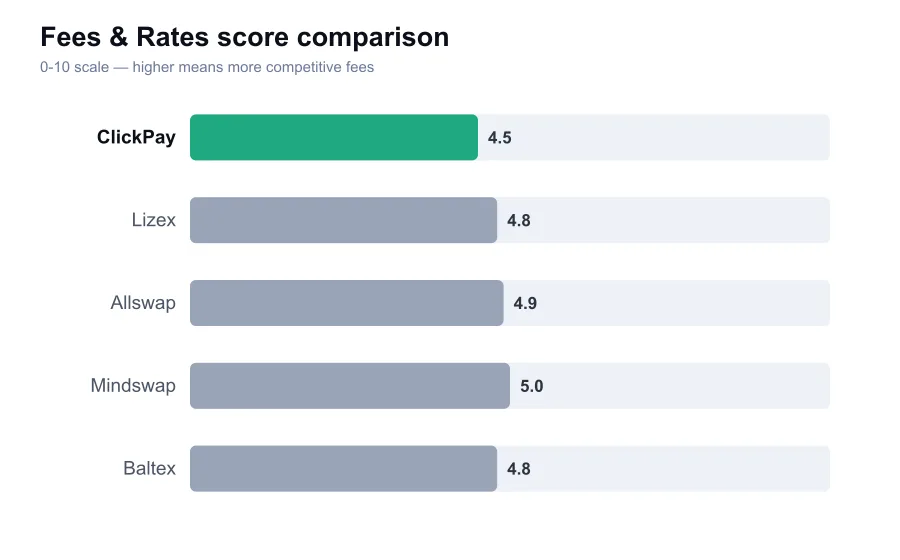
Pricing is the first place where that lack of clarity becomes frustrating. Well established payment companies publish card rates, payout fees, chargeback charges, currency conversion margins, and contract conditions in plain sight. With ClickPay, pricing often appears to be quote based or dependent on an individual merchant arrangement. That is normal for higher volume payment processing, but it is not consumer friendly for smaller businesses trying to compare providers. A percentage that looks cheap can become expensive once foreign exchange, rolling reserves, gateway charges, and withdrawal costs appear.
I would not accept vague assurances about low fees here. Ask for the effective rate on a domestic card, an international card, a cryptocurrency payment, a refund, and a cross border settlement. Also ask whether crypto is converted instantly to fiat, held in a digital asset balance, or passed through a third party processor. Those are very different services with very different risks. A 1 percent processing quote is not a 1 percent all in cost if the conversion spread alone absorbs another meaningful slice of the transaction.
For buyers, the fee picture can be even less transparent. A checkout page may show a final price without explaining the exchange rate source, network fee policy, or the time for which a quote is locked. That is not necessarily deceptive, but it leaves little room for an informed decision. Crypto payments can fail because a network fee was set too low, a payment arrived after a quote expired, or the wrong network was used. A capable checkout provider anticipates those situations. A generic payment page does not always do so.
Speed depends less on ClickPay's interface than on the rails behind it. Card authorizations can appear almost instantly, but merchant settlement may still take business days. A blockchain payment can be broadcast in seconds and remain economically unsettled until the required confirmations arrive. Bitcoin can take far longer than a stablecoin transfer on a fast chain, while a congested network can turn a supposedly quick payment into an anxious wait. Marketing language around instant payments should be read as authorization speed, not guaranteed access to cleared money.
For merchants, a realistic expectation is same day visibility into a successful payment and slower settlement according to the acquiring agreement, cut off times, banking holidays, and risk review. That is not unusual. Stripe, Adyen, and many regional processors work on similar settlement logic. What separates a strong provider is whether it documents that logic well and gives a proper dashboard trail from authorization to payout. ClickPay's public footprint does not provide enough consistent evidence to rank it with the most transparent operators on that standard.
Security is where I become more demanding, not less. A payment provider touches customer data, merchant balances, refund rights, and sometimes digital asset addresses. It should clearly identify the operating company, regulatory permissions where relevant, data protection approach, account security controls, and dispute process. Two factor authentication, role based staff access, withdrawal controls, and sensible transaction alerts should be baseline expectations. If a representative cannot explain these basics in writing, walk away.
KYC is also not a minor detail. Legitimate payment services may require identity checks, business registration documents, beneficial ownership information, proof of address, invoices, and source of funds evidence. That can feel intrusive, but it is normal in regulated payments. The warning sign is not that ClickPay might ask for verification. The warning sign would be an unclear policy, an abrupt freeze with no documented escalation route, or a request for sensitive documents through an unofficial chat account or personal email address.
ClickPay does not have the long, independently documented crypto market record that lets a reviewer confidently assess reserves, custody practice, security incidents, or operational resilience. That does not prove the service is unsafe. It does mean its reputation score has to stay modest. A payments provider earns trust through years of clear public documentation, named leadership, consistent support, audited compliance where applicable, and a visible pattern of resolving disputes. I cannot find enough dependable evidence to credit ClickPay with that depth of track record.
The lack of a clean market identity makes comparison hard. Coinbase Commerce, BitPay, CoinGate, and NOWPayments are recognizably crypto payment products with clearer public descriptions of how merchants accept and settle crypto. Traditional providers such as Stripe and Adyen are equally clear about being payment infrastructure rather than crypto exchanges. ClickPay sits in a fuzzier space. Fuzziness is manageable for a small test transaction. It is a poor basis for routing meaningful revenue.
Customer support should be judged before an account holds a balance, not after. Send a detailed presales question about settlement currency, chargebacks, refunds, crypto conversion, and account verification. A serious provider should answer directly, not just send a sales brochure. It should identify support hours and offer a ticket record for financial issues. Telephone availability can help, but a written case trail is more valuable if there is a disagreement about a payout.
Merchants should also test the operational side. Create a low value payment, issue a refund, download a transaction report, and check whether the reconciliation fields match what an accountant needs. A beautiful checkout page is not much use if the payout ledger is unclear. The service's real quality shows up in exception handling, especially duplicate payments, partial refunds, expired invoices, and failed blockchain transfers. Those cases are where smaller payment brands tend to show their limits.
For a customer simply trying to acquire crypto, I would not choose ClickPay without knowing exactly which regulated partner is executing the purchase and holding the funds. A dedicated exchange with transparent trading fees, published asset support, meaningful security controls, and a visible history is usually the better route. ClickPay may be part of a merchant payment flow, but that is not the same job as being a reliable retail exchange.
My view is cautious rather than hostile. ClickPay could be suitable as a narrowly scoped payment option for a merchant that has completed legal, technical, and pricing due diligence. It has not earned enough public transparency to deserve blind trust with large balances or critical business cash flow. Start small, obtain the full contract, and verify the company behind the specific version of the service you are being offered. If those basics cannot be established quickly, choose a better documented processor.