Nexchange is an instant cryptocurrency exchange service and API provider built for direct conversions rather than active trading. Its product is closer to a checkout flow than to a full exchange terminal. A user selects two assets, enters a destination address, sends the deposit, and receives the converted asset. Developers can use its API to build similar conversion functionality into wallets, apps, and payment flows.
That positioning gives Nexchange a practical niche. It is useful when a user wants to convert assets without opening a custodial trading account, navigating an order book, or holding a balance on a platform. It is less attractive for traders who need charting, limit orders, deep execution data, or the lowest possible price. Nexchange sells simplicity and integration convenience, not professional-market infrastructure.
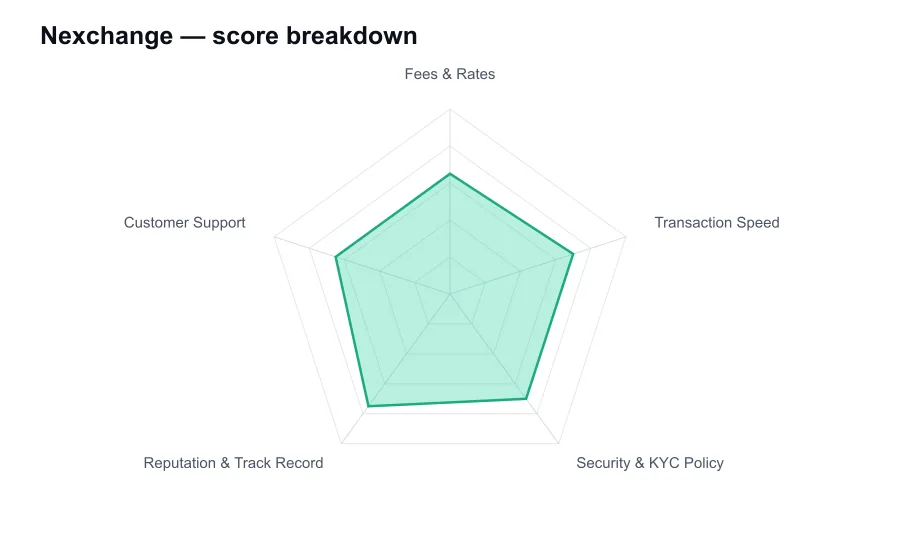
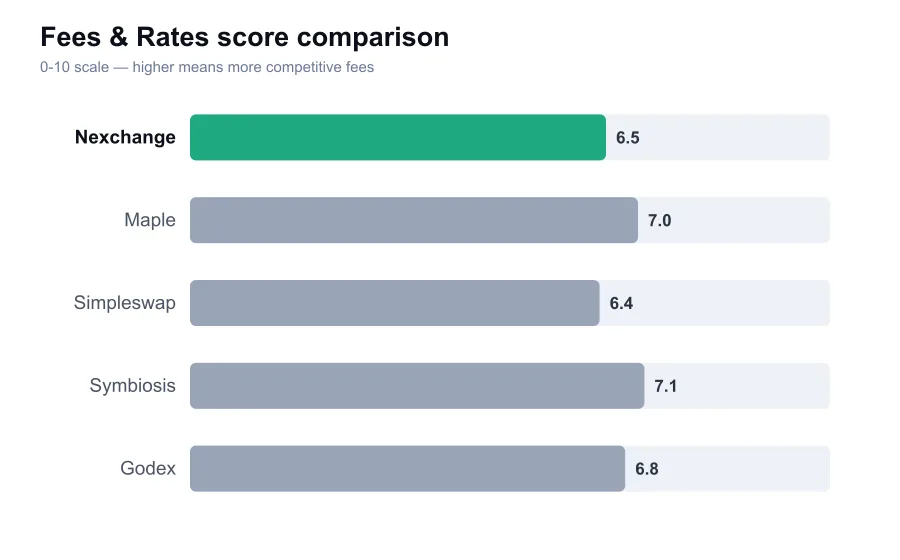
Its fees should be judged from the quote, not from a single headline number. Instant exchangers commonly bundle provider margin, liquidity costs, and network-fee estimates into the exchange rate. Nexchange has historically described floating and fixed-rate exchange options, and the distinction matters. A floating rate can improve or worsen while the deposit confirms. A fixed rate usually costs a little more for certainty, but it is often the better option for a payment or budgeted conversion.
The final received amount is the figure that counts. Before sending, compare Nexchange's quote with ChangeNOW, StealthEX, SimpleSwap, and a centralized exchange if account access is not a problem. The gap may be small for liquid pairs, but it can widen on low-liquidity assets or during volatility. It is reasonable to pay a modest premium for a clean one-off swap. It is not reasonable to ignore a large spread simply because the interface is convenient.
Network fees also complicate comparisons. Bitcoin, Ethereum, and token transfers can have very different costs depending on congestion, and a quote can account for this in ways that are not obvious to a casual user. Sending a tiny amount can be uneconomic on expensive networks. Users should inspect minimum limits, estimated output, and the exact network selected, especially for assets that exist on more than one chain.
Transaction speed is generally good for uncomplicated routes, but the word instant has limits. Nexchange must receive the deposit, wait for sufficient confirmations, obtain or allocate the output asset, and broadcast the payout. Fast chains can produce a quick result. Bitcoin deposits, congested Ethereum transactions, and routes requiring additional liquidity sourcing can take substantially longer. The status page and transaction identifier are useful, but they are not a substitute for patience during confirmation windows.
A common user error is sending the wrong asset, network, or amount. An instant exchange cannot always recover such a transfer, especially if the deposit was made to an address or chain the service does not support. Minimum amounts matter too. Deposits below the stated threshold may not cover network and processing costs. Test transactions are sensible for unfamiliar assets, and they are mandatory in spirit for large amounts.
Nexchange is noncustodial only in the practical, transaction-by-transaction sense. It does not require users to maintain a funded account balance, which reduces exposure to a large centralized hot wallet. During an exchange, however, it takes control of the deposited funds and depends on internal systems and liquidity partners to deliver the payout. That is less custody risk than leaving assets on an exchange indefinitely, but it is not trustless settlement.
KYC policy requires a realistic reading. Services in this category often allow ordinary conversions without account creation or upfront identity checks. They can still use compliance monitoring and may request information if a transaction triggers risk controls or comes through a regulated liquidity partner. Users who require guaranteed anonymity should not rely on marketing shorthand. A no-registration flow is not a promise that no transaction will ever be reviewed.
For security, Nexchange benefits from a relatively clear, long-running identity as a crypto exchange API and service. It has been known in the industry for years, particularly among integration partners, which is more reassuring than a recently created anonymous swap page. But it is not a bank, and users should not send funds based on brand recognition alone. Verify the website, secure the receiving wallet, and retain every exchange reference and transaction hash.
Its reputation is respectable in the instant-exchange category, though not at the level of the largest global retail brands. Nexchange has a more durable public presence than many small swap sites and a recognizable business-to-business angle through its API. That said, user experiences in this sector often depend on individual routes and blockchain conditions. A smooth stablecoin swap does not guarantee that every obscure asset pair will perform equally well.
Support is important because a swap has several moving parts and errors cannot simply be reversed. Nexchange provides support channels and exchange tracking, but users should arrive with usable evidence: the order ID, sending transaction hash, input amount, deposit address, and destination address. A vague message saying that funds have not arrived will slow the process. Good support can investigate a traceable problem, but it cannot fix a wallet address typo after settlement.
For API customers, the service is more interesting than it is for a casual retail user. A wallet or application can use Nexchange to offer conversions without building direct liquidity relationships for every supported asset. That convenience has value, but developers should test error handling, quote expiry, rate changes, webhook behavior, and compliance edge cases. The integration layer should never assume every quote will settle identically under network stress.
Nexchange is a sensible choice for straightforward, medium-sized swaps where account-free convenience matters and the user has compared the payout. I would not use it for a large conversion that absolutely requires the tightest execution, nor for a transaction with a hard deadline. A liquid centralized exchange still wins on price discovery and trading tools. Nexchange wins on friction reduction.
My judgment is positive but practical. The service has a credible place in the instant-exchange market, particularly because its API history gives it more substance than a generic swap front end. Its pricing needs to be checked quote by quote, and its support model cannot eliminate blockchain mistakes or compliance reviews. For routine wallet-to-wallet conversions, it is a capable option. For professional trading or maximum certainty, choose a venue built for those jobs.