SimpleSwap is one of the better-known instant cryptocurrency exchange services, built for users who want to convert one asset into another without learning a traditional trading terminal. It does not try to be a full spot exchange with an order book, perpetual futures, margin accounts, or institutional custody. Instead, it asks for a pair, an amount, and a destination address, then routes the trade through its liquidity arrangements. That stripped-down proposition has real appeal for wallet users, although it comes with trade-offs that are easy to miss if you focus only on the word simple.
The company has been active since 2018 and supports a large selection of coins and tokens, including many assets that are awkward to find on highly regulated centralized exchanges. That breadth is one reason SimpleSwap remains popular. Someone holding Bitcoin who wants a less common altcoin, or a user consolidating tokens from a self-custody wallet, can often complete the conversion without opening another exchange account. It is a convenience product first. It is not the venue I would choose for price discovery or active trading.
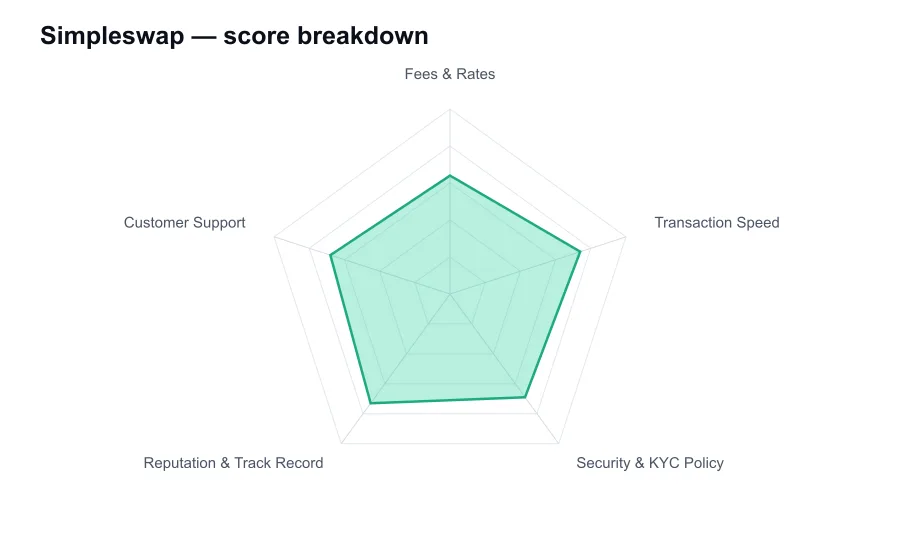
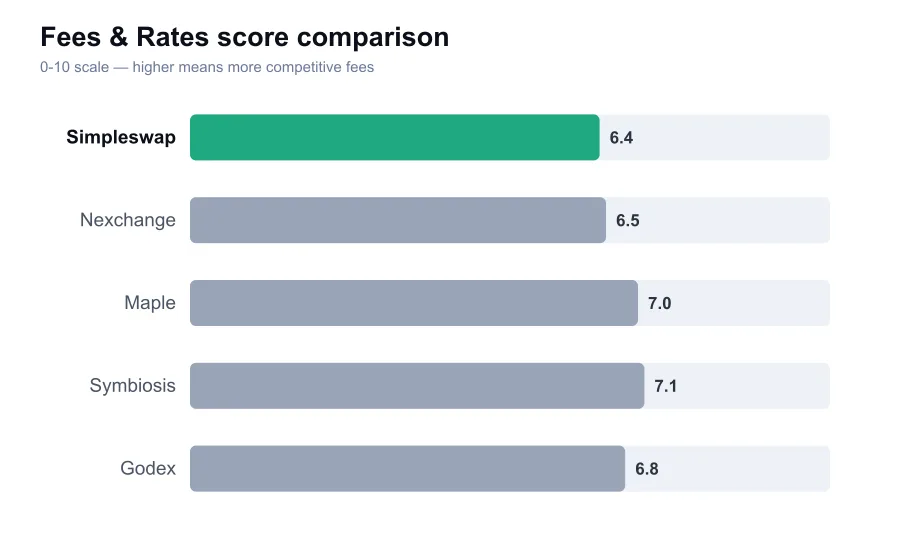
SimpleSwap's fees are folded primarily into the exchange rate it presents rather than delivered through a classic published maker and taker schedule. In practical terms, the number that matters is the output amount displayed before you send funds. The platform offers floating-rate and fixed-rate options for supported pairs. Floating rates can be more competitive at the initial quote but can change with the market. Fixed rates give the user more certainty about the expected output, though the protection usually has a cost. Neither option is automatically cheaper in every market.
This is where comparisons matter. On a liquid pair such as BTC to ETH, ETH to USDT, or SOL to USDC, SimpleSwap may be convenient but often will not beat the all-in price available to a user who already has accounts at Kraken, Coinbase Advanced, Binance, or a strong decentralized exchange. The difference can be small on a modest swap, particularly after considering withdrawal costs and time. On a larger order, the embedded spread can become substantial. A serious user should open a second quote elsewhere before committing, not after the coins are sent.
Network fees are separate from exchange-rate economics and can cause confusion. The cost of sending Bitcoin, Ethereum, or another asset into the swap depends on the sending wallet and blockchain conditions. The outgoing transfer also has a network component built into the service's process. A user who sees a disappointing received amount should not assume SimpleSwap kept every difference as profit. Still, the service has a responsibility to make its quote clear enough for users to distinguish blockchain expense from the conversion rate, and instant swap providers are rarely as transparent here as fee-conscious traders would like.
Speed is generally good for the task it performs. Many swaps complete after the deposit receives the required confirmations and SimpleSwap can execute the outgoing transfer. Fast chains and high-liquidity pairs can finish in minutes. Bitcoin, Ethereum during congestion, assets with slower confirmation rules, and transactions flagged for review can take considerably longer. The site cannot force a blockchain to confirm faster, and users should avoid a floating-rate swap if they cannot tolerate price movement while their deposit is waiting in a mempool.
Fixed-rate swaps are the more sensible choice for someone moving a specific amount for a time-sensitive payment or treasury purpose, provided the pair is supported and the quoted premium is acceptable. The customer knows the expected payout before depositing, which removes one major source of anxiety. Floating-rate swaps are reasonable for smaller speculative conversions where a slightly better initial rate matters more than certainty. What users should not do is select floating rate, send a low-fee Bitcoin transaction, and then complain that the market changed during a long confirmation delay. The mechanism needs to match the use case.
SimpleSwap is commonly described as non-custodial, and that description is broadly useful but needs precision. It does not function like a deposit exchange where users maintain a persistent trading balance under the service's control. Funds are nonetheless sent to addresses involved in the swap process, and the company or its partners control execution until the output reaches the destination wallet. This lowers long-term custody exposure. It does not eliminate counterparty risk during the transaction, nor does it protect a user who enters a wrong destination address or sends an unsupported asset.
Routine use does not normally require a traditional account or upfront KYC, which is one of the product's attractions. But no-KYC should not be interpreted as guaranteed anonymity or immunity from compliance review. SimpleSwap's terms and policies allow it to request information in certain cases, particularly where a transaction triggers risk controls. That is a standard reality across this segment. Users dealing with tainted funds, sanctions exposure, stolen assets, or suspicious transaction patterns can encounter delays or verification demands. If you need certainty about compliance treatment, a regulated exchange account is often less ambiguous.
On reputation, SimpleSwap sits above obscure clone-like swap sites but below the top tier of globally regulated exchanges. Its multi-year presence, broad asset coverage, public-facing support material, and recognizable brand give it a meaningful track record. It has also been integrated into parts of the wallet and crypto-service ecosystem, which is more reassuring than a swap site with no external connections. Still, it has attracted the kind of complaints common to instant exchangers: delays, rate differences, transaction reviews, and frustration when a user expected an irreversible blockchain process to operate like a card payment.
Those complaints should be read critically rather than ignored. Some arise from a genuine service failure. Others come from users choosing the wrong chain, overlooking a minimum amount, sending a token without its required memo, or misunderstanding a floating quote. The sensible test is whether the company provides a transaction ID, explains the status, and responds coherently when something goes wrong. SimpleSwap offers support channels and a help center, and it has a more mature support presence than many minor competitors. I would still save every order ID, wallet hash, and screenshot until the swap is complete.
The interface is refreshingly direct. It is well suited to a self-custody user who knows exactly what asset they hold and what network their recipient wallet accepts. That user can avoid the friction of depositing to an exchange, selling, buying, and withdrawing. A newcomer may find the same simplicity deceptive. There is no forgiving bank-style confirmation system if USDT is sent over an unsupported network. There is no cancel button once the deposit is broadcast. The easiest interface in crypto can still sit on top of irreversible plumbing.
SimpleSwap's strongest use case is occasional conversion, especially between assets held in personal wallets. It is useful for portfolio cleanup, moving between ecosystems, or acquiring a supported token unavailable on your preferred exchange. It is weak for recurring high-volume trading, where transparent fee tiers and deep order books matter. It is also not where I would buy crypto with fiat unless the local payment option and final quote beat a mainstream on-ramp. The service wins on fewer steps, not necessarily on absolute price.
My view is that SimpleSwap is a legitimate convenience tool with a decent operating history, but it should be used with the discipline people apply to any intermediary handling an irreversible transfer. Compare the output rate, choose fixed versus floating deliberately, and send a test amount for unfamiliar networks. Its broad selection and wallet-friendly flow are real strengths. Its opaque all-in pricing, potential review delays, and limited recourse are equally real. For modest swaps, that balance can be attractive. For large sums, execution quality and accountability matter more than a clean interface.