Godex is one of the older names in the instant crypto swap market. It offers a familiar promise, exchange one cryptocurrency for another without creating an account, undergoing routine identity checks, or depositing funds into a long term trading balance. The service has been around since the middle of the last decade, which gives it more operational history than many newer swap sites. That history is valuable, although it does not make every quote or every support experience equally good.
The product is simple by design. Choose a pair, enter your destination wallet address, send the input asset to Godex, and wait for the output transaction. Godex supports a large list of coins and tokens, including many assets that may not be convenient to access on a mainstream exchange. That breadth is a meaningful advantage for users who want to move between a major coin and a lesser known altcoin without juggling several platforms.
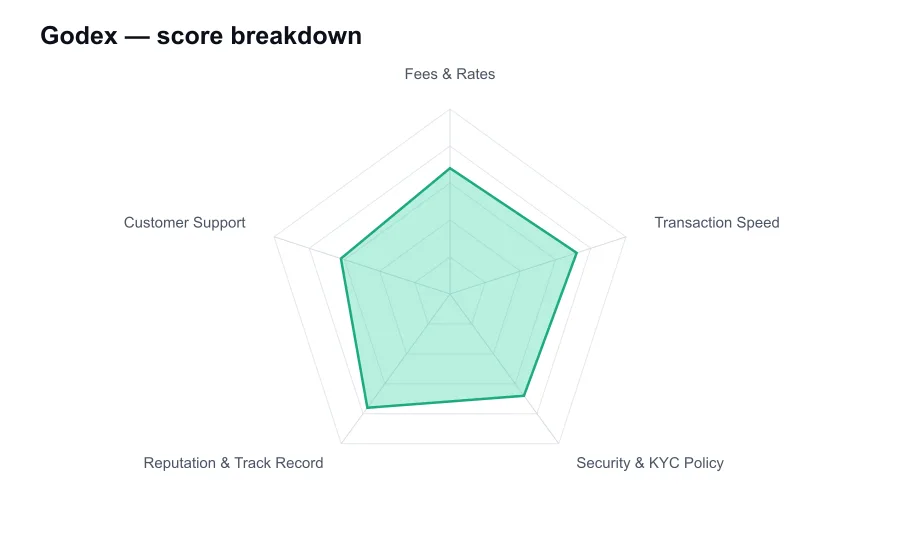
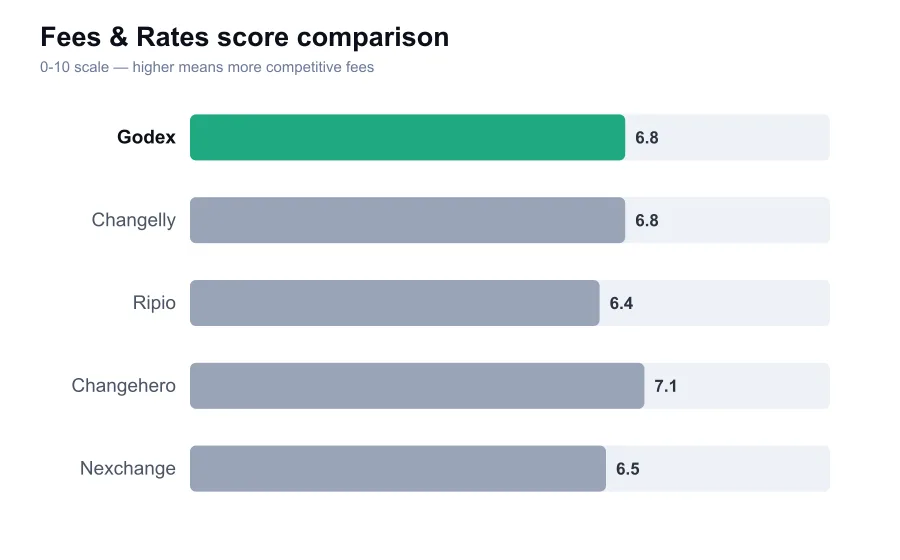
Godex commonly advertises a 0.5 percent exchange fee and markets its rates as fixed. The fee claim is useful as a starting point, but it should not be mistaken for the full cost of a swap. The final payout also reflects network costs, market depth, and execution spread. In practical terms, a customer should compare the amount they will receive, not assume that 0.5 percent means Godex will always beat a competitor with a less prominent headline fee.
The fixed rate approach is one of Godex's strongest selling points. A customer sees a stated expected amount before sending, which makes budgeting easier in a volatile market. It is particularly useful when converting Bitcoin or Ethereum into a stablecoin during a sharp move. The catch is that fixed quotes come with payment conditions. Send the wrong amount, wait too long, or use the wrong network, and the neat fixed rate promise may turn into a manual support case.
On common liquid pairs, Godex's price is often acceptable but rarely extraordinary. It is a service you use because you value a direct, no account transaction, not because you expect professional trading costs. Kraken, Coinbase Advanced, and Binance can all be materially cheaper for users able to complete KYC and manage their own withdrawals. Godex is competing with ChangeNOW, StealthEX, Exolix, and similar services, where the convenience of a single swap flow is the real product.
The cost picture can deteriorate on obscure tokens. Thin markets introduce wider spreads, and a long list of supported assets does not mean every asset has equal liquidity at every hour. This is not unique to Godex. It is a structural fact of instant exchange aggregators. Still, Godex users should be especially careful with small cap coins, large orders, and token versions that exist on several chains. A quick quote check can prevent an expensive mistake.
Speed is usually adequate rather than exceptional. Godex can complete straightforward exchanges quickly after the deposit reaches required confirmations, often within minutes on responsive networks. Bitcoin deposits can take longer, and Ethereum or other congested networks can create delays that no front end can solve. The company does not control the blockchain, and it may depend on liquidity partners for the conversion itself. Anyone who needs settlement at a precise time should not rely on an instant exchanger.
Fixed rate swaps may feel slower than users expect because Godex has to receive and verify the deposit before it can commit the outgoing amount. That is normal. The more frustrating delays are the exception cases, such as wallet maintenance, a malformed destination address, a coin with a mandatory memo, or a transaction selected for extra review. Godex provides order tracking, but status pages do not always answer the practical question customers have, which is what exactly is happening and when it will be resolved.
Godex's no registration policy is a major attraction. Users do not need to create a profile for a routine swap, and the platform does not present itself as a custodial account service. This reduces the amount of personal information collected in ordinary use. Yet customers should keep their expectations grounded. Godex reserves the right to apply AML and compliance checks to suspicious activity. A blocked transaction can still lead to document requests or a delay while the provider investigates.
The security model is therefore better described as low persistence custody, not zero counterparty risk. Godex does not require users to leave a trading balance on the site, which is preferable to parking coins at an unregulated exchange. But it receives the funds during the conversion process. The service, its wallets, and its liquidity partners must perform correctly for the swap to finish. That is why I would never send an amount I could not tolerate having delayed through any instant exchange service.
Godex has a longer record than many competitors, and that gives it a reasonably solid reputation in the no KYC swap niche. It has processed a large number of routine transactions over the years and remains widely recognized in crypto comparison sites and wallet integrations. Public feedback is not spotless. The complaints that recur involve delayed orders, payout disputes, transaction holds, and support replies that feel too generic. Those are common industry complaints, but frequency matters more than marketing claims.
I am more comfortable with Godex for ordinary, well understood swaps than for complex or high value transfers. The site works best when both assets are liquid, the networks are healthy, and the destination wallet is under your control. It is much less appealing if you need a guaranteed execution deadline, detailed compliance documentation, or a dedicated person to call. The service's long life is reassuring, but not enough to erase the inherent limitations of the model.
Customer support is serviceable, not a selling point. Godex provides contact and order support, but independent user reports suggest that response quality can vary sharply when an order falls outside the automated path. That is where a provider reveals its standards. A clean interface and a large coin list are easy to build compared with a clear refund process and prompt, specific human communication. Godex could improve its standing by being more proactive about delay explanations.
For privacy minded users, the lack of routine account creation is useful, but there is a broader privacy tradeoff. Blockchain transactions remain public, and instant exchange providers can use analytics tools to screen them. Avoiding an account does not make a transfer invisible. It simply means you are not opening a conventional customer relationship before every exchange. That is an important distinction for anyone choosing Godex because of the no KYC label.
My opinion is that Godex remains a valid option, especially for users who need broad asset coverage and prefer a fixed quote without registration. It is not the cheapest route, the fastest route, or the most support intensive route in every case. Its value lies in being a mature, straightforward utility that has survived longer than most minor swap brands. Use it with normal crypto caution, compare the payout, and keep large or complicated transactions at venues with stronger accountability.