Pegasusswap is the kind of name that requires more caution than a familiar exchange brand. It appears to operate in the decentralized swap category, where a user connects a wallet and trades through smart contracts rather than opening a conventional custodial brokerage account. That can be attractive. It also removes many of the protections, disclosures and support expectations that people assume are standard after using Coinbase, Kraken or Bitstamp.
The first problem is not necessarily the interface. Smaller decentralized exchanges often look perfectly modern. The real issue is verification. A user needs to establish which chain the application uses, who deployed the contracts, whether those contracts have been independently audited, where liquidity comes from, and whether the domain being used is the authentic application. With a prominent DEX, that research is already demanding. With Pegasusswap, it is essential.
I would not treat the word "swap" as evidence of a non-custodial guarantee. A wallet connection can still approve a malicious token allowance, route funds through risky contracts or expose a user to a fake front end. Before connecting any wallet, inspect the official project communications, verify the contract address through a reputable block explorer, and use a separate wallet containing only a small test amount. That sounds tedious because it is tedious. It is also cheaper than recovering from a bad approval.
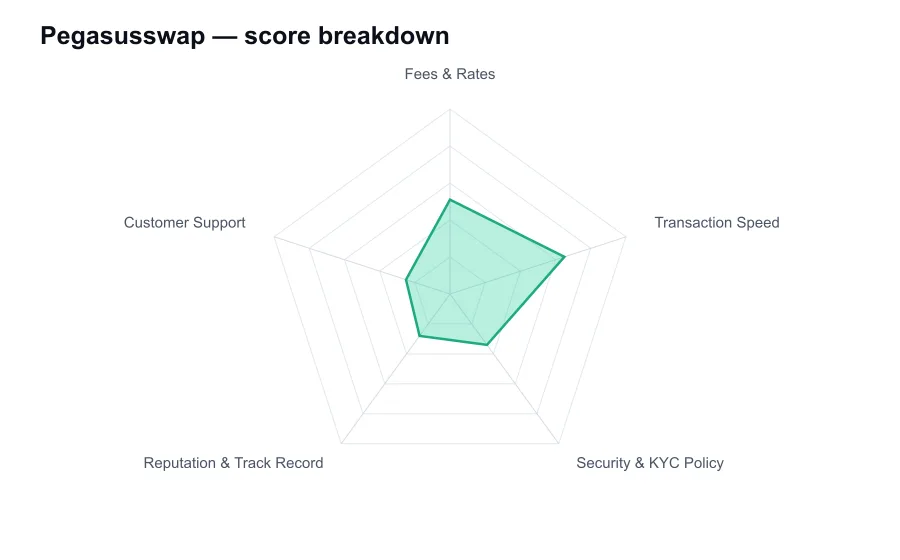
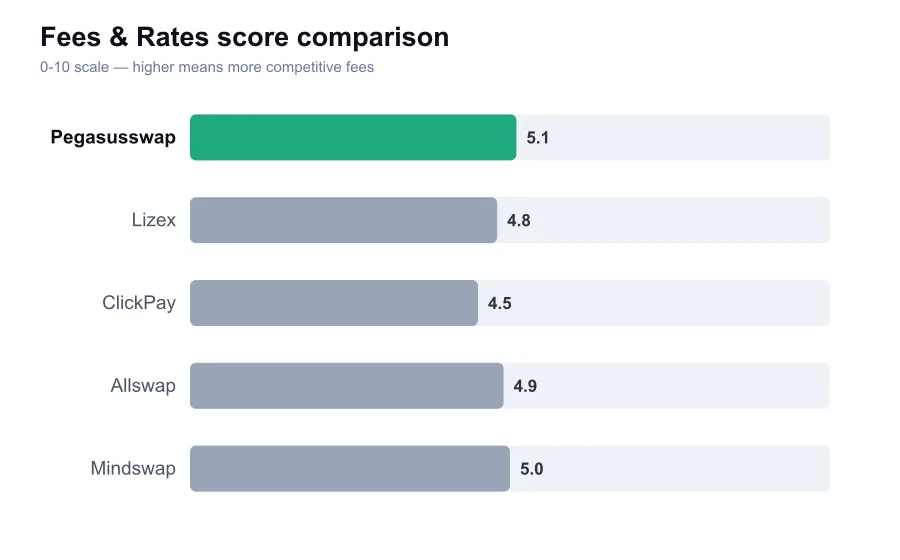
Fees on a DEX are usually made up of more than one moving part. There may be a liquidity-provider fee, protocol fee, route-related costs, price impact and the network gas fee. Pegasusswap does not have the transparent, mature public fee documentation I would want before recommending it for large transactions. If the application displays a percentage fee, users still need to look at the actual expected output. The final received amount is the number that matters.
This is a major difference from a centralized exchange with a published maker-taker schedule. On an order-book venue, you can often see the fee and the market depth separately. On a thin DEX pool, a transaction may show a modest fee while losing far more to slippage. A small swap might execute acceptably. A large sale of an obscure token can move the pool price dramatically, especially if there is little genuine liquidity behind it.
Transaction speed depends on the underlying blockchain, not on a support agent pressing a button. A swap broadcasts as soon as the wallet signs it, then waits for network confirmation. That can mean seconds on a fast, low-cost chain, or several minutes during congestion. It is fast in the narrow sense that there is no manual withdrawal queue. It is not always fast in the sense users care about, because a pending trade can still fail, be repriced or become uneconomical if gas spikes.
The absence of conventional KYC is likely to appeal to people who want to trade from a self-custody wallet without sharing ID documents. But no-KYC does not mean no risk. It shifts responsibility to the user. There is no account recovery team if a seed phrase is lost, and there may be no meaningful route to challenge a bad transaction. Regulatory rules can also affect access at the front-end level, even if the underlying smart contract remains visible on-chain.
Security claims from a small DEX should be read with a very high bar. I would want a named audit firm, public audit reports, contract addresses, a bug-bounty program, multisig details and evidence that liquidity controls cannot be changed by a single anonymous operator. If those details are absent, difficult to locate or framed only as promotional language, that is a serious negative. Smart contracts do not need to be hacked for users to lose money. Admin keys, token permissions and thin liquidity can do enough damage.
Pegasusswap does not have the long, independently documented operating history that supports confidence in Uniswap, Curve, PancakeSwap or 1inch. Those platforms are not risk-free either, but their contracts, integrations, usage patterns and incidents have been examined by much larger communities. A smaller project may be legitimate and still not deserve the same trust allocation. Reputation is earned through years of transparent operation, not through a clean landing page or a social-media following.
The token list is another area where users need restraint. Permissionless or lightly screened markets can provide early access to assets unavailable on large exchanges. That is the upside. The downside is that a token can have misleading branding, transfer restrictions, a punishing sell tax, concentrated ownership or no viable exit liquidity. If you cannot explain how a token works and who controls it, buying it because a swap interface makes it easy is speculation at its least forgiving.
Support appears limited compared with a full-service exchange. Smaller DEX teams commonly rely on community channels, documentation and social accounts rather than staffed ticket operations. That may be adequate for a basic routing question, but it is no comfort after a mistaken transfer or compromised wallet. Be especially suspicious of anyone who contacts you first through Telegram, Discord or direct message claiming to be support. Legitimate teams do not need your seed phrase to diagnose anything.
There is also a practical usability issue. A DEX asks the user to manage network selection, gas tokens, wallet permissions, token contracts and slippage settings. Experienced DeFi users may see that as normal. Beginners often make expensive errors. A centralized exchange is less private, but it usually protects users from sending the wrong network fee token or approving unlimited spending permissions without understanding the consequence.
My approach to Pegasusswap would be deliberately limited. I would use it, if at all, only for a small transaction that cannot be done more safely through an established exchange or a well-audited decentralized protocol. I would not use it as a primary wallet, a place to store assets, or a venue for a large trade. A cheap test transaction, followed by a review of the on-chain approval, should be the minimum standard.
Pegasusswap may suit an informed DeFi user who has independently verified the exact application and contract they intend to use. It is not a provider I can recommend on brand reputation alone. The lack of broad public operating evidence, the uncertainty around fee disclosure and the limited recourse are too important to wave away. In crypto, small platforms can occasionally offer an opportunity. More often, they ask users to take risks they have not been paid nearly enough to take.