EasyBit is an instant crypto exchange service aimed at a simple use case: send one digital asset and receive another without opening a full trading account. It sits closer to services such as ChangeNOW, SimpleSwap, StealthEX and FixedFloat than to an order-book exchange like Kraken. The appeal is obvious. Pick a pair, enter a receiving address, send funds, and wait for the swap to complete. For a one-off conversion, that can feel much lighter than creating a custodial account.
The service presents itself as a noncustodial exchange, which is directionally useful but needs plain-English translation. EasyBit does not operate like a platform where users retain a standing balance and trade repeatedly from an internal wallet. It still receives the asset sent for an exchange and coordinates the conversion before forwarding the output. During that operational window, users are relying on EasyBit and its liquidity arrangements. Noncustodial does not mean no counterparty risk.
EasyBit offers both floating-rate and fixed-rate exchange options for supported pairs. A floating quote follows the market while the transaction is processed. It can deliver a better result in a favorable move, but it can also deliver less than the estimate if the market shifts or network delays occur. A fixed-rate quote provides more certainty for a limited period, usually at a price that reflects the provider's risk of market movement. That choice is genuinely useful, especially in volatile conditions.
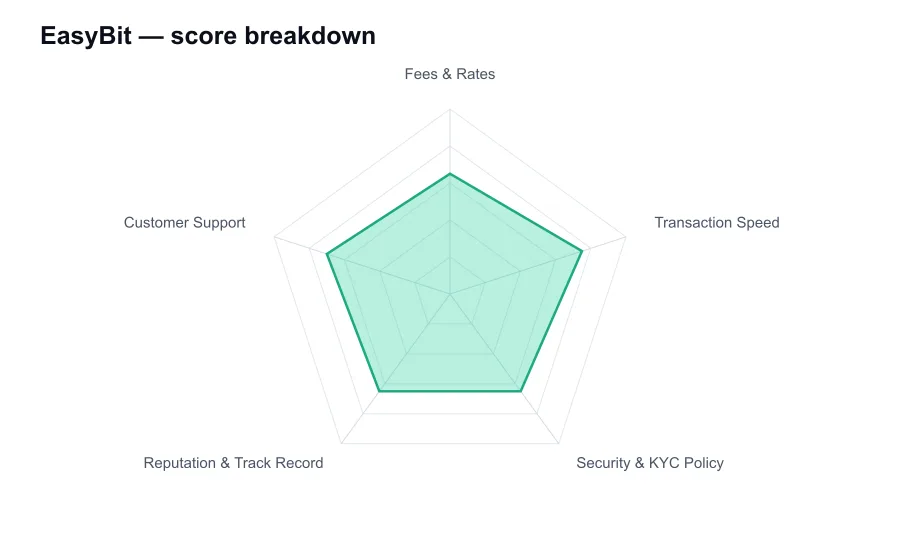
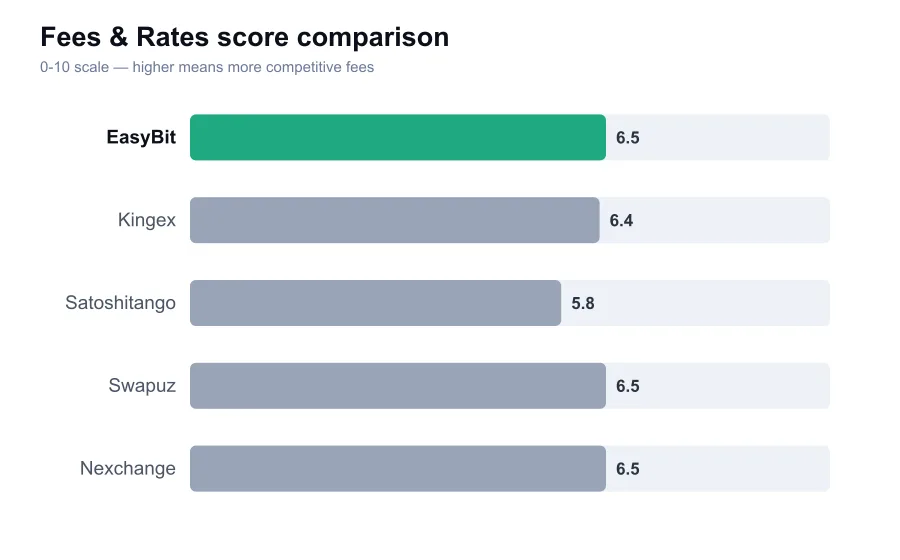
The fee story is less transparent than a trader should ideally want. EasyBit may advertise competitive or zero-fee exchanges, but the cost of an instant swap is normally embedded in the quoted rate, alongside liquidity-provider costs and market spread. That is standard for this category, not an accusation of wrongdoing. Still, users should never compare only an advertised fee percentage. Compare the exact amount of BTC, ETH, USDT or other asset you will receive against at least one rival's quote.
On common, liquid pairs, EasyBit can be competitively priced. On niche assets or during sharp market moves, the spread can widen enough that a centralized exchange or a direct decentralized swap is cheaper. Fixed-rate orders may also look more expensive than floating ones because EasyBit is pricing in execution risk. There is nothing wrong with paying for certainty, but users should know they are doing it rather than assuming the fixed option is automatically superior.
Speed is usually good for the category, but it is constrained by blockchains rather than a clean stopwatch on EasyBit's website. The exchange cannot fully process an incoming deposit until it sees the required confirmations. Bitcoin can take materially longer than Litecoin, Tron, Solana or many Ethereum layer two networks. A congested sender transaction, a memo mistake, a delayed wallet broadcast, or an exchange withdrawal review can turn a quick swap into a support case.
For an ordinary confirmed transaction on a fast network, the experience is often measured in minutes. Bitcoin and some privacy-oriented or heavily congested networks can take longer, sometimes much longer. The sensible approach is to use the transaction identifier and status page, rather than assuming the funds are lost because the receiving balance has not appeared quickly. It is also wise to avoid making a time-sensitive payment through any instant exchanger unless the recipient accepts the settlement risk.
EasyBit's no-registration approach is a real convenience. Users can generally initiate an exchange without creating a username, password or customer profile. That reduces data collection and makes the service useful to people who do not want another exchange account exposed in a data breach. It is also less friction than centralized platforms that demand identity checks before a first withdrawal.
No-registration should not be mistaken for an unconditional promise of anonymity. Like other crypto exchange services, EasyBit has an AML and compliance policy. A transaction can be flagged, delayed or require additional information if risk systems identify a problem. The exact outcome depends on the case and policy enforcement, but the basic lesson is clear: do not send funds if you would be unable or unwilling to provide requested source-of-funds or identity documentation. Crypto users often learn this only after a hold occurs.
That compliance caveat is one reason I prefer EasyBit for straightforward, lawful wallet-to-wallet conversions rather than as a primary financial hub. If a large transfer needs certainty, formal account records, a dedicated compliance contact and predictable dispute handling, a regulated exchange is usually the better fit. EasyBit's format is built for convenience, not for institutional workflow. A small test transaction is prudent before sending a large amount or using an unfamiliar network.
The site supports a broad list of coins and tokens, but breadth can be misleading. A long asset list does not mean every pair has equal liquidity, equal speed or equal pricing. Check the network carefully, particularly for USDT and USDC, which exist on several incompatible chains. Entering an ERC-20 address while sending a TRC-20 asset, or overlooking a destination tag for XRP and similar networks, can create a difficult recovery problem.
Security is strongest where the user controls it. Use a hardware wallet or reputable self-custody wallet, verify the destination address character by character, and navigate directly to the official domain rather than through a sponsored search result. EasyBit cannot protect someone who gives a seed phrase to a fake support account. It also cannot reverse a completed blockchain transfer merely because the user chose the wrong address.
The provider has been operating since 2018, which gives it more history than many short-lived instant exchangers. That is a positive signal, though it is not comparable to the regulatory transparency, financial disclosures or public-market scrutiny of the largest centralized exchanges. Public review sites show the familiar pattern for this category: many users praise simple swaps and fast delivery, while complaints tend to focus on rate changes, compliance requests, delayed orders or misunderstood network requirements.
Support is available through the website's live chat and email channels, and that matters more here than on a DEX because a pending swap can require an operator's intervention. Reports of fast help are encouraging, but support quality must be judged in difficult cases, not only routine ones. Save the exchange ID, transaction hash, screenshots and exact sending details before contacting support. A concise evidence-rich request will get further than an angry message with no transaction information.
EasyBit is a useful specialist service, not a place to build an entire crypto life. It is at its best for someone who already owns crypto, wants to convert a modest amount between supported assets, and values a short no-account flow. It is weaker for price-sensitive traders, fiat users, and people who need guaranteed access to a human compliance team. Check the final quote, respect network rules, and use fixed rate when certainty is worth paying for. Those habits make the service substantially safer to use.