1Mile presents the kind of evaluation problem that should make a careful crypto reviewer slow down. The name is generic, public information is limited, and it does not have the visible market presence of a major exchange, a leading DeFi protocol, or a regulated brokerage. In an industry where impersonation and short-lived services are common, lack of verifiable information is not a minor administrative issue. It is itself a risk factor.
I cannot place 1Mile in the same category as a well-documented trading venue because its operating model, ownership, jurisdiction, and security controls are not sufficiently established through reliable public material. A crypto site can call itself an exchange, a broker, an exchanger, or a wallet, but those labels tell a customer very little. The questions that matter are who controls the funds, where the company is registered, how disputes are handled, and whether claims can be independently checked.
That does not automatically mean every transaction involving 1Mile will go wrong. It does mean the burden of proof should sit with the provider, not with the customer. A legitimate service handling client money ought to make its legal entity, service terms, privacy policy, risk procedures, supported networks, and contact method easy to inspect. If those items are vague, incomplete, contradictory, or only supplied after a deposit, that is enough reason to leave.
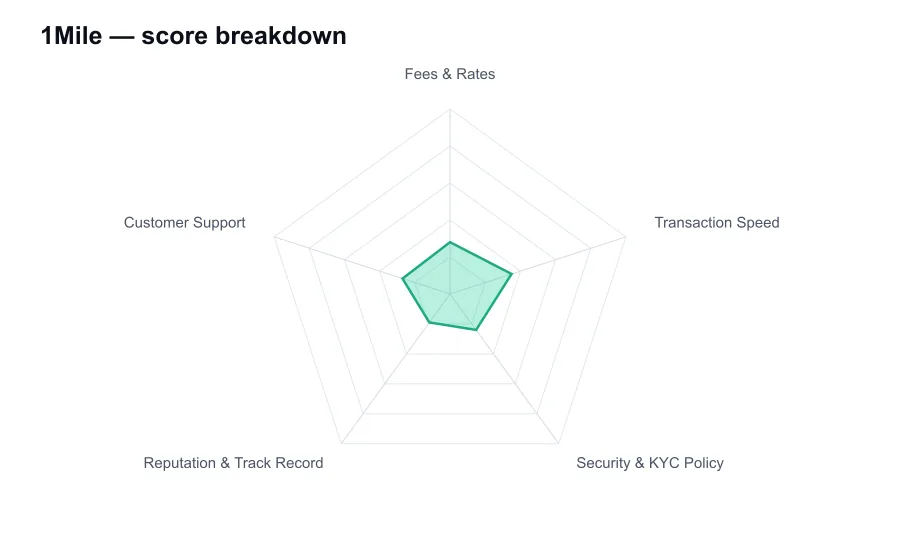
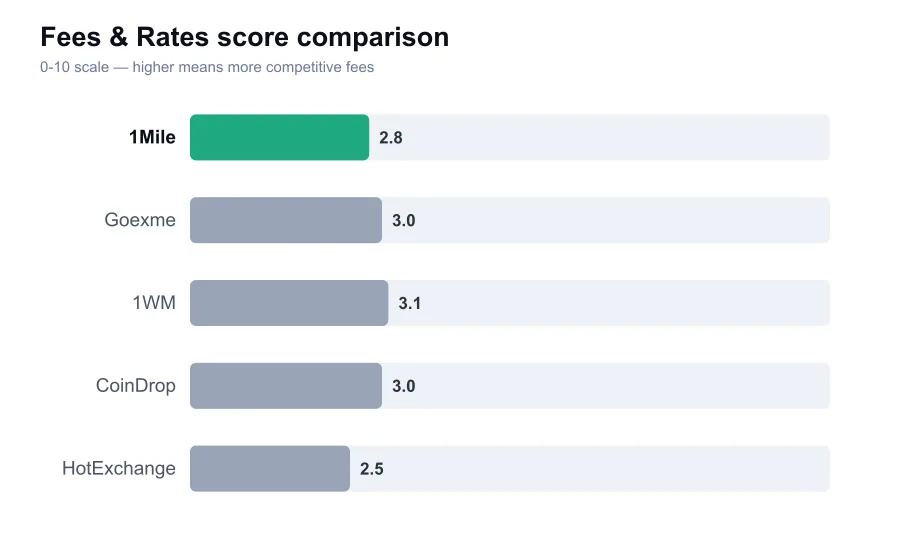
Fees are impossible to score generously without a public and intelligible rate structure. A provider might advertise competitive exchange rates while embedding the actual charge in a spread between market price and customer payout. It might also add network costs at the final step, impose a minimum deposit, or apply an exceptional processing fee during a supposed compliance review. These practices are not equally likely at every platform, but opacity creates room for all of them.
The sensible way to assess a quote is not to ask whether it looks attractive. Compare the exact amount you will receive against a liquid reference market and against reputable alternatives at the same moment. Include the withdrawal or network charge. If a service cannot show whether a rate is fixed or floating, assume the customer bears meaningful market risk. If it asks for an extra payment after a deposit to unlock, verify, insure, or release funds, stop and seek independent advice before sending anything else.
Speed claims deserve the same skepticism. A small instant-exchange service can complete a liquid swap in minutes if it has working liquidity arrangements and automated wallets. It can also remain pending for hours or days if the transaction needs manual review, the asset is illiquid, an external exchange freezes withdrawals, or there is no real operational capacity behind the page. A countdown timer or an automated status screen is not evidence that settlement is imminent.
Blockchain explorers can help a user separate fact from messaging. After sending funds, identify the deposit transaction, check whether it confirmed, and see whether the provider's receiving address later moved assets. This does not prove the service will pay out, but it provides a record. Save screenshots of the quote, order ID, addresses, timestamps, and every support message. Crypto disputes are difficult enough without relying on memory or a webpage that may later change.
Security is the sharpest concern. There is no sufficient public basis to credit 1Mile with audited smart contracts, segregated custody, proof-of-reserves reporting, formal penetration testing, or a mature security program. Those are demanding standards, but they are the standards a customer should want before placing meaningful funds in anyone else's hands. A service that simply says it uses encryption or security technology has not answered the custody question.
A no-registration or low-KYC pitch can sound attractive, especially to privacy-minded users. It should not be confused with a guarantee of anonymity or a safety feature. Most crypto conversion businesses reserve the ability to request documents if a transaction is flagged by their risk tools or banking partners. The dangerous version of this arrangement is a user learning about that policy only after funds are held. Read the terms before sending and decide whether you could tolerate a delayed compliance request.
Reputation is not just a star rating. Real reputational evidence includes years of continuous service, credible technical discussion, named leadership, responses to complaints, known partnerships, app-store history, regulatory filings where relevant, and independent coverage that does more than repeat marketing copy. 1Mile does not offer enough of that evidence for a high confidence rating. Affiliate review pages and anonymous testimonials should carry almost no weight, because they are cheap to produce and hard to verify.
Support is likely to be the test that matters if something breaks, yet it is also the category customers cannot properly assess before a problem. Send a low-risk question first. Ask about fixed-rate conditions, KYC triggers, supported token contract addresses, or a specific network. A useful reply should be clear, timely, and internally consistent. Generic replies asking you to deposit first, or support representatives who move the conversation to an unsecured messenger account, are serious warning signs.
I would not use 1Mile for a first purchase, a large conversion, a payroll payment, or any transfer tied to a deadline. The potential downside is disproportionate to the possible convenience. A recognized centralized exchange may require identification, but it generally offers clearer transaction records, published fee schedules, and established escalation routes. A leading noncustodial protocol has different risks, though at least its execution can be inspected onchain and its contracts can be studied publicly.
If someone insists on testing 1Mile, the responsible approach is a tiny amount that would not matter if delayed or lost. Confirm the exact domain independently, use a self-custody receiving wallet, never reuse a password, and do not send a second payment to resolve a claimed issue with the first. Do not give remote access to a computer or disclose a seed phrase. Those precautions sound obvious, but they are the line between an inconvenient experiment and a damaging loss.
My assessment is deliberately conservative because the available evidence does not support confidence. 1Mile may be a functioning service, but a customer should not have to guess about the fundamentals of a financial counterparty. In crypto, uncertainty is often marketed as privacy or simplicity. It is neither. Until the operator establishes a durable, independently verifiable record and clear customer protections, better-known alternatives deserve the business.