HotExchange is one of those crypto brands that requires more scrutiny than enthusiasm. It does not occupy the same category as established global exchanges with audited operations, clear licensing disclosures, and a long archive of public performance. Its market presence is limited, and that matters. In crypto, a polished website or a broad token list tells you almost nothing about whether a platform can protect funds or resolve a problem fairly.
The central concern is verifiability. Before opening an account with HotExchange, a user should be able to identify the operating company, its jurisdiction, its compliance status, and the rules governing custody and withdrawals. I could not establish a strong public record on those points. If a platform is serious about customer trust, these are not details that should need detective work. They should be plainly available in legal documents and security materials.
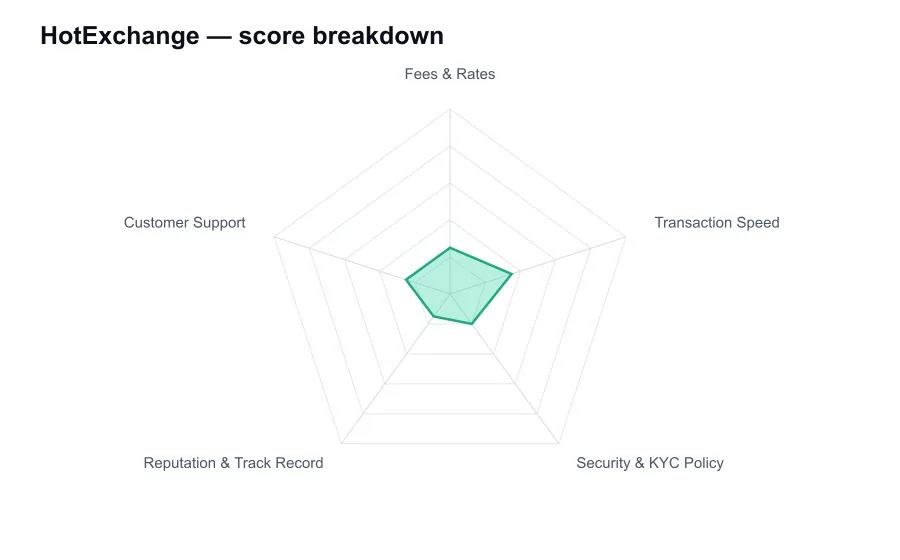
That uncertainty makes a conventional scorecard slightly misleading. Fees, speed, security, and support are not isolated features when the operator itself is hard to assess. A low trading fee isn't valuable if a withdrawal is delayed without explanation. A broad list of markets isn't useful if the real execution price is poor. HotExchange may have functionality, but public evidence is not strong enough to put it on the same footing as venues that publish volume data, market-depth information, and detailed customer terms.
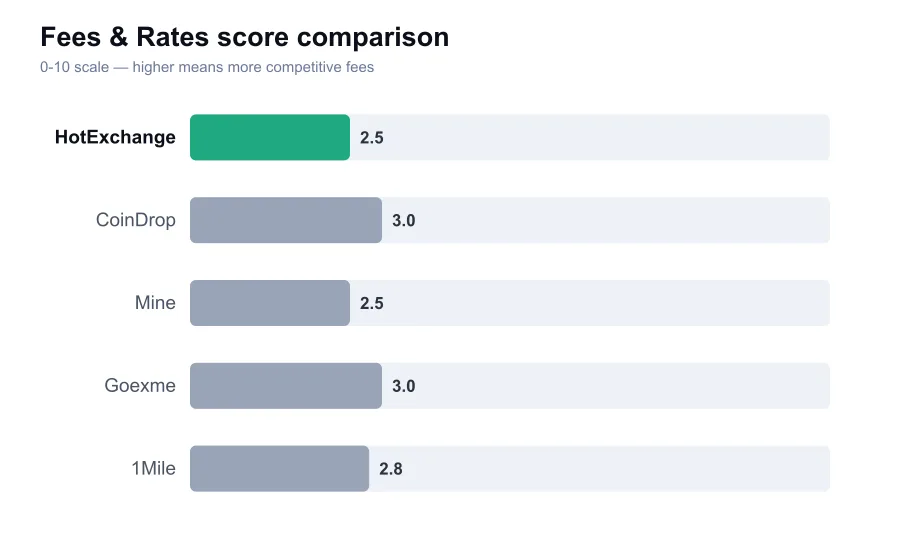
Start with fees, because this is where smaller platforms can appear attractive. A stated percentage fee is only one part of the bill. Traders also pay through spread, thin order books, price impact, deposit charges, withdrawal charges, and in some cases a token-specific minimum withdrawal that makes small balances awkward. If HotExchange shows a low headline fee without a clear all-in cost estimate, I would assume nothing. Compare the actual fill or final withdrawal amount with a major exchange before committing.
For a market order, liquidity is often more important than the maker and taker schedule. On a deep BTC or ETH market, a modest order should trade close to the displayed price. On a thin market, the price can move across several orders immediately. That is slippage, and it can cost more than a fee difference of a few tenths of a percent. HotExchange has not built a visible reputation for institutional-grade liquidity, so large market orders would be a poor idea.
Transaction speed has the same qualification. Internal balances can update quickly, yet that does not mean external transfers are fast or dependable. A responsible exchange provides a clear withdrawal status, a transaction hash once funds are broadcast, and notices when network congestion or compliance checks cause a hold. Without a well-documented public service record, users should plan for delays rather than trust promotional language about instant processing.
Blockchain timing varies by asset. Solana transfers can confirm in seconds, while Bitcoin and Ethereum may take longer depending on network conditions and the fee selected by the sender. The exchange controls the important middle step, which is approving and broadcasting your withdrawal. That is the step where weak operations become visible. Never send funds to HotExchange for a deadline-sensitive payment, and do a small deposit and withdrawal test before relying on it for anything larger.
Security information is not optional background reading. I would want to know whether HotExchange uses multi-signature cold storage, role-based employee access, withdrawal allowlisting, two-factor authentication, device management, and external testing. I would also want to know whether it maintains an insurance arrangement and exactly what that arrangement covers. A generic claim that funds are secure is not a substitute for those details. I could not find a sufficiently robust public security case.
KYC deserves a practical reading rather than an ideological one. People often search for exchanges with minimal verification, then discover that a withdrawal, a card payment, or a larger trade triggers an identity review at the worst possible moment. HotExchange should clearly state what verification is required, which countries are supported, what documents are accepted, and what happens if a review is rejected. If those rules aren't clear before deposit, assume friction is possible afterward.
A platform without visible compliance standards can also create downstream risk. Banks may reject transfers. A receiving exchange can question the source of funds. Blockchain analytics flags can require documentation. These issues happen even on reputable platforms, but established providers generally have known processes and a formal complaints route. With HotExchange, the absence of a strong public profile means users have little basis for predicting how an edge case will be handled.
Reputation is HotExchange's weakest category. It lacks the durable, independently observable track record of exchanges that have endured bull markets, bear markets, withdrawal stress, and regulatory change. It also lacks the public visibility that lets prospective customers judge whether complaints are isolated incidents or a repeating pattern. Quiet can mean competent. It can also mean too few users and too little oversight. Neither interpretation justifies a large deposit.
Support is especially important at a smaller exchange because there may be no local office, regulated ombudsman, or large compliance department to escalate to. A contact form can be enough for routine questions, but it is not enough evidence for a custody relationship. Look for a published support address, ticket history, response hours, multilingual assistance where relevant, and a specific escalation procedure. If a service cannot answer direct questions about a pending withdrawal, move on.
HotExchange may appeal to users chasing unusual coins or a quick account opening process. That appeal is understandable, but it is not a reason to suspend risk management. Keep records of every deposit address, transaction hash, order confirmation, and support interaction. Enable two-factor authentication if available, use a unique password, and do not keep idle assets on the platform. Those are basic habits, but they become vital where the counterparty is lightly documented.
My recommendation is conservative. HotExchange has not provided enough public evidence of fees, controls, liquidity, and customer recourse to earn a place as a primary exchange. A sophisticated user may choose to test it with a trivial amount for a token unavailable elsewhere, but that is a speculative operational decision, not an endorsement. For fiat on-ramps, recurring trading, or meaningful holdings, established exchanges with transparent terms and a proven withdrawal history are the better choice.