1WM is another crypto provider name that does not carry the public footprint needed for an easy endorsement. It is not widely recognized alongside the major centralized exchanges, established instant-swap companies, or leading decentralized protocols. That does not make it illegitimate by itself. Crypto markets are full of small operators. It does mean a reviewer has to prioritize verifiable facts over branding, because customers are being asked to send assets that cannot be recalled once confirmed.
The first question is what 1WM actually is in a transaction. Is it a custodian taking a deposit and sending a later payout, a broker sourcing liquidity from another exchange, a peer-to-peer marketplace, or merely a front end for a third-party swap provider? The customer experience can look identical in all four cases, but the risks are very different. Without clear documentation, users cannot know who has custody during processing or where responsibility sits if an order fails.
A serious provider should publish terms that identify the contracting entity, governing jurisdiction, dispute process, service restrictions, and conditions under which an order can be paused. Those are not decorative legal pages. They tell a customer whether there is any meaningful framework for a complaint. With 1WM, publicly verifiable information is too limited to grant high marks on that basic accountability test. I would be wary of any service whose key information only appears after starting an order.
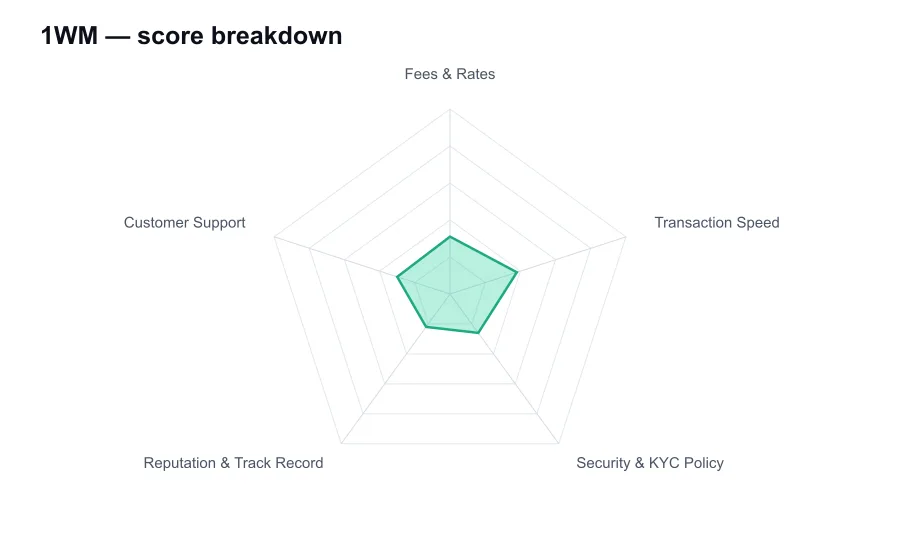
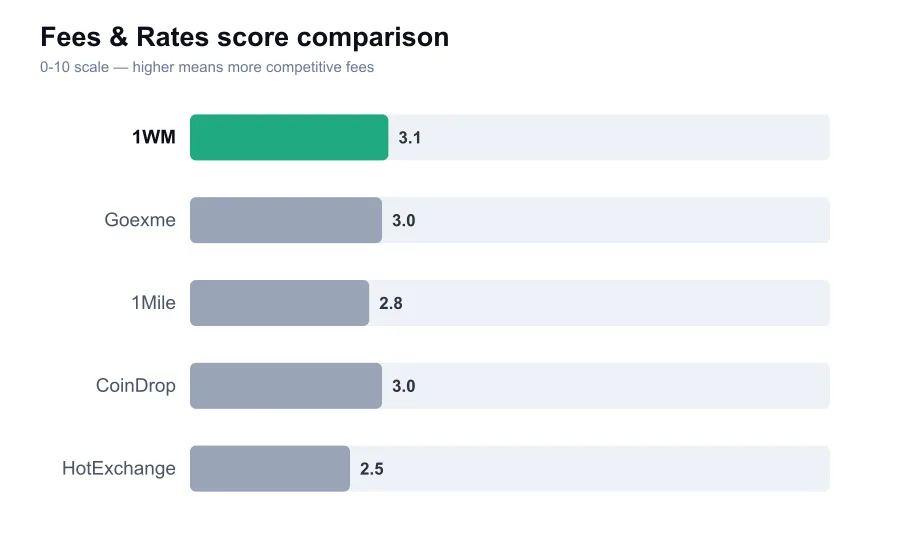
Fee evaluation starts with the actual receive amount. In crypto exchange services, a low stated fee can coexist with a poor exchange rate, and a zero-fee slogan can simply mean the charge is hidden in the spread. The customer should compare the quoted payout with the mid-market price, include network fees, and check whether the rate is guaranteed. If 1WM cannot clearly explain that calculation before a deposit, then its price is not competitive in any meaningful sense, regardless of the marketing claim.
The danger grows with less liquid tokens. Providers can show a plausible estimate while relying on a market that cannot support the order at that price. The resulting swap may be repriced, delayed, or subject to a partial fill mechanism buried in the terms. Major exchanges handle this through visible order books and execution reports. A small conversion service asks the customer to trust its back end. That can be acceptable for a tiny swap, but not for a large position.
Transaction speed is similarly route-dependent. A transfer on a fast network may confirm quickly, yet that only solves the first half of the process. The provider still needs to recognize the deposit, perform risk checks, source the outgoing asset, and broadcast the payout. If it is using manual review or outside liquidity, a supposedly instant order can become a support ticket. There is no reliable public performance record that lets me say 1WM consistently meets a particular settlement time.
Users should be especially careful about asset and network names. Sending USDT on TRON to an address intended for USDT on Ethereum, or using an unsupported token contract, can cause a difficult recovery even at an excellent company. At a small provider with uncertain support resources, it may be unrecoverable. Check the network on both sides, copy rather than type addresses, and send a test transaction where the amount justifies the extra step.
Security is where the lack of public detail becomes most serious. I found no sufficient basis to credit 1WM with independently audited reserves, a regulated custody framework, extensive security reporting, or a proven history of protecting customer assets through market stress. A padlock in the browser bar only encrypts a connection. It does not tell you whether hot-wallet keys are protected, whether customer funds are segregated, or whether the operator can meet withdrawals.
KYC is often misunderstood at smaller conversion services. No signup form does not mean there will be no compliance intervention. Many services reserve the right to suspend a swap for identity verification, blockchain-risk screening, or source-of-funds review. A fair provider makes that possibility clear before funds are sent and gives realistic timelines. A poor one uses vague compliance language to hold a transaction indefinitely. With limited evidence about 1WM's practices, customers should assume that a hold is possible.
The reputation score is low because there is too little independently corroborated history, not because anonymous online criticism alone settles the question. A mature business leaves traces. There are technical discussions, clear leadership, company records, a history of product updates, credible review patterns, and visible handling of difficult cases. Small providers can build that record over time. 1WM has not established enough of one for a reviewer to recommend it over competitors with more to lose reputationally.
Support can make or break a small exchange, particularly where users cannot reverse a transfer. Before depositing, test the contact channel with a detailed question and judge the answer, not merely the response time. Ask whether the quote is fixed, what happens if a deposit arrives late, how a chain mismatch is handled, and whether verification can be triggered. Vague reassurances are not useful. A written answer creates a record and reveals whether the operator understands its own process.
I would not put 1WM near business treasury funds, an urgent stablecoin transfer, or a first-time user's savings. Its potential appeal is convenience, perhaps coupled with a lighter account process than a regulated exchange. But convenience from an unknown counterparty is a weak reason to accept avoidable risk. Kraken, Coinbase, Bitstamp, and established regional exchanges all have drawbacks, including KYC and withdrawal policies, yet their accountability is meaningfully easier to assess.
For an experienced user who still wants to experiment, strict limits are essential. Use a fresh self-custody destination address, a unique password if an account is involved, and an amount small enough to write off. Preserve transaction hashes and every screenshot. Never install remote-control software at support's request, never disclose a recovery phrase, and never compound a troubled transfer by paying an unexpected fee to unlock it.
1WM has not earned a positive recommendation from me because transparency is too thin where it matters. Its brand does not compensate for the absence of a robust, publicly checkable record. It may process a routine small swap without issue, but that is not the standard for entrusting a financial intermediary with meaningful assets. Until it can demonstrate transparent pricing, clear ownership, reliable support, and a sustained reputation, established alternatives are the more responsible choice.