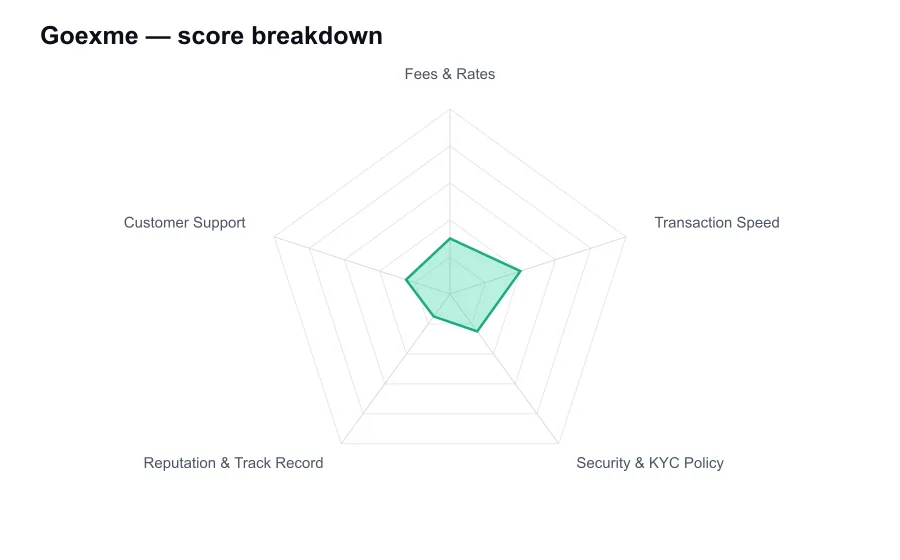
Goexme presents itself as a crypto exchange service, but it sits at the far less established end of the market. It doesn't have the visible scale, regulatory footprint, or years of independently documented operations that give users confidence in better known exchanges. That does not automatically make it illegitimate, but it changes the standard a sensible buyer should apply. With a small or opaque venue, the burden is on the platform to prove its safeguards. Goexme does not make that case clearly enough.
The first problem is basic transparency. I could not verify a detailed public corporate profile, a meaningful operating history, or a regulator-backed license that clearly identifies which legal entity holds customer assets. Serious exchanges put this information where anyone can find it. They name their registered company, jurisdiction, licenses where applicable, custody approach, and risk disclosures. Goexme appears thin on those fundamentals, which makes every other promise harder to evaluate.
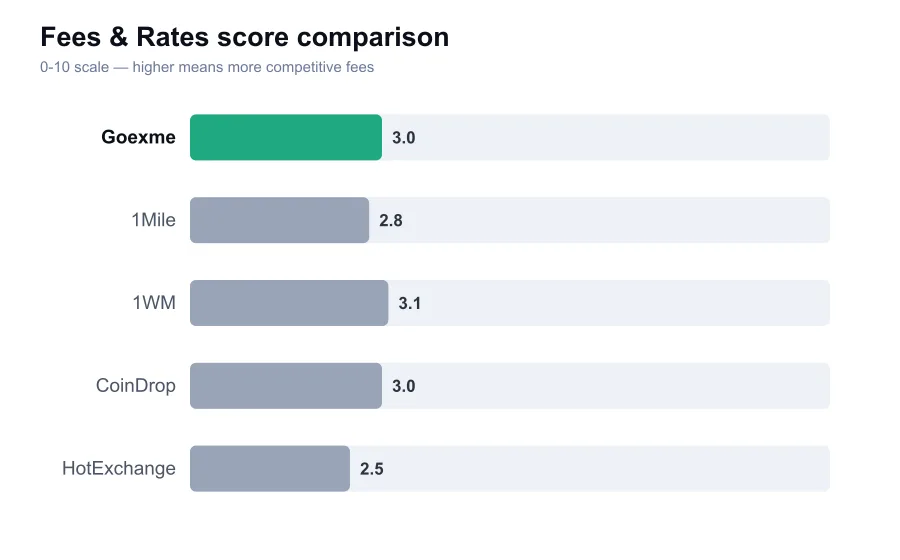
Fees are also difficult to assess with confidence. A reliable exchange publishes a trading fee schedule, spread methodology, deposit and withdrawal charges, and the circumstances in which rates can change. If a service gives a quote only at checkout, users need to compare that quote against the market price before approving it. A seemingly simple swap can include a wide spread, a platform margin, and the network fee all at once. That may be convenient, but it is not necessarily cheap.
For small one-off conversions, a quoted-rate model can be easier to understand than a maker and taker table. You see the amount you will receive and decide whether to accept it. The catch is that you need a second price source. Check the same pair on Kraken, Coinbase Advanced, Binance where available, or a liquid decentralized venue. If the gap is noticeably larger than the underlying blockchain fee and a modest service charge, you are paying for convenience more than execution quality.
Goexme is not a venue I would use for active trading. There is no compelling public evidence of deep order books, advanced order controls, reliable API access, or institutional liquidity. Without those, the quoted price matters more than any advertised fee. Thin liquidity tends to show up in the spread, especially for smaller tokens and larger orders. A service can process an order quickly while still delivering a poor execution price.
Speed claims deserve similar skepticism. Crypto transfers are never solely controlled by the exchange. Bitcoin withdrawals may need several confirmations and can slow down sharply when network fees rise. Ethereum and token withdrawals depend on gas conditions. A platform's internal processing, risk screening, and manual review can add another delay before a transaction is broadcast. Unless Goexme publishes service-level expectations and transaction status details, users should not assume instant means instant settlement.
A swap that is completed on the platform can look immediate, while the actual outbound blockchain transfer still takes time. This distinction matters if you are moving funds to meet a deadline, collateral requirement, or merchant payment. Test any unfamiliar service with an amount you can afford to have delayed. Watch for a transaction ID, then confirm it in a public block explorer. If no transaction ID appears after a reasonable period, support quality becomes the deciding factor.
Security is where the lack of verifiable disclosure is most troubling. I found no strong public basis for judging its cold-storage ratio, key management, proof of reserves, independent penetration testing, or incident response procedures. Those aren't decorative compliance statements. They tell customers whether a platform has prepared for the ordinary failures that have repeatedly hurt crypto users, from compromised hot wallets to internal access mistakes.
KYC policy also needs to be explicit. Some smaller exchange services advertise lighter onboarding, but that can mean different limits, added checks later, or frozen transactions when a compliance review begins. A legitimate business may need identity documents and source-of-funds information, particularly for larger orders. The problem is not KYC itself. The problem is uncertainty about when it applies, what documents are accepted, and how a customer can appeal a mistaken review.
No-KYC marketing should never be confused with safety. In fact, an exchange that is vague about its identity checks can create risk for honest customers, since a payment provider or blockchain analytics flag might interrupt a transaction with little warning. Regulated competitors can feel more intrusive, but their policies are usually readable before money is sent. At Goexme, I would not deposit an amount that would materially affect you if access became difficult.
The public reputation signal is weak. There is little established independent commentary, few durable user discussions, and no track record comparable with long-running platforms that have survived multiple market cycles. A lack of complaints is not proof of quality when there also appears to be limited volume and limited public scrutiny. Reputation is built through years of predictable withdrawals, transparent handling of problems, and a visible response when things go wrong.
Customer support could be perfectly adequate in routine cases, but the available public information does not give confidence that it can handle a difficult one. The real test is not whether someone answers a pre-sale question. It is whether a customer can reach a knowledgeable person after a delayed withdrawal, an incorrect memo, a blocked payment, or a KYC dispute. I would look for a documented support channel, realistic response commitments, and an accessible complaints route before relying on the service.
There is a difference between taking a calculated risk on a new product and treating an unproven platform like a bank account. Goexme belongs in the first category. If you are determined to try it, use a fresh wallet, make a small test transaction, record the quoted rate, save the order confirmation, and withdraw immediately after completion. Do not leave a balance sitting there simply because the interface is convenient.
My view is blunt: Goexme has not earned the trust required for significant crypto holdings or time-sensitive transfers. The platform may suit a tiny experimental conversion for someone who understands wallet security and can independently verify the final price. It does not compare favorably with established regulated exchanges on disclosure, track record, or recoverability if something goes wrong. Until its ownership, policies, fees, and security controls are much more transparent, caution is the only responsible recommendation.