Magnatus presents itself as a small crypto exchange service rather than a full-scale trading venue with the tooling, liquidity, and public footprint of Binance, Kraken, or Coinbase. That distinction matters. It appears aimed at users who want a straightforward conversion rather than active traders looking for deep order books, advanced charting, margin products, or a heavily regulated fiat gateway. The service is obscure enough that any prospective customer should begin with caution, not enthusiasm.
The first issue is basic transparency. Magnatus does not have the volume of independent reporting, public corporate disclosures, or widely documented operating history that lets a reviewer build much confidence in an exchange. A small provider can still be legitimate, of course. Plenty of niche swap services serve customers competently. But users are being asked to trust an entity with an unusually thin public record, and that changes the standard of proof it should meet.
Its appeal, if there is one, is simplicity. A conversion-focused service can remove some friction for someone who doesn't want to learn order types or maintain balances across a large exchange. That works best for modest, occasional swaps. It is not a compelling reason to send a large holding to a little-known service, especially when reputable instant-swap competitors such as ChangeNOW, SimpleSwap, and StealthEX provide clearer public information and much larger review trails.
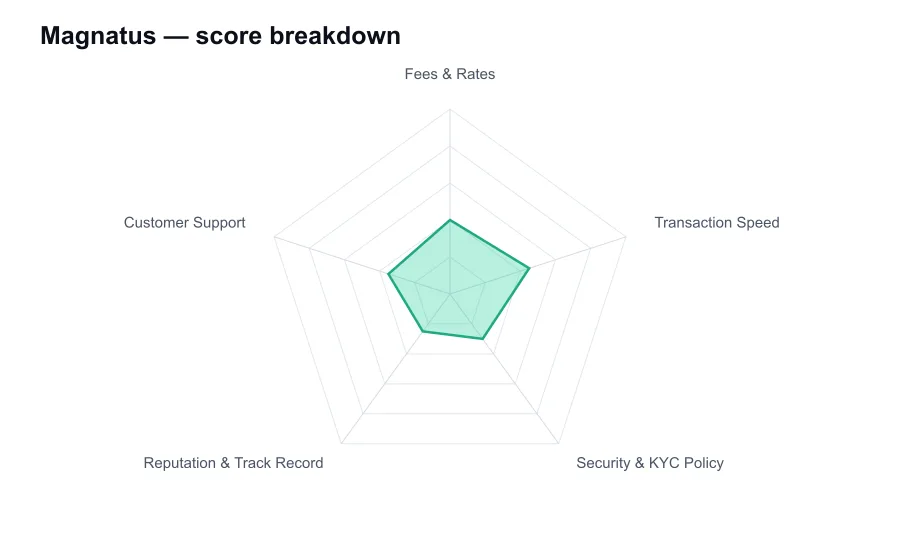
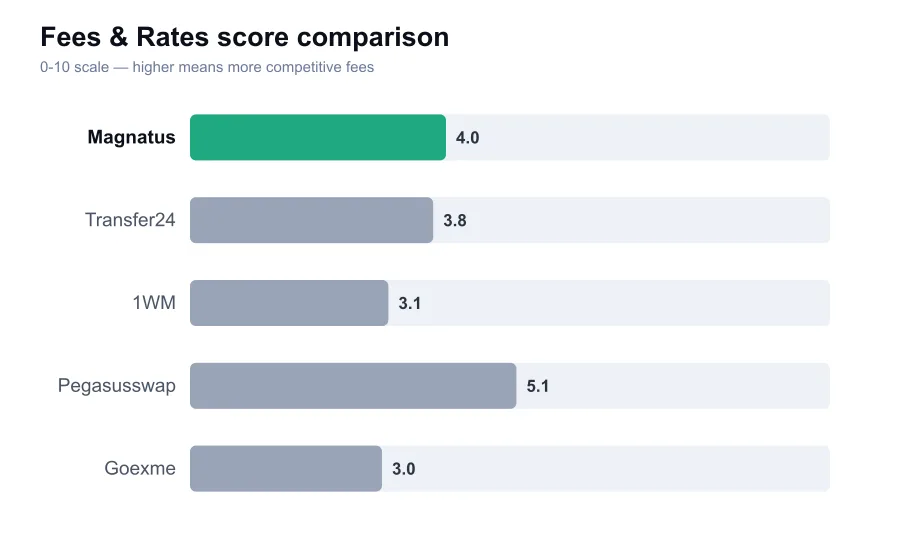
Fees are difficult to score generously because Magnatus does not appear to publish the kind of comprehensive, auditable fee schedule serious users should expect. With a traditional exchange, you can inspect maker and taker rates, withdrawal charges, spreads, and minimums before depositing. With a swap provider, the equivalent is a quote that clearly separates network cost, service fee, and market spread. If the only meaningful price disclosure arrives at the moment of a transaction, users cannot properly compare the offer.
That does not automatically mean every quote is expensive. A provider can offer a reasonable all-in exchange rate without presenting each component separately. The problem is repeatability. A user who receives an attractive quote for one BTC to USDT trade has no assurance that the next route will be similarly priced, particularly on thinly traded assets or during volatile periods. Check the final amount against at least two established alternatives before confirming anything.
Speed is similarly route-dependent. A non-custodial style swap can be fast if the service has liquidity available and the source network is uncongested. Bitcoin deposits need confirmations, Ethereum transactions can be delayed by gas conditions, and some assets require destination tags or memos. Those realities are normal. What is less acceptable is a provider failing to show a clear transaction status, expected processing stage, and practical explanation of what happens after funds arrive.
For simple major-asset conversions, users should think in terms of minutes to an hour, not an instant promise. A transaction that remains unresolved for several hours needs an accessible support channel and a reliable transaction identifier. Magnatus has not earned a reputation for operational transparency in the way larger services have. That makes delays more worrying, because there is little independent evidence about how consistently cases are handled when an automatic swap fails.
Security is not only about whether a website uses HTTPS or offers a wallet address. The relevant questions are who controls funds after deposit, whether the business publishes its legal identity, whether it has incident disclosures, and whether customers can verify support contacts outside the site itself. Magnatus does not offer enough visible evidence in these areas to justify treating it like an established custodian. Don't keep funds there, and don't treat a successful first swap as proof of long-term reliability.
KYC policy also needs plain language. Many small exchange services advertise ease or privacy, then request identification after a transaction triggers an internal compliance rule. That is a common industry practice, but it becomes dangerous if the service has not explained the triggers, review process, and options available to customers whose funds are held. Before sending coins, read the terms closely and assume that a flagged transfer may require documentation.
Reputation is Magnatus's weakest category. I could not identify a broad, durable body of credible third-party commentary, major industry coverage, security audits, regulatory registrations, or years of independently verifiable customer experience. Absence is not proof of misconduct. It is proof that the customer has less information to work with. In financial services, that is enough to reduce the amount you should risk dramatically.
Customer support should be tested before money moves. Send a specific pre-sale question about a network, refund policy, minimum amount, or a hypothetical missing memo, then judge the quality and speed of the answer. A vague response, a social account with no verifiable link to the service, or a support address that cannot explain a basic policy is a reason to walk away. An exchange's real character usually appears when a transaction does not go as planned.
The practical risk with Magnatus is not merely that a swap could be slower than expected. It is that a user has limited recourse if the quoted rate changes, the destination network is suspended, a compliance review starts, or a refund is needed. Larger competitors are not perfect, but they usually have documented procedures, more visible teams, and enough public cases to judge how they respond under pressure.
I would not call Magnatus a sensible primary exchange. There is no compelling public evidence that it beats better-known alternatives on price, speed, asset access, or customer protection. Its low-profile model might suit a technically capable user experimenting with a very small amount, provided that user independently verifies every address and quote. That is a narrow use case, not a recommendation for routine crypto buying or storage.
My view is blunt: Magnatus has not supplied enough public trust signals to overcome the risk of its obscurity. Start with a regulated exchange for fiat purchases and use a well-known non-custodial swap service only where it genuinely solves a problem. If you choose Magnatus anyway, make the first transfer small, retain every transaction record, avoid illiquid pairs, and don't send an amount you cannot afford to have tied up during a dispute.