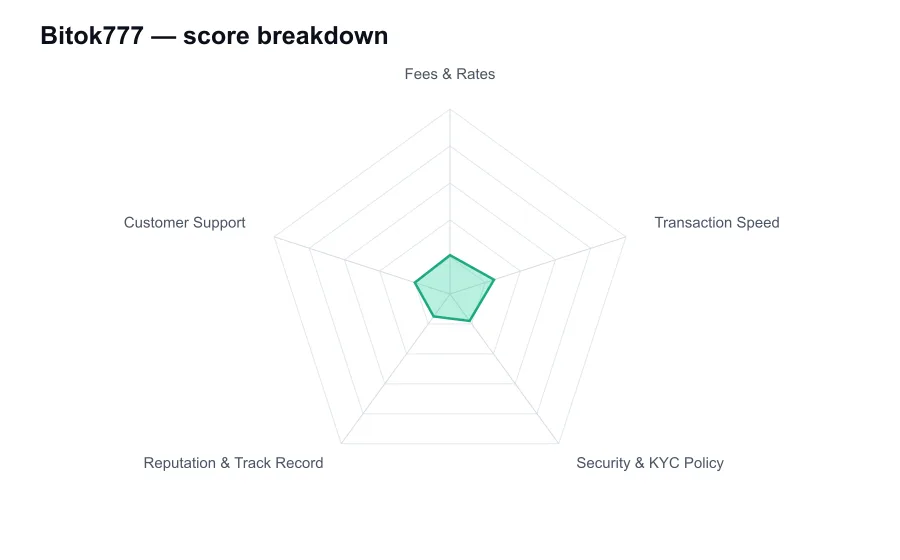
Bitok777 belongs in the category that should make a careful crypto user slow down before depositing: a lightly documented brand with a name that does not carry a substantial public operating history. The crypto market is full of sites that promise easy conversions, large returns, or frictionless account access. Some are merely small businesses. Others are short-lived operations built around aggressive acquisition tactics. Without strong independent evidence, a reviewer should not give Bitok777 the benefit of the doubt.
That isn't a claim that every transaction through the service will fail. It is a statement about evidence. A trustworthy exchange normally leaves a trail: identifiable legal ownership, a clear jurisdiction, detailed terms, security documentation, consistent public support channels, external coverage, and years of verifiable customer interaction. Bitok777 does not have the sort of well-established public profile that lets a customer verify those basics with the confidence available at Kraken, Coinbase, Bitstamp, or a respected regional operator.
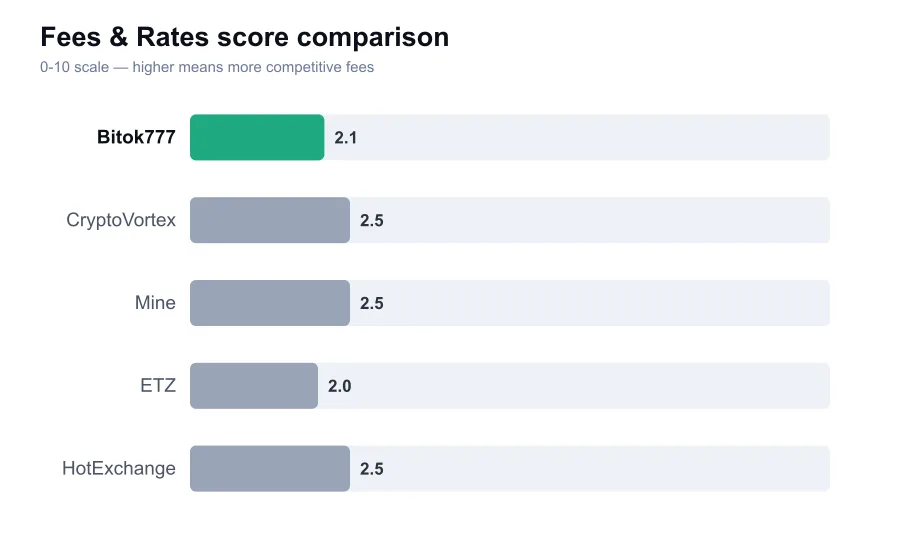
The first warning sign in evaluating a little-known crypto provider is often the fee story. A site may advertise low or zero commission while making money through an unfavorable rate, a withdrawal charge, an account-upgrade demand, or an unexplained processing requirement. There is no credible reason to judge Bitok777's pricing by a banner or a claim alone. The user needs to know the exact asset amount sent, the exact asset amount promised, the blockchain network, and every fee that can arise before and after the deposit.
If a provider cannot present that information in a stable, readable form, it is not competitive on fees, whatever headline it uses. Legitimate exchanges do not need users to discover the cost only after money is inside the system. A normal spread can be compared. A vague promise of a better rate cannot. This is especially serious if the platform encourages deposits in stablecoins, because customers may assume a stable asset eliminates risk while the real risk is the counterparty.
I would not send a meaningful sum to Bitok777 in pursuit of a supposedly exceptional rate. A few basis points saved on a quote are irrelevant if withdrawal reliability is uncertain. The correct benchmark is not the best possible price on a screen. It is the amount a user can reliably receive in a wallet or bank account they control. A provider with transparent fees and a proven withdrawal record is cheaper than an opaque provider that leaves funds in limbo.
Speed claims also need to be separated from reality. Depositing cryptocurrency is easy because a blockchain will record a transfer to almost any valid address. The meaningful test is the outbound side: whether Bitok777 credits the deposit correctly, permits withdrawal without invented obstacles, and broadcasts the payout in a reasonable period. There is no substitute for public evidence of this behavior across time. A dashboard showing a balance is not proof that the balance is liquid or withdrawable.
Users should be particularly wary of requests to pay an extra fee to release a withdrawal, unlock an account, cover an alleged tax, or complete a security verification after funds are already held. Network withdrawal fees can be legitimate, and regulated companies can require KYC. But fees and verification requirements should be disclosed before a deposit, not introduced as a succession of new hurdles after the customer asks to withdraw. That pattern is a major fraud indicator across crypto scams.
The security position is impossible to rate highly without verifiable information about custody, wallet controls, penetration testing, incident response, and account protection. A padlock in the browser only means the connection is encrypted. It says nothing about whether customer funds are segregated, whether withdrawals require robust authentication, or who controls the private keys. Many unsafe services have perfectly modern-looking websites. Design is not due diligence.
A responsible exchange will normally explain how it handles two-factor authentication, suspicious login detection, withdrawal address changes, and support impersonation. It will also provide a clear legal entity and realistic risk disclosures. If Bitok777 offers incomplete answers on these subjects, users should view that omission as information. Crypto is an industry where opacity usually benefits the operator, not the customer.
KYC creates an awkward but important test. Some customers seek a no-KYC service because they value privacy, but no-KYC marketing can also become a way to sidestep accountability. Conversely, a sudden KYC request after funds are deposited is not automatically legitimate just because the provider invokes compliance. The key question is whether the policy was specific, public, proportionate, and backed by an identifiable business. Bitok777 does not have the visible credibility needed for a customer to confidently hand over both crypto and identity documents.
That last point is crucial. Do not upload a passport, selfie, proof of address, or bank statement to an obscure platform merely to recover a small deposit. Those documents have enduring value to identity thieves. If a service's legal identity and data practices cannot be independently verified, the user may be exchanging one risk for another. The safest outcome is to avoid creating that dilemma in the first place.
Reputation is Bitok777's weakest category. There is no broad, longstanding record of regulated operations, sustained specialist coverage, or transparent corporate accountability that would support a high trust score. A few online comments, affiliate pages, or social profiles do not close that gap. Scammers and weak operators can generate those signals cheaply. Reputation must be built through time, public scrutiny, and accountable behavior under pressure.
Even the name should make users alert to impersonation and search-engine confusion. Crypto brands using generic words and numbers can be difficult to verify, which creates room for cloned domains, fake support accounts, and misleading promotional pages. Never rely on a link delivered through Telegram, WhatsApp, Discord, or a direct message. If a platform is hard to identify through independent sources, that is a reason to avoid it, not a puzzle the customer needs to solve with money at stake.
Support cannot compensate for weak transparency, but poor support makes everything worse. A reputable operator offers a documented route for account issues and transaction disputes. It does not pressure users through private messages, ask for seed phrases, or demand remote access to a computer. Any alleged Bitok777 representative requesting a wallet recovery phrase should be treated as a scammer. No legitimate support team needs it.
For someone who has already deposited, the sensible steps are conservative. Preserve screenshots, transaction IDs, wallet addresses, timestamps, and every message. Attempt a small normal withdrawal if the interface permits it, but do not send more funds to unlock existing funds. Do not pay a purported tax or recovery charge through a separate wallet. If the service blocks access or requests escalating payments, seek advice from the relevant payment provider, law enforcement, and a qualified local fraud-reporting channel.
There is no user type for whom I would actively recommend Bitok777 based on the publicly verifiable information available. Crypto newcomers should use a regulated, well-known platform and learn self-custody slowly. Experienced users who want decentralized trading have better options in established noncustodial protocols, provided they understand smart-contract and wallet risks. Neither group needs to gamble on a provider with an unclear track record.
My verdict is blunt because the downside is too large for polite ambiguity. Bitok777 has not demonstrated the transparency, public reputation, security evidence, or support accountability required for a positive exchange recommendation. A glossy offer, fast chat response, or unusually favorable quote would not alter that assessment. Keep funds and personal documents away unless you can independently establish a legitimate operating entity and a strong record that is presently missing.