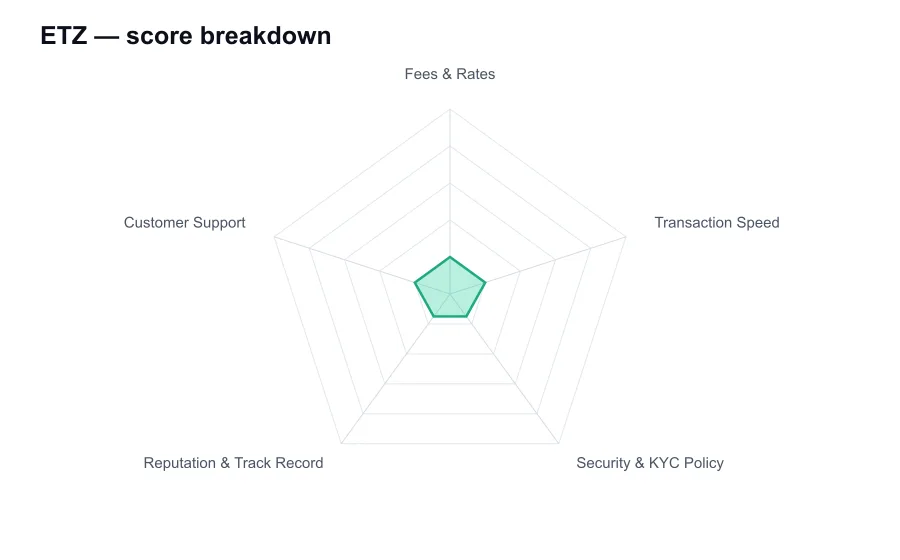
ETZ is the hardest provider in this group to assess responsibly because the name does not resolve to a clearly established, widely documented crypto exchange brand. In crypto, that is not a minor research inconvenience. It is a risk signal. Short names are routinely reused by tokens, apps, shell projects, social accounts and websites, and a search result alone is not enough to establish who operates a service or what legal entity holds responsibility for customer funds.
A serious exchange review starts with basics: an official domain, a legal operator, jurisdiction, terms of service, fee schedule, custody model, supported assets, licensing claims and meaningful public history. For ETZ, I could not independently verify a sufficiently clear set of those facts to recommend it as a trading or swap venue. I am deliberately not attaching an official URL here. Inventing one, or assuming a similarly named site is the intended provider, would be irresponsible.
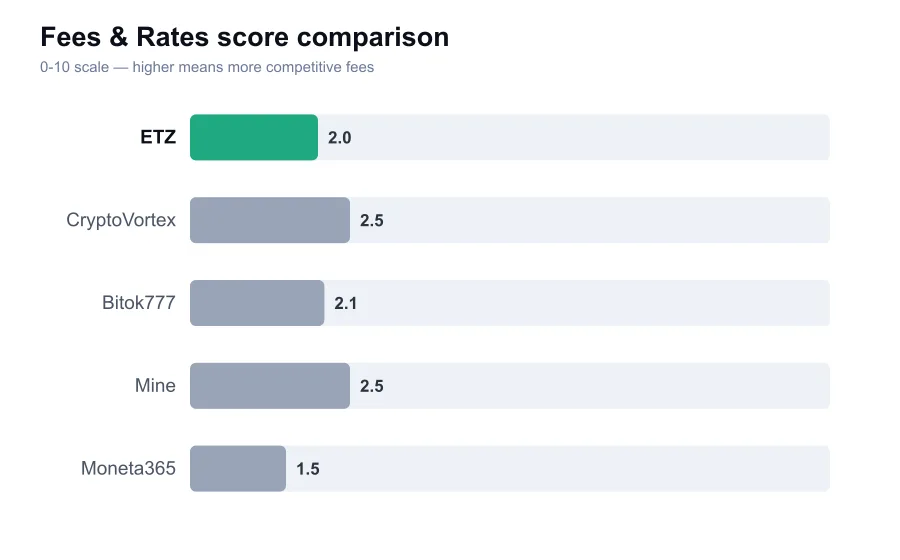
That lack of verifiable information affects every scoring category. Fees cannot be judged fairly when there is no authoritative published schedule to inspect. A provider may advertise zero fees while embedding a large spread in the rate, or it may charge withdrawal and network fees that only appear at checkout. Without a stable, official fee page and testable public quotes, any claim that ETZ is cheap would be marketing repetition rather than analysis.
The same applies to speed. An exchange can claim instant settlement, but users need to know whether that means an internal ledger update, an onchain transfer broadcast, or actual blockchain confirmation. Those are very different things. A legitimate provider should explain confirmation requirements, processing windows, downtime procedures and how users can track an order. If this information is not available before funds are sent, a customer is being asked to accept too much uncertainty.
Security cannot be inferred from a polished logo, a modern landing page, or a social media account. For a custodial exchange, I would expect a named operating company, a clear security architecture, information on cold storage or custodial partners, two-factor authentication, withdrawal controls, incident procedures and ideally evidence such as proof of reserves or third-party security work. For a noncustodial swap provider, I would want a transparent explanation of liquidity partners, compliance holds and asset flow.
ETZ does not earn credit simply for using crypto vocabulary such as decentralized, encrypted, secure or AI-powered. Those terms have no value without verifiable implementation details. If a service asks users to deposit crypto before it can demonstrate who runs it and how a withdrawal works, I would assume the burden of proof has not been met. In this market, the safer default is to walk away, not to send a test amount that may be difficult to recover.
KYC policy is another area where ambiguity creates problems. Some users seek no-KYC services for privacy, while others need a regulated venue with clear identity checks and transaction records. Either model can be described honestly. What should concern users is a provider that markets anonymity but reserves the right to freeze assets without publishing a comprehensible AML process, or a provider that collects sensitive identity documents without identifying the entity responsible for protecting them.
There is also a difference between no account and no accountability. A noncustodial protocol may not require an account because trades are executed through public contracts. A centralized service that avoids providing a company identity is not automatically private or decentralized. It may simply be opaque. ETZ's unclear public footprint makes it impossible to place it confidently on either side of that line.
Reputation is built slowly through independent references, public incident history, long-term user reports, named team members, business registrations, open source work, regulatory records and years of successful withdrawals. It is not built by a few anonymous five-star comments or by a listing on a low-quality directory. I could not establish the kind of independent, long-running track record that would justify trust with meaningful funds under the ETZ name alone.
That does not prove ETZ is fraudulent. It does mean there is insufficient evidence to treat it as a proven provider. Responsible reviewing is not about declaring every obscure service a scam. It is about recognizing that a user cannot meaningfully price risk when the operator, product and record are unclear. An unknown exchange has to earn confidence. Until it does, the sensible score is low, not neutral.
Support is especially important at little-known providers because the usual failure modes are mundane: a deposit is credited late, a token uses the wrong network, a withdrawal is held, an account is locked, or a compliance review begins after funds arrive. A credible service should offer a documented support route, published response expectations, ticket references and a verifiable public support presence. Private messages from accounts with similar names are not customer service and should never be trusted.
Anyone considering ETZ should first perform basic verification outside its own promotional materials. Find the legal entity in a relevant company registry. Read terms and privacy policies for matching company names and dates. Look for a published fee and withdrawal schedule. Verify official social links from the domain, not from search ads. Search for credible reporting, regulatory warnings, technical documentation and a history of users completing withdrawals over time.
If the service claims to be licensed, verify that claim directly with the named regulator. If it claims to be noncustodial, identify the contracts, wallet flow or exchange mechanism that makes that true. If it claims proof of reserves, look for a current independently verifiable attestation rather than a screenshot. If the answers are vague, contradictory, or hidden behind a deposit requirement, stop there. No attractive rate compensates for uncertainty about whether funds can be withdrawn.
A small test transaction is often suggested for unfamiliar services, but that advice has limits. It can establish whether a wallet address receives a small transfer. It cannot establish solvency, fair treatment during a compliance dispute, safety of stored identity documents, or the reliability of a large withdrawal during market stress. Testing is a safeguard, not a substitute for due diligence. Never increase the amount just because one small transaction succeeded.
The practical comparison is unfavorable to ETZ. Established providers such as Kraken, Coinbase, Bitstamp and regulated regional exchanges offer clearer corporate disclosure and support channels, even if they demand KYC. For self-custody swaps, recognizable protocols and established aggregators provide transparent onchain transaction paths. Those alternatives are imperfect, but their risks are at least easier to identify, compare and manage.
My view is straightforward: ETZ should remain on the watchlist, not in the wallet. Until a specific, independently verifiable ETZ service can show who operates it, how it prices trades, what happens to customer assets, and how it handles disputes, I would not recommend depositing funds. The low scores are not punishment for being small. They reflect the absence of the evidence a reviewer needs before telling readers that a crypto provider is trustworthy.