BtcChange24 belongs to the older-school online exchanger category, where the product is not a trading terminal but a conversion service. These platforms are often used by people moving between crypto, stablecoins, and sometimes payment-system or fiat-linked options. The model can be convenient, especially for users who do not want the delays and documentation demands of a large exchange. It also creates a different kind of risk, because the customer is relying on a relatively small operator to execute a transfer correctly.
The service is best judged as an exchanger, not as an investment platform. There is no reason to expect the tools, liquidity visibility, custody safeguards, or regulatory framework associated with a serious global exchange. That distinction sounds obvious, yet it is where people get into trouble. A website can look clean and offer dozens of directions while still having much thinner reserves, fewer support staff, and less room to absorb operational mistakes than the biggest names in crypto.
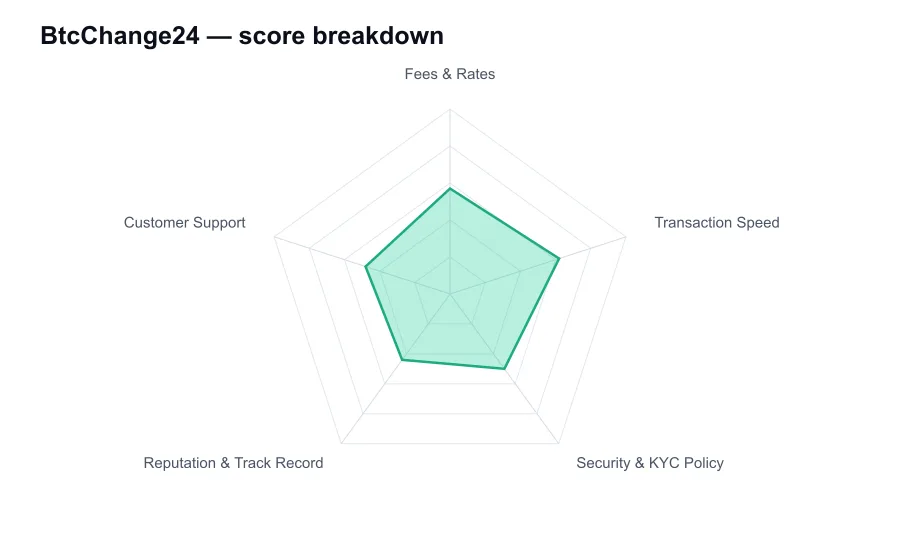
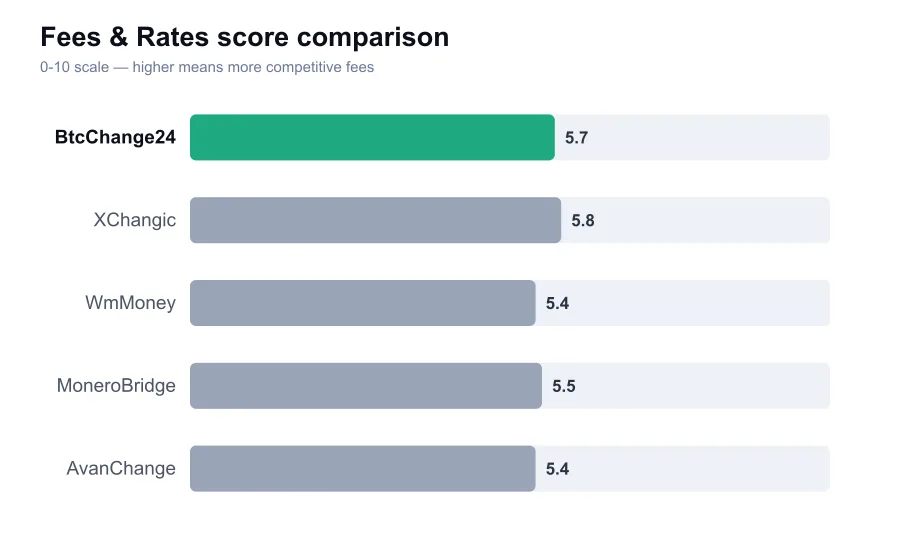
BtcChange24's fees are likely to matter more in the exchange rate than in a plainly itemized commission. That is standard in this sector, but it is still frustrating. A user should be able to tell whether a difference in payout comes from a service fee, a market spread, a reserve constraint, or a network charge. With quote-driven exchangers, you often only see the final answer. The fair way to use BtcChange24 is to compare that answer, not to assume the advertised direction is cheap.
On major, liquid pairs, the difference may be tolerable for someone valuing convenience. On less common assets or routes involving payment processors, the gap can be substantial. This is where a small exchanger can become expensive without explicitly looking expensive. A 2 percent or 3 percent difference against the best available quote may be an acceptable price for speed. A much wider gap is not, particularly if you are exchanging an amount large enough for the difference to matter.
Fixed-rate and floating-rate language also deserves close attention. A fixed quote can protect a customer from a sudden market move, but only if the provider defines the time window, required deposit amount, and conditions for honoring it. A floating quote exposes the customer to market movement until execution. Neither structure is inherently superior. What matters is whether the platform tells you clearly which one you are accepting before funds leave your wallet.
BtcChange24 can be fairly quick on normal orders, especially for assets with cheap and fast networks. But this is not a service where I would promise a precise completion time to a client or use it for a deadline-heavy payment. The exchange has to receive the deposit, wait for enough confirmations, source the outgoing asset, and broadcast the payout. Delays can occur at every one of those stages. Weekend timing and third-party payment methods can add another layer of uncertainty.
The real measure of speed is how an exchanger behaves when the simple path breaks. An underpayment, an old rate, a memo omission, or a compliance flag can all move the order from automated processing to manual review. BtcChange24 does not have the public operational footprint that lets me assume these cases are resolved quickly. That does not mean every issue becomes a problem, but it does make a small test transaction the sensible entry point.
Security is partly about technology and partly about business behavior. Users should verify the exact web address manually, use a fresh wallet address supplied for the order, and avoid communicating through unsolicited social-media accounts. Impersonation is common around small exchangers because users do not have years of brand familiarity to fall back on. A support agent who asks you to send funds to a different address outside the created order should be treated as a major warning sign.
The KYC situation should also be approached realistically. BtcChange24 may offer a low-friction process for ordinary exchanges, but no responsible reviewer should tell users that identity checks are impossible. Financial-crime controls, sanctions screening, unusual transfer sizes, and blockchain-risk signals can lead to a request for documents. If preserving privacy is essential, read the current rules before depositing and understand that refusing a requested review may complicate recovery of a held order.
The reputation picture is mixed simply because BtcChange24 lacks the broad, extensively audited public record of a large exchange. In this segment, review-site ratings can be useful signals but should not be treated as proof. Look at dates, complaint detail, and replies. A pile of vague five-star comments tells you less than a handful of specific reports explaining whether the quoted amount was honored and whether support solved a real problem.
I would be especially cautious about reserve claims. A service can list a direction as available while needing to source liquidity after a deposit arrives. That is not necessarily deceptive, but it affects delivery time and price certainty. For larger swaps, ask support about limits and expected execution before creating an order, then keep the conversation attached to official channels. If the response is evasive, move on. Crypto has too many alternatives to reward opacity.
Customer support looks like a practical necessity rather than a standout strength here. For routine questions, a ticket or chat channel may be enough. For a disputed transaction, users need more than reassurance. They need transaction IDs, clear status explanations, and a named process for escalation. Smaller exchangers often fail at this point by communicating in fragments. BtcChange24 would benefit from more visible documentation around delayed, incorrect, or compliance-reviewed payments.
There is a certain user for whom BtcChange24 can work well. It is the person who understands confirmations, checks addresses character by character, and is exchanging an amount small enough that a delay is inconvenient rather than damaging. That user can use the service's directness to good effect. The inexperienced buyer who expects bank-like reversibility should stay away. Blockchain transactions are final, and an exchanger cannot undo a mistake after coins have been sent.
My view is restrained. BtcChange24 can be a usable tactical option if its live quote beats alternatives and the transaction is modest. It does not present enough independently verifiable depth, transparency, or support confidence to deserve blind trust. Compare it against more established instant exchangers and regulated trading platforms before sending. If it wins on the actual payout and you can accept the counterparty risk, use it carefully. If not, there is no shortage of better-known places to exchange crypto.