WmMoney is positioned in the online exchanger market, where the main job is moving value between cryptocurrencies, electronic money systems, cards, and bank transfer methods rather than operating a full featured trading venue. Services in this category can be genuinely useful, especially for users dealing with payment rails that mainstream exchanges do not support. They also demand more personal caution because the transaction is fundamentally counterparty based.
The brand should not be confused with a conventional bank, a regulated brokerage, or a major crypto exchange simply because its name sounds financial. A customer generally creates an exchange order, pays into the stated route, and receives the corresponding asset or payout after processing. That is a much narrower service than custody, investing, or long term account management. Understanding that boundary avoids unrealistic expectations.
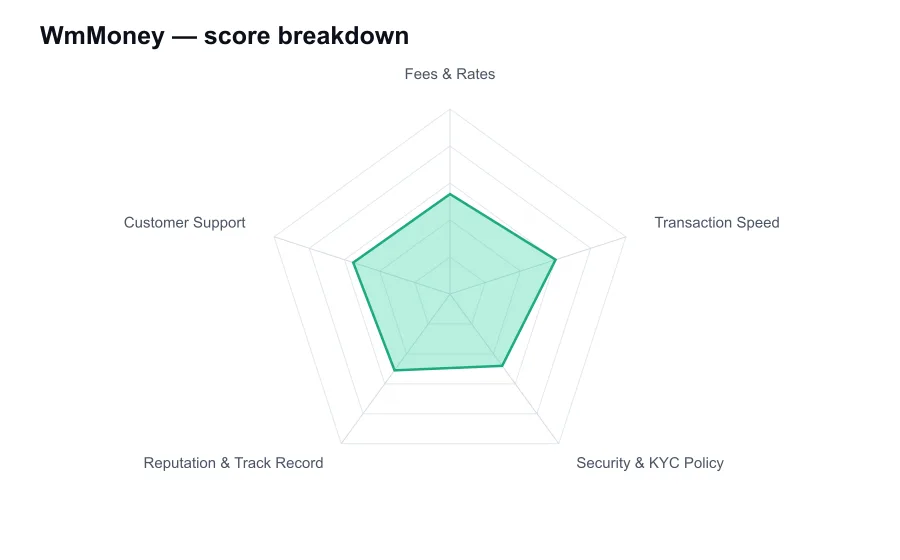
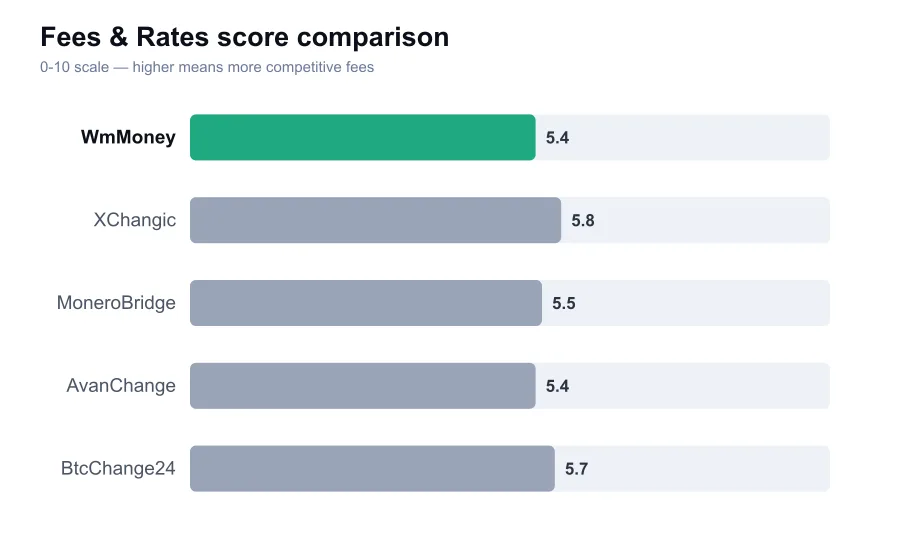
Pricing is where an exchanger must earn its keep. WmMoney's cost is likely to be primarily contained in its quoted exchange rate rather than displayed as a tidy maker and taker schedule. This can be convenient because the user sees a final amount before payment. It can also hide a large premium if the customer has not checked a market reference and competing offers. The quote is the fee calculation in practical terms.
A favorable rate is only meaningful after checking minimums, maximums, available reserves, and payment method charges. Card and electronic money directions can carry costs that are not visible in a crypto market price. A small transfer may be uneconomic because a fixed operational spread has a larger percentage effect. Conversely, a large order may trigger a rate recheck, liquidity constraint, or manual compliance discussion. Neither outcome should surprise an informed user.
For price sensitive crypto buyers, a liquid exchange plus a bank transfer is usually the lower cost route, provided the user is eligible and prepared to complete KYC. WmMoney's case is convenience. It may solve a particular payment problem in one step where a conventional exchange would require several accounts and withdrawals. That service can be worth paying for, but it is not automatically cheaper because it appears simpler.
Settlement speed follows the same pattern. An uncomplicated crypto order can be completed soon after required confirmations arrive and the exchanger has matching liquidity. Electronic payment systems may be quick in normal conditions. Bank and card withdrawals are less predictable, because the sending operation can finish while the receiving institution still places its own delay, limit, or fraud review on the money.
The customer should read the payment instructions closely before starting. Exchangers often require an exact amount, a specified memo, and payment from an account in the customer's own name. A missed instruction can turn an otherwise fast conversion into a support case. Taking a screenshot of the order details and transaction hash is not paranoia. It is the simplest way to make a payment lookup easier if something does not match automatically.
Security should be judged according to the role WmMoney actually plays. HTTPS and a clean website interface are basic expectations, not proof of financial strength. The decisive question is whether you are comfortable sending the stated asset to the business for a one time settlement. Since the service is not where anyone should store a balance, the safest behavior is to use it for the exchange, receive the output, and move on.
There is also an unavoidable compliance angle. Some people assume an exchange without a lengthy registration form guarantees privacy. It doesn't. A transaction can be screened or held if the payment source, wallet history, size, or bank behavior raises a concern. This is particularly important with funds coming from third parties, gambling related sources, sanctioned regions, or wallets associated with stolen crypto. Ask before sending if the order has unusual circumstances.
WmMoney's public reputation should be assessed conservatively. Smaller exchanger brands may have monitoring site listings and customer reviews, which provide some evidence that ordinary orders are fulfilled. They rarely provide the level of disclosure found at a major exchange, such as detailed corporate reporting, reserve information, deep licensing records, or independent audit material. That does not prove the service is unsafe. It means the user has less evidence to lean on.
The sensible test is a small initial order through the exact route you expect to use later. Confirm that the website domain is correct, the support contacts match the official site, and the payout reaches the intended wallet or account. Do not be persuaded by a social media message to change a wallet address. A legitimate staff member should be able to work from the order number inside official support, not pressure you in a private messenger.
Support quality can make or break an exchanger, because the routine transaction needs almost no conversation. WmMoney is most valuable when its team can trace a payment promptly and explain the next step in plain language. If an issue involves anti money laundering review, expect a slower process and potentially document requests. That is frustrating, but a clear, documented response is far better than a vague promise that an operator is checking.
I would reserve WmMoney for modest conversions where its particular direction offers a practical advantage. It is not the right place for a treasury balance, aggressive trading, or a deadline that cannot survive a payment provider delay. Users with high volumes are better served by an exchange with transparent tiers or by an OTC desk that agrees the process and documentation in advance. Convenience is valuable, but it should be used within limits.
WmMoney can fill a useful gap between crypto wallets and local payment systems. Its strengths are the simple transactional model and potential access to payment routes outside a global exchange's core offering. Its limitations are structural, rate spreads, reduced public transparency, and dependence on manual help when an order breaks. I would use it only after rate checking, with a small test transaction, and with no funds left exposed beyond the time needed to settle.