CoinCraddle does not have the kind of verifiable public footprint that a reviewer should demand from a crypto exchange, broker, or payment provider. I cannot confidently identify a long standing regulated business, independently confirmed operating history, transparent ownership structure, or reliable official documentation under this name. That is not a small administrative gap. In crypto, uncertainty about who runs a platform and under what legal framework is one of the clearest reasons not to deposit funds.
A polished website, if one is presented, would not solve that problem. Fraudulent crypto operations regularly borrow the language of established exchanges, advertise impossible returns, show fabricated trading dashboards, and use testimonials that cannot be verified. A live looking balance is not proof that assets exist or can be withdrawn. The only meaningful test is whether the service has a documented legal identity, credible independent coverage, clear terms, and a demonstrated record of honoring withdrawals without pressure or additional payments.
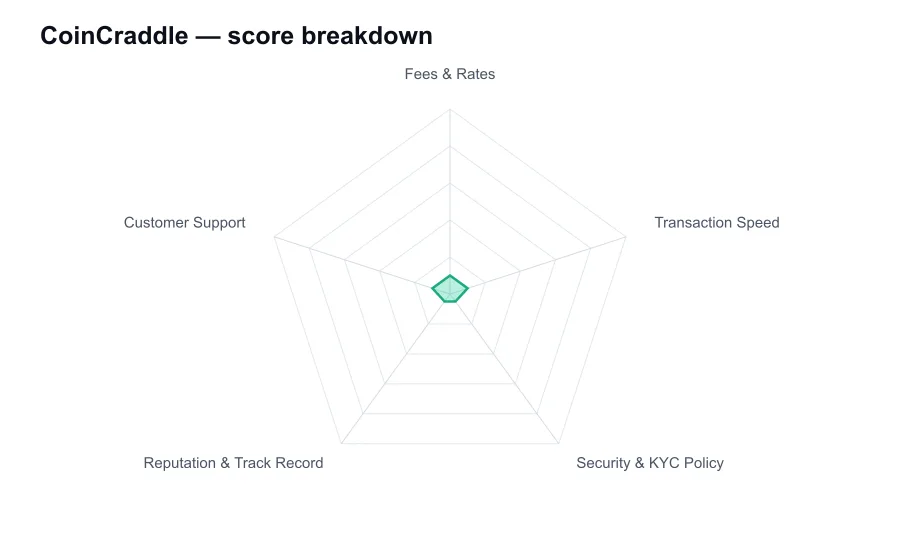
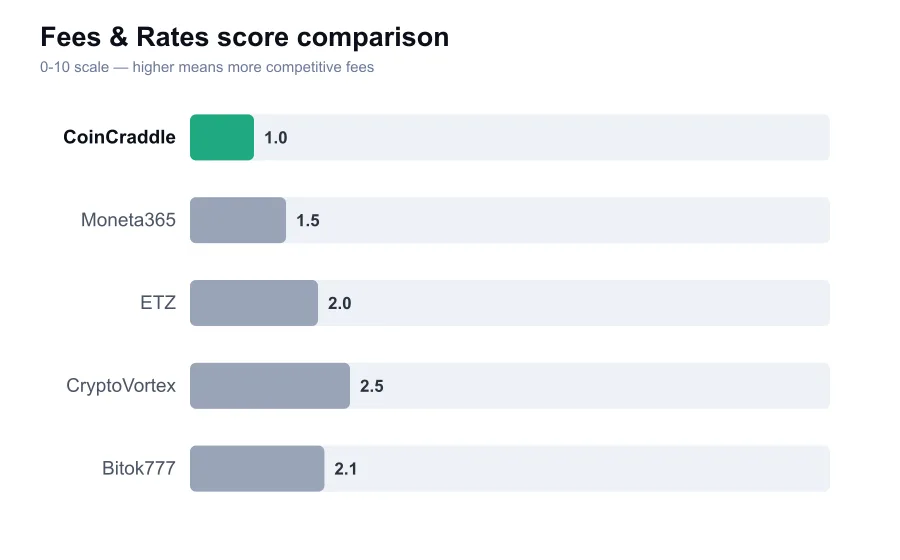
Because CoinCraddle's fee schedule cannot be reliably verified, it cannot receive a normal fees score. There is no defensible basis for claiming low trading charges, competitive spreads, or transparent withdrawal costs. A platform that does not publish clear fees before deposit is already failing a basic consumer standard. Worse, some questionable operations initially show no fee at all, then demand a tax, insurance payment, account upgrade, liquidity charge, or verification deposit before releasing funds. Legitimate exchanges deduct disclosed fees from balances or explain requirements in advance.
Do not send CoinCraddle money to discover what it charges. Ask for a complete written fee schedule first, including trading commissions, spreads, deposit costs, withdrawal charges, minimums, inactive account fees, liquidation rules, and currency conversion margins. If the answer is vague, if fees change after a profitable trade, or if an agent says you must pay more crypto to unlock a withdrawal, stop. That is a classic danger signal, not routine exchange administration.
Speed claims are equally impossible to assess responsibly without verified users, operating statistics, API documentation, and evidence of actual settlement. A screen that updates prices quickly proves only that it can display prices. It does not prove that orders are routed, that liquidity is real, or that withdrawals will be broadcast to a blockchain. The part that matters is not how fast a dashboard animates. It is whether a user can move their own money out promptly and without invented conditions.
This is where many victims get trapped. An alleged account manager may say a withdrawal is delayed by compliance, market volatility, blockchain congestion, or an administrative queue. Real compliance reviews do occur, and blockchain networks can be busy. But a legitimate company can identify itself, explain the issue, state what documents are needed, and provide a formal support trail. It does not demand a personal payment, remote access to your device, or a further deposit as the price of releasing your own balance.
Security cannot be rated highly where the basic identity of the business is unverified. Two factor authentication, encryption badges, and claims of cold storage are easy words to place on a website. The useful questions are tougher. Which company controls private keys? What jurisdiction governs customer agreements? Is there a regulatory register entry that matches the business name and address? Are terms, risk disclosures, privacy policy, and complaint procedures internally consistent? Can those claims be checked independently rather than through links supplied by a salesperson?
A no KYC promise would not reassure me here. On a legitimate noncustodial wallet or a privacy conscious swap service, limited identity checks can be a deliberate model with clear boundaries. On an unverified investment or exchange website, it can simply mean there is no accountable compliance program at all. Conversely, handing identity documents to an unknown platform creates a second risk: identity theft. Do not upload a passport, selfie, bank statement, or proof of address until the operator has been thoroughly verified.
CoinCraddle also lacks a reliable reputation trail. A credible exchange builds one through years of incident reporting, media scrutiny, known executives, regulator interactions, technical documentation, user communities, and independent reviews that contain more than generic praise. I cannot establish that foundation here. Search results, social media comments, and review sites can be manipulated. A handful of five star comments with nearly identical wording is not reputation. It is often marketing material.
The absence of evidence is especially damaging in crypto because the user bears much of the irreversible risk. Card payments sometimes offer a dispute route, although that is never guaranteed. Blockchain transfers are generally final. If you send USDT, Bitcoin, or Ether to an address controlled by a bad actor, there may be no practical recovery path. This is why unfamiliar platforms should face a higher bar than a familiar, licensed exchange, not a lower one because they promise better returns or lower fees.
Support claims should be treated with the same suspicion. A Telegram or WhatsApp contact is not credible financial customer service by itself. Scammers prefer private messaging because it is easy to pressure people, delete messages, and switch identities. A real provider should offer a domain based support route, written policies, a ticket trail, and a way to escalate a complaint. Even then, support quality is only one factor. Fast replies from a persuasive agent do not compensate for an unverified company.
Never let a support agent install screen sharing software or guide you through a wallet connection if you do not understand every permission. Never disclose a seed phrase, recovery phrase, private key, exchange login code, or two factor authentication code. No legitimate support team needs a seed phrase. If someone says they do, assume your wallet is about to be emptied. Change passwords and revoke wallet approvals immediately if you have already shared sensitive information.
If you have already deposited with CoinCraddle and encounter withdrawal trouble, do not send further funds to unlock the account. Preserve screenshots, transaction hashes, emails, chat logs, wallet addresses, and payment records. Contact the bank, card issuer, payment provider, or exchange used to fund the transfer as quickly as possible. Report suspected fraud to the relevant local financial regulator and cybercrime authority. Recovery firms that demand an upfront crypto payment often create a second layer of loss.
The right comparison is not with a flashy new trading app but with platforms that can be verified. Kraken, Coinbase, Bitstamp, Gemini, and regulated local exchanges all have their own shortcomings, and no exchange is risk free. Still, they offer far more public accountability than an obscure brand with no dependable track record. For self custody, established hardware wallet makers and open source wallet software are preferable to leaving funds with an unknown website.
Could CoinCraddle be a new and legitimate service that simply has not established a public record? In theory, yes. New businesses exist. But a reviewer should not convert that possibility into a recommendation, and users should not convert it into a deposit. Financial trust is earned with transparent legal information, independently checkable operations, and time. CoinCraddle has not supplied enough verifiable evidence to clear that threshold.
My verdict is simple: avoid it until and unless its legal entity, ownership, regulatory position, operating history, fees, and withdrawal record can be independently confirmed. The upside of trying an obscure platform is small because reputable exchanges already provide broad asset access and competitive pricing. The downside can be a total and irreversible loss. In this category, caution is not pessimism. It is basic financial hygiene.