SecureShift presents itself as a crypto conversion service rather than a full conventional exchange, which immediately puts it in a crowded and occasionally confusing corner of the market. Services in this category promise a quick route from one coin to another, often without a user account, an order book, or a lengthy identity process. The appeal is obvious: enter an amount, provide a receiving address, send funds, and receive the output asset. The harder question is whether the service provides enough public evidence about pricing, operations, and support to deserve trust with a meaningful transfer.
That question matters more here than it does with a household-name exchange. SecureShift is not a provider with the public footprint, trading history, independent market coverage, or institutional profile of Kraken, Coinbase, Bitstamp, or even the larger instant-swap brands such as ChangeNOW and SimpleSwap. A smaller service is not automatically unsafe. Plenty of useful crypto companies began small. But users should apply a higher standard of verification before sending funds because crypto transfers are irreversible and a slick conversion page is cheap to build.
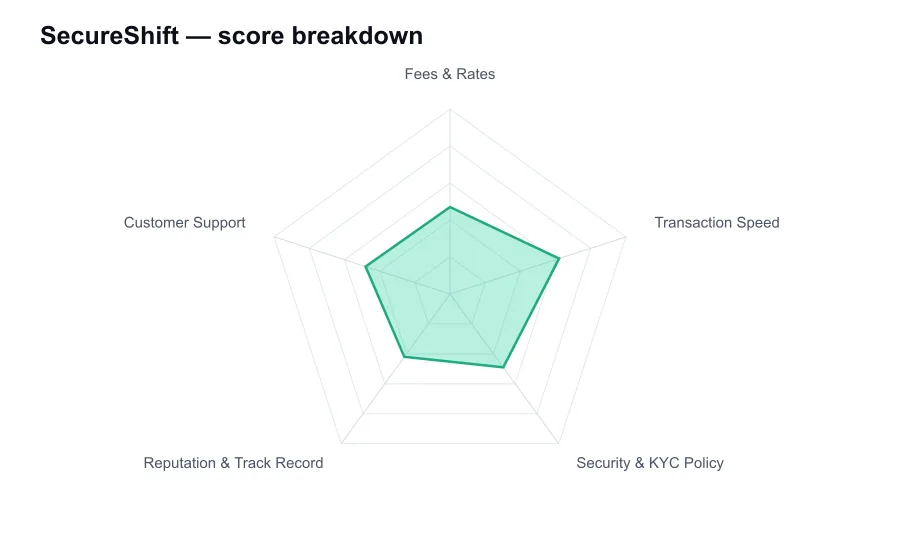
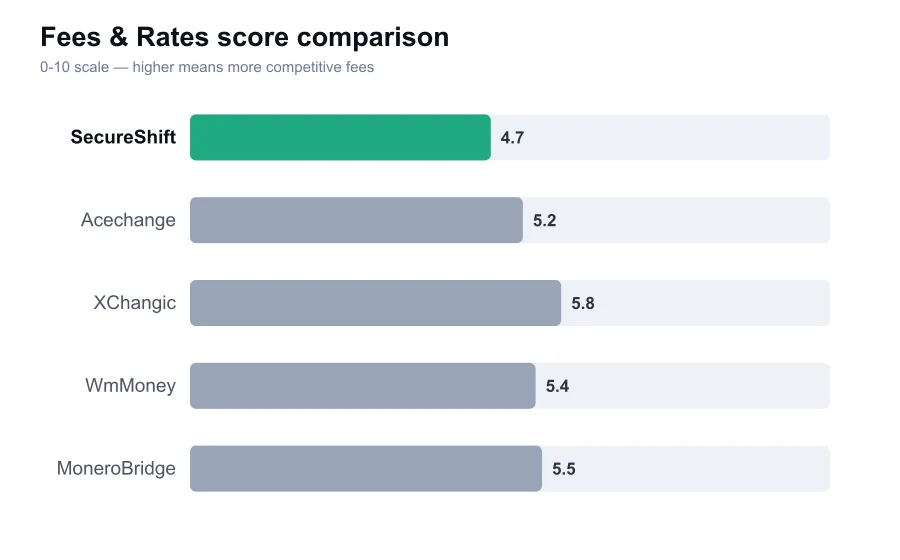
The fee model is the first area where caution is warranted. Instant swap providers commonly earn through a quoted exchange rate, a liquidity-provider spread, network fees, and sometimes an explicit service charge. SecureShift does not have the sort of widely recognized, granular public fee schedule that lets a reviewer confidently say what every customer will pay under normal conditions. That lack of clarity is a disadvantage. A user can still make a sound decision by comparing the quoted output against two or three competitors immediately before sending, but the platform itself does not make independent cost forecasting easy.
Do not focus only on the rate displayed at the beginning of a swap. Find out whether the quote is fixed or floating, whether it expires quickly, and whether the receiving amount can change after the deposit is detected. A floating-rate swap can be perfectly legitimate, particularly in a volatile market, but it exposes the customer to both market movement and the provider's execution process. Fixed-rate swaps offer more certainty, yet they may include a wider spread. The right choice depends on the urgency and amount, but ambiguous quote mechanics are never a feature.
Transaction speed also depends on more than SecureShift's interface. The platform can process a request only after the inbound transaction has enough blockchain confirmations and after any internal risk checks are completed. A Litecoin, Solana, or Tron transfer may arrive quickly. Bitcoin can require materially more patience, particularly if the sender chose a low network fee. Cross-chain conversions add another layer because the service must source and broadcast the output asset. An advertised instant swap should be read as a product category, not a literal guarantee of instantaneous settlement.
For small, routine conversions, a service like SecureShift may be convenient if its live quote is good and the deposit address is verified carefully. That is a narrow endorsement, not a blank check. I would not use a lightly documented swap service for a large portfolio rebalance, a time-sensitive stablecoin transfer, or money I could not afford to have held in a review queue. In those cases, the ability to contact a proven support team, see an established operational history, and use a deep market is worth more than a few minutes saved in onboarding.
The privacy story needs similar skepticism. Non-custodial swap services often say they do not require registration or routine KYC, and that can be true for a normal low-risk transaction. It does not mean the service is incapable of pausing a transfer or requesting verification. Blockchain analytics, sanctions screening, source-of-funds questions, and unusual transaction patterns can trigger review at many providers. Any user who sends funds under the assumption that no questions can ever be asked is misunderstanding the model. No-account access is not the same thing as a contractual promise of anonymity.
Security has two parts. The first is technical: secure web infrastructure, protected operational wallets, sensible transaction handling, and limited custody during the swap. The second is organizational: identifiable operators, clear terms, responsive support, incident disclosure, and a credible track record. SecureShift may reduce the exposure of leaving funds on a centralized exchange for weeks because the intended custody period is short. That is useful. Yet short-term custody remains custody. During the swap, you are trusting the provider to deliver the quoted asset correctly and to resolve a mistake if something goes wrong.
A polished SSL connection or a padlock in the browser does not answer those organizational questions. Every legitimate website has HTTPS. What matters is whether the company has transparent legal information, consistently maintained documentation, authentic public channels, a history that can be checked outside its own marketing, and clear procedures for failed deposits or wrong memo tags. SecureShift's comparatively limited independent footprint makes it difficult to award high confidence on that basis. The absence of widely documented scandals is not the same as a deeply tested reputation.
Support is particularly important for swap providers because there is no order book to cancel and no bank chargeback process to lean on. If the receiving address is wrong, a tag is omitted, the transaction lands below a minimum, or the payout is delayed, the customer needs a human response. SecureShift should be judged by how visibly it explains those scenarios before a deposit is made. If an answer depends solely on a chatbot, generic ticket form, or social-media direct message, that is not enough for substantial transfers. Good support is an operational control, not a cosmetic extra.
There are simple ways to reduce risk if you decide to use it. Start with the smallest amount permitted, preserve the transaction ID and quoted details, and compare the output with at least one established competitor. Make certain the destination network matches the asset, especially for USDT and USDC, where similarly named tokens exist on several chains. Never send a token that is not explicitly listed as supported. And do not allow a search advertisement or unsolicited message to choose the website for you, because fake swap pages are a persistent phishing route.
SecureShift's potential appeal is straightforward. It may offer a quick, account-light conversion workflow for users who already understand wallets and want to avoid parking funds on a large custodial exchange. That can be useful for a modest one-off swap. The problem is that trust is earned through transparency and time, and this provider has less publicly verifiable material than leading alternatives. The burden of due diligence therefore falls more heavily on the user, which undercuts some of the convenience a simple swap service is meant to offer.
I would not call SecureShift a scam merely because it is lesser known. That would be lazy reviewing. I also would not recommend treating it as interchangeable with providers that have years of independently visible operating history, published policies, and broad user scrutiny. The sensible posture is guarded experimentation, not confidence. Test it with a trivial sum if the quote is compelling, avoid sending large amounts, and have a backup route ready. In crypto, opacity around a service's operations is a risk factor even when the front-end experience looks smooth.
My final view is that SecureShift may serve a limited purpose for technically confident users making small conversions, but it has not earned a high trust score from public visibility alone. Its apparent no-account convenience is attractive, and short-duration swaps can reduce the need to maintain an exchange balance. Those strengths do not compensate for unclear fee predictability and a thinner public reputation. Users who want low-friction experimentation can assess it carefully. Users who need reliable execution, meaningful support, or a place for sizeable funds should choose a more established venue.