StealthEX is a noncustodial crypto swap service built for people who want to exchange assets directly from one wallet to another without opening a traditional trading account. It sits in the same broad category as ChangeNOW, SimpleSwap, and SwapSpace, but it has built a recognisable identity around a large asset catalogue, a clean interface, and an emphasis on no-registration swaps. It is not a full exchange, and that distinction matters.
There are no spot order books, no advanced charting tools, and no reason to leave a portfolio sitting on the platform. You choose the coin you are sending, the asset you want back, the destination address, and the rate type. StealthEX then routes the conversion through liquidity providers. For a self-custody user who just wants to turn Litecoin into USDC or Bitcoin into Ethereum, that is a much less cumbersome experience than moving funds through a centralized exchange.
The catalogue is one of StealthEX's stronger points. It supports a very large selection of cryptocurrencies and tokens, including assets that are awkward to find on regulated exchanges. That breadth is valuable, though it should not be mistaken for equal liquidity across every pair. Major pairs such as BTC, ETH, USDT, USDC, SOL, and LTC normally have more dependable execution than obscure tokens with thin markets.
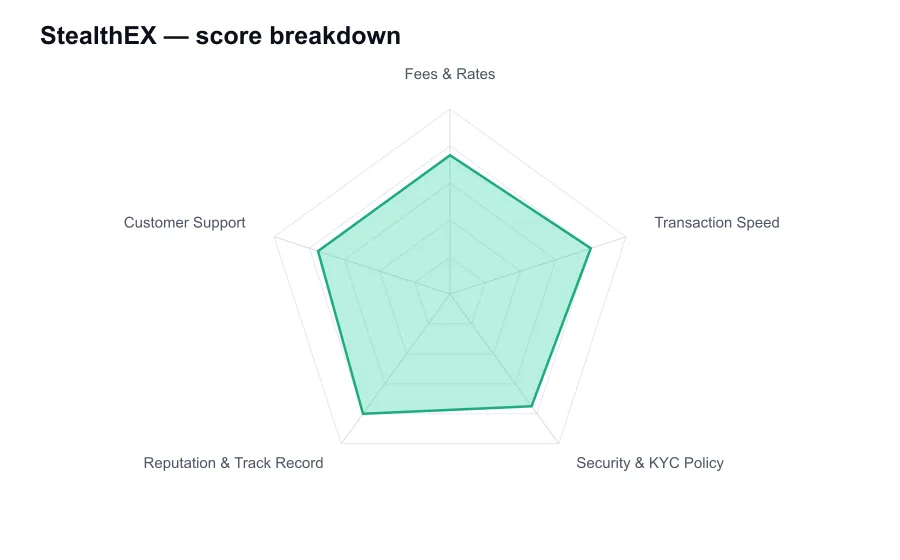
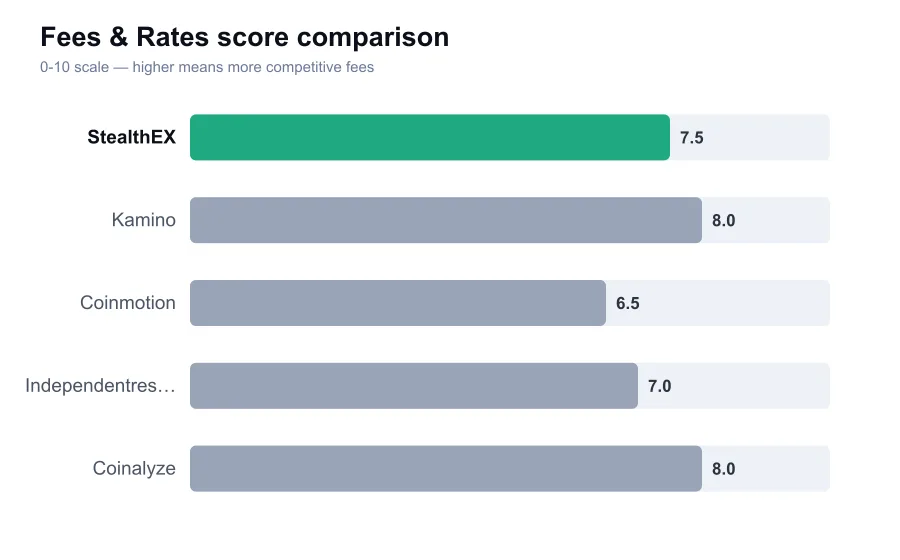
StealthEX says it charges a 0.4 percent service fee on exchanges, with the final rate also reflecting liquidity-provider pricing and blockchain network costs. That is reasonably transparent by instant-swap standards, but the number alone is not the whole bill. The effective cost can still be materially higher on thin pairs, during sharp price moves, or when the network fee for the outgoing asset is expensive. Compare the amount you will receive, not just the advertised percentage.
For liquid pairs, StealthEX is often competitively priced, though it is not consistently the cheapest option. ChangeNOW can sometimes show a better final amount, while aggregators can occasionally find a superior route. StealthEX's advantage is that the quote process is straightforward and the fixed-rate option gives users a clearer choice about price risk. That is more useful than pretending every swap has one universal best provider.
The service offers floating and fixed-rate exchanges. Floating rates track the market after the order is created, so they can work well if prices are stable and liquidity is deep. Fixed-rate swaps lock the expected output within stated limits and are the better choice for users who need a precise amount, especially when converting into a stablecoin, paying an invoice, or dealing with a volatile market. The fixed route may cost more, but it buys certainty.
Transaction speed is generally good for an instant exchange. After the deposit receives the required confirmations, the actual conversion on common routes can be completed in minutes. A simple Litecoin or Tron-based stablecoin swap can be quick. Bitcoin deposits, Ethereum congestion, wallet fee settings, and manual compliance reviews are the usual reasons a transaction takes longer than the optimistic estimate on the order page.
StealthEX is noncustodial in the practical sense that it does not ask customers to maintain an account balance. Funds are sent into a transaction-specific swap process, then released to the receiving wallet. That reduces the risk of leaving coins on a centralized venue for months, but it does not make the service trustless. During the swap, you are depending on StealthEX and its partners to execute accurately and resolve exceptions.
The no-registration approach is attractive, particularly for users who do not want another exchange account tied to their activity. Still, StealthEX is not a guarantee of anonymity. Its terms and compliance process allow transactions to be screened, and it can request KYC information where an order is identified as risky or where a liquidity partner requires it. That is a common reality across instant exchange services, and users should understand it before depositing.
This conditional KYC model is the fairest reason not to call StealthEX purely private. Most uncomplicated swaps may proceed without identity documents, but a flagged transaction can be paused. If that possibility is unacceptable, an on-chain decentralized exchange may be more appropriate, although that creates different risks involving token approvals, slippage, and smart contracts. StealthEX is convenient privacy, not absolute privacy.
Its public reputation is better developed than that of many smaller swap sites. StealthEX has operated for years, has a visible product presence, and is regularly discussed alongside established instant-exchange competitors. That does not make every complaint invalid. Delays, rate disputes, and KYC holds are the recurring pain points across this entire sector. What matters is whether a customer can document the order and get a meaningful answer when something unusual happens.
Support is available around the clock through live chat and email channels, and the site has a useful help centre for routine questions. In normal cases, this is enough. The tougher test is an order involving a missing memo, a wrong network, an under-minimum deposit, or a compliance review. For those events, users should expect a ticket-based process rather than the instant resolution implied by the word swap.
There are a few habits that make StealthEX much safer to use. Confirm the exact chain for USDT, USDC, and other multichain assets. Never send tokens over a network that the order page does not list. Verify destination addresses carefully, retain the order ID and transaction hash, and avoid making a first transaction larger than you can tolerate being delayed for a day or two.
StealthEX is strongest as a practical tool for self-custody users who want broad coin support without the friction of a centralized exchange account. It is weaker for active traders seeking deep execution, people buying with fiat, or anyone who expects guaranteed privacy under every circumstance. The interface is pleasantly uncomplicated, but the transaction itself is still exposed to blockchain timing and third-party liquidity.
My take is that StealthEX belongs in the upper middle tier of instant exchanges. It earns that position through transparent published service-fee language, broad asset coverage, fixed-rate capability, and a more established operating history than many anonymous-looking competitors. It is not the cheapest on every route, and no-KYC should be read with the usual compliance caveat. For a carefully checked wallet-to-wallet swap, it is a credible option. For large trades, compare the quote and split risk rather than blindly trusting any single provider.