XGram operates in the online exchanger category, where the promise is a quick conversion between digital assets and payment methods without the overhead of a conventional trading exchange. It is aimed at users who already know the asset they hold and the destination they need. That narrow focus can make a transaction feel refreshingly simple, but it also removes some of the protection and transparency people take for granted at bigger platforms.
The name should not lead customers to assume an affiliation with a messaging platform or a global remittance company. In the exchange business, branding is often compact and generic, while the important facts sit in the order rules, reserve availability and support response. Those facts matter much more than a slick landing page. XGram should be approached as a transaction counterparty, not as a familiar consumer brand.
The basic exchange flow is familiar. Select the source and destination, see an indicative conversion result, submit recipient details and make the payment. For someone cashing out a crypto amount to a supported payment channel, that can be less intimidating than depositing to an exchange, selling at market and withdrawing. It can also be more expensive, so convenience needs to earn its premium.
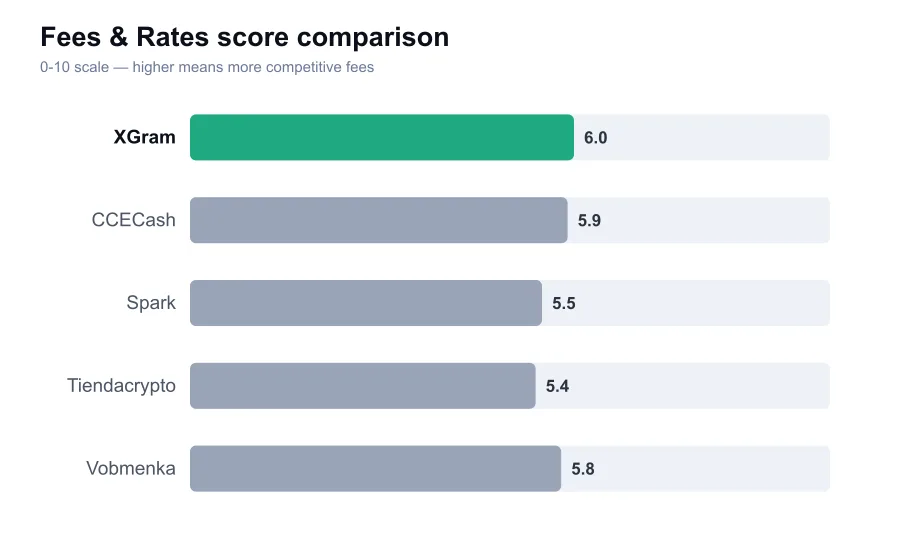
XGram's pricing should be judged by the final output, never by an isolated percentage claim. Exchange offices normally build their service margin into the rate. The rate may also change with reserve conditions, payment direction and the asset's network fee. A cheap-looking stablecoin quote can become ordinary once the network charge and payout spread are included. Compare a live quote with more than one competitor at the same minute.
This is particularly important for small exchanges. Fixed overhead can make a modest transaction disproportionately costly, while minimum order limits can push customers into sending more than intended. Read the amount fields carefully. If the order requires an exact amount, send that amount and use the required payment reference if one is provided. An underpayment of even a small amount can turn a simple automated flow into a manual reconciliation task.
On speed, XGram has the usual strengths and weaknesses of the model. It can be faster than a full exchange withdrawal for a clean, well-supported route, because there may be fewer account steps. Yet blockchain confirmation times remain real, and payout providers do not operate on the exchanger's timetable. Stablecoin orders can often be handled far faster than Bitcoin transfers, while card payouts may vary widely by bank.
The user should distinguish between processing and settlement. An operator may mark an order processed once it sends the outgoing payment, but the recipient bank or wallet may not show the funds immediately. This is not automatically evidence of a problem. Still, XGram would inspire more confidence if every order clearly explained the expected confirmation requirement, the processing window and how customers can verify that an outbound transfer has been sent.
I would not choose XGram for a time-critical trade, liquidation or payment to a seller waiting in real time. The best use case is a personal conversion where an hour or a longer bank delay is inconvenient but manageable. If the payment needs to arrive by a specific deadline, use an established rail with direct tracking and a support team that can offer formal escalation rather than a chat-only answer.
Security begins with a realistic assessment of the service. XGram is not a bank and should not be treated as a wallet. The safest method is to fund a single order from a wallet you control, then verify the outgoing payment before closing the page. Leaving an unused balance with any small exchanger is needless risk. There is little upside and no reason to assume institutional-grade custody or insurance.
KYC language also needs careful reading. A low-friction or no-account process may be convenient, but it cannot be interpreted as a promise of anonymity. Card processors, banks and blockchain analytics can all flag a transaction. In that case, an exchange desk may ask for proof of ownership, identity documents or clarification of source of funds. Customers who send money while refusing any possibility of review are creating their own problem.
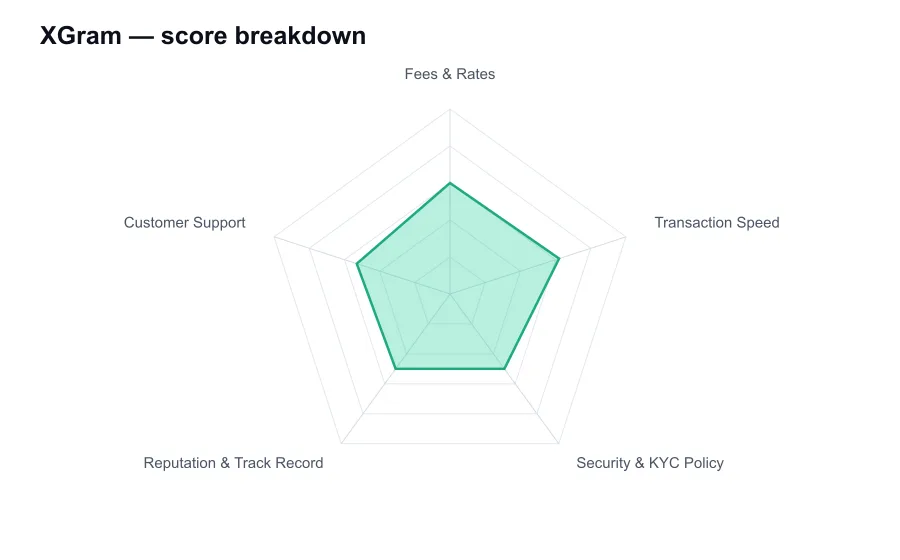
The concern is not that review exists. Responsible fraud prevention is necessary. The concern is how transparent the procedure is before funds arrive and whether the operator has a clear way to resolve a contested case. XGram does not have the visible compliance documentation, audited reporting or regulatory footprint that would make me comfortable sending a large sum without prior experience. That calls for a modest security score.
Its reputation is better approached through patterns than star totals. A few good reports can establish that a service has completed orders, but they cannot establish how it behaves under stress. Search for reports involving delayed confirmations, payment reversals, KYC requests and incorrect destination details. A provider's response to those situations tells more than a quick success story. The available public signal around XGram is not strong enough to treat it as battle-tested.
Support appears to be a practical dependency rather than a major differentiator. In a clean exchange, support should barely be needed. In a problematic one, the entire value of the service depends on whether an agent can trace payment status and offer a clear remedy. Customers should preserve the order number, receipts and transaction hash, then communicate in one concise thread. Fragmented messages make resolution slower at any exchange office.
A sensible first test is a common asset and a common destination, not an obscure token or an unusual bank route. That reduces the chance of a reserve or compatibility surprise. It also gives a fairer picture of how XGram handles its normal workload. If the service settles accurately and communicates clearly, it may be a practical repeat option for similar sizes. Do not extrapolate that result to every asset pair.
XGram's strongest argument is straightforward convenience. It can make a simple crypto conversion less laborious than using a larger exchange, provided the live quote is good enough to justify the spread. Its weakest argument is trust depth. There is too little public institutional evidence to support blind reliance, and no small exchanger should receive blind reliance anyway.
My recommendation is conservative. XGram can fit technically confident users carrying out small, routine exchanges with flexible timing. It does not fit people seeking a regulated custody relationship, guaranteed anonymity, or large-ticket settlement with formal protections. Compare rates, use a test order and keep records. Those habits matter more here than brand presentation.